
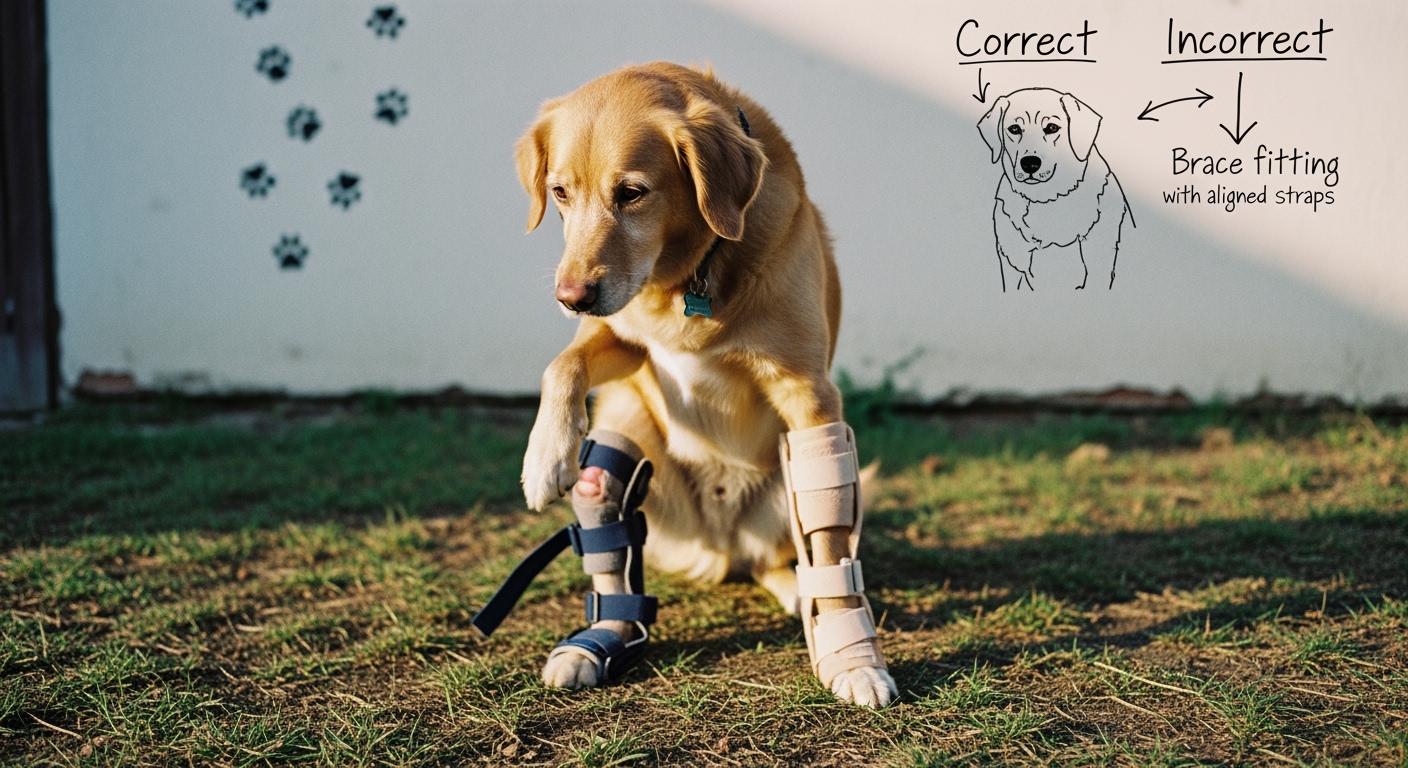
You fit the brace. Both straps feel snug. Your dog takes five steps, then the whole assembly pulls left. One knee feels locked. The other feels loose. This is not a sizing error. It is a symmetry assumption baked into the product—and it is the most common reason a double knee brace for dogs stops working before the first walk ends.
Two knees rarely heal at the same rate or carry the same load. When a brace forces identical tension across both sides, the weaker knee drifts, the tighter knee over-compresses, and the pelvic anchor—the single structural point holding the entire assembly in place—begins to rotate. At that point the brace is not stabilizing anything. It is introducing a new gait fault the dog was not walking with before.
Why a Double Knee Brace Pulls Toward the Weaker Side
The problem starts at the pelvic anchor. In a bilateral brace, the rear-body strap or suspension cradle is the one point that bridges left and right support paths. If both knees offered identical resistance, the anchor would sit centered. They almost never do.
Here is the chain that plays out: one knee has less muscle tone, or is further along in healing, or carries less load due to a contralateral compensation pattern the dog developed weeks earlier. That knee offers less resistance to compressive force. The brace’s unified strap system cannot meter tension independently per side—so the tighter side pulls the whole anchor toward itself. The anchor rotates a few degrees. One hinge now sits anterior to the joint axis; the other sits posterior. Both are wrong.
The dog feels the misalignment within steps. The response is predictable: shortened stride on the over-supported side, toe-dragging or circumduction on the loose side. The owner sees a limp that was not there before and assumes the brace does not work. The brace can work—but not when it assumes symmetry that does not exist.
Check this yourself. Walk your dog on a flat surface for ten minutes with the brace on. Stop. Look at the pelvic anchor from directly above. Has it rotated more than half an inch off the centerline of the spine? If yes, the left-right tension balance is off. The fix is not tightening everything—it is backing off the over-tight side until the anchor re-centers.
Fit Problems That Cause Slipping, Twisting, and Rubbing
Fit failures in a double knee brace are rarely about the dog’s leg shape. They are about how the brace distributes force across two independent structures that move together but heal separately.
Uneven Strap Tension Across Both Rear Legs
A strap pulled tighter on one side does not just compress that knee more. It pulls the opposite-side strap into an angle it was not designed for. Narrow straps concentrate this lateral pull along a thin edge—and that edge rolls. Once a strap edge rolls, its contact patch shrinks to a line. Friction drops. The brace slips.
Wider, padded strap beds spread the same tension across more surface area. They resist edge-rolling because the force per linear inch stays below the threshold that initiates fabric deformation. This is not about comfort. It is about whether the closure holds its position for an entire walk or gives up after three minutes.
Observable check: mark strap positions with a small piece of tape before a ten-minute walk. After the walk, measure the gap between tape and strap edge. More than half an inch of drift on either side—the strap configuration is wrong, not just the tension.
| Real-use problem | Why it happens | Better structure | Stop or adjust signal |
|---|---|---|---|
| Brace twists toward one side | Uneven strap tension pulls the anchor off-center, rotating the entire assembly | Independent left-right strap tension with a centered anchor that does not bridge-load | Dog walks sideways, brace visibly rotated from above |
| Rear legs cross or narrow | One leg is pulled inward by over-tension on the opposite side | Adjust per-side tension independently; verify knee hinge aligns with joint axis | Legs cross mid-stride, dog stumbles |
| Dog freezes or bunny-hops | Brace stiffness blocks natural stifle flexion; the dog cannot load the rear end normally | Flexible hinge stops that limit hyperextension without blocking functional range | Dog stops walking, hops with both rear legs together |
| Groin rubs raw | Straps cut into the inguinal crease; thin or absent padding at the anchor cradle | Contoured groin padding with rolled strap edges; shorten session duration | Red skin, licking, chewing at the inner thigh |
| Straps loosen mid-walk | Hook-and-loop closure contaminated with fur or debris; strap order wrong during application | Clean closures before each session; follow correct strap sequence | Brace needs re-tightening multiple times per walk |
Knee Alignment Drift During Movement
A hinge that sits even a quarter-inch anterior to the joint axis changes the moment arm through the knee. Force that should travel axially through the joint instead creates a rotational vector. Over weeks of daily wear, that small misalignment can turn into persistent synovitis—the joint lining stays inflamed because the brace is loading it off-axis with every step.
This is why knee brace rotation and patellar tracking are linked: when the brace rotates, the patella’s glide path changes. The dog compensates by externally rotating the entire limb, which loads the medial compartment unevenly. The brace is now contributing to the very instability it was supposed to control.
Groin Pressure and Inner-Thigh Skin Breakdown
The groin is the highest-friction zone in any bilateral rear-leg brace. Straps cross the inguinal fold at an angle that changes with every step. If the strap edge is unfinished or the padding compresses to less than two millimeters under load, skin contact becomes abrasive within fifteen minutes of walking.
Observable check: remove the brace after a twenty-minute session. Run the back of your hand along the inner thigh where the strap sits. Damp skin means ventilation is insufficient. A visible crease that does not fade within three minutes means the padding has bottomed out—the strap is transmitting full tension directly to skin.
For dogs with short coats, these checks are visual. For double-coated breeds, small-breed fit checks rely more on hand-feel because dense undercoat hides early rub marks that a short-coated dog would show within minutes.
| Signal | What it looks like | What to do |
|---|---|---|
| Green | Stable walking, centered anchor, no skin marks after 20 minutes, normal resting posture | Continue, re-check fit after each walk |
| Yellow | Mild anchor drift under 0.5 in, light skin crease that fades within 3 min, short-term hesitation at walk start | Adjust strap balance, shorten session to 10 min, monitor next two walks |
| Red | Anchor rotated over 0.5 in, swelling, limping worse than pre-brace, toe dragging, cold paw, open skin, panic response when brace is picked up | Stop use immediately, contact your veterinarian |
When a Double Knee Brace Is the Wrong Tool
A double brace is not a safer version of a single brace. It introduces an additional failure mode—cross-side load transfer—that does not exist in a single-side design. Before committing to bilateral support, confirm that both knees actually need mechanical stabilization, and that the brace structure can deliver it without creating a new problem.
When a Single Knee Brace Is the Safer Choice
If only one knee has a structural injury—a partial CCL tear, a grade-2 luxating patella, or post-surgical protection while the contralateral leg is sound—a single brace avoids the cross-side pull entirely. Using a double brace on a dog with one healthy knee forces the healthy leg to fight the brace’s resistance. That fight creates a compensation pattern the dog carries into every future step, braced or not.
The decision between single and double comes down to what each knee actually needs, not what looks more comprehensive. A single-versus-double support assessment starts with confirming whether the contralateral knee shows any clinical signs—not just assuming symmetry because the brace can cover both sides.
When a Lift Harness Does What a Brace Cannot
Bilateral knee braces stabilize joints. They do not bear weight. For a dog that cannot rise from a down position, has severe hip dysplasia where the rear end collapses on load, or is in the first week post-TPLO where non-weight-bearing is required, a lift harness is the correct tool—not a brace with more straps.
The distinction matters because owners sometimes add a brace hoping it will provide enough structural support to replace a harness. It will not. A brace resists joint motion; a harness transfers body weight to the handler. These are different mechanical jobs, and the types of knee support available each serve a distinct load path.
Disclaimer: the fit checks described here assume a dog with standard rear-leg conformation. Dogs with angular limb deformities, very deep chests that alter the pelvic anchor plane, or significant muscle atrophy on one side may distribute brace pressure in ways these surface checks do not catch. If the dog’s leg shape falls outside typical breed norms for which the brace was patterned, a hands-on fitting evaluation is the safer path than self-adjustment guided by visual inspection alone.
Stop-Use Signals That Override Any Fit Adjustment
Some failure modes are not fixable by adjusting straps. Swelling that increases session over session, a knee that feels hot to the touch compared to the opposite side, a popping or clicking sound during flexion, or a dog that panics when the brace is picked up—these are stop signals. Not adjust signals. Continuing through them turns a fit problem into a joint injury.
Structure Details That Determine Whether a Double Brace Holds Its Position
Not all double knee braces fail the same way. The difference between a brace that stays put for a full walk and one that needs re-adjustment every few minutes comes down to three structural choices.
Independent Left-Right Tension Control
A brace with a single strap that bridges both knees—one continuous band pulled tight and locked—cannot accommodate different compression needs. The tighter knee determines the tension for both. An independent strap system, where each side is tensioned and locked separately against a stable central anchor, lets the fitter match support to the knee that needs it without over-driving the other side.
This is the structural distinction that separates knee brace solutions that hold alignment from those that drift: the anchor must be rigid enough to resist rotational torque from asymmetric loading, and the straps must act independently so one knee’s tension setting does not become the other knee’s problem.
Padding That Survives Compression
Padding looks good in product photos. Under load, cheap padding compresses to nothing. A three-millimeter foam that bottoms out to half a millimeter under strap tension is not padding—it is a cosmetic layer. The material that matters is closed-cell foam with a compression set low enough that it recovers thickness between sessions. If the padding stays compressed after the brace comes off, it stopped protecting skin about halfway through the last walk.
Anchor Stability and the Rear-Body Connection
The pelvic anchor is the fulcrum. Every asymmetry in leg loading transmits through it. A flexible anchor—one made from soft fabric with no internal stiffener—absorbs the imbalance by deforming. That deformation shifts both hinge positions simultaneously. A semi-rigid anchor with a contoured shape resists this rotation without making the brace uncomfortable to wear while lying down.
The tension between stability and wearability is real. A rigid anchor holds position better; a soft anchor is easier to tolerate for longer sessions. The right balance depends on the dog’s activity level, and knee pads designed for daily hind-leg use illustrate the trade-off: more padding increases comfort but can reduce anchor precision if the material stack gets too thick.
FAQ
How do you tell whether both knees need a brace or just one?
Start by watching the dog walk without any brace. If only one leg shows a shortened stance phase or an abnormal foot placement, that leg may be the primary problem. A contralateral limp that appears only when the primary leg is braced suggests the second knee was already compensating—not injured. Your veterinarian can differentiate compensatory gait from structural injury through palpation and drawer testing, which is information no fit check can replace.
How long can a dog wear a double knee brace in one session?
Start at ten minutes on flat ground. If skin checks pass—no dampness, no crease lasting more than three minutes—increase by five-minute increments per session. Most dogs top out between twenty and thirty minutes of continuous wear before the combination of heat, moisture, and strap pressure makes a break necessary. Remove the brace during sleep and any unsupervised rest.
What is the difference between a knee brace slipping and the dog walking differently on purpose?
Slipping is passive—the brace migrates while the dog walks normally. A purposeful gait change is the dog adjusting its movement to avoid brace discomfort. You can tell them apart by checking the anchor position after a short walk: if the brace has not moved but the dog is still shortening stride or toe-dragging, the brace itself is restricting motion, not slipping out of place. That is a stiffness problem, not a fit problem.
