
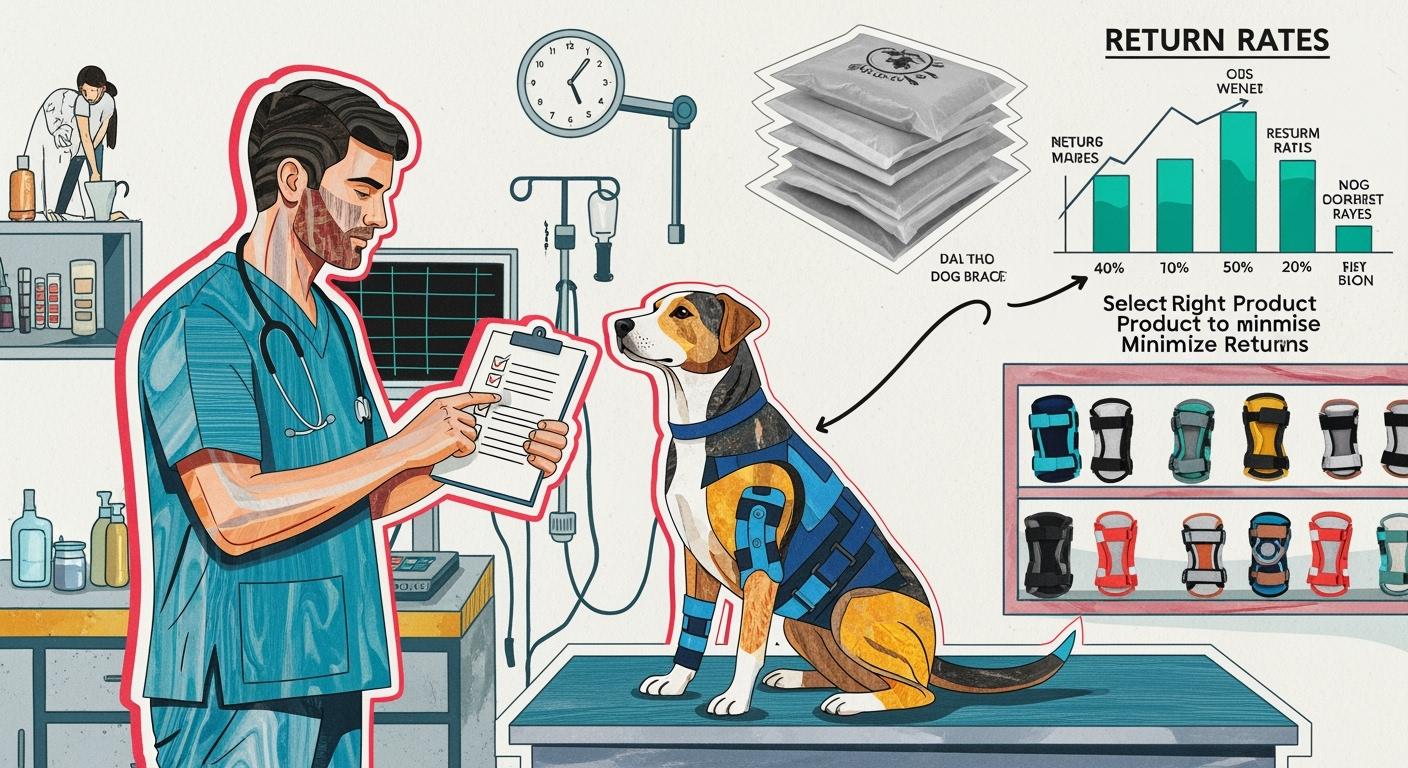
A clinic, rehabilitation provider, or veterinary-channel distributor does not need the largest possible brace catalog. It needs a product range that staff can size consistently, explain clearly, inspect on arrival, and support after the first order. When those controls are missing, a buyer may not know whether a complaint came from measurement, product selection, fitting, design limits, production variation, or shipping damage.
This guide explains how to evaluate wholesale dog braces for clinic and rehabilitation programs without turning the article into a treatment protocol. It focuses on product-range planning, sizing-system review, supplier documentation, sample validation, pilot-order controls, and written after-sales terms.
Scope note: A brace category does not determine diagnosis, treatment, or clinical suitability. Product selection and use instructions should be reviewed within the buyer’s own veterinary, rehabilitation, and market requirements.
Key Takeaways
- Define the purchasing model before choosing SKUs: clinic use, rehabilitation distribution, resale, and private-label supply require different product and documentation controls.
- Build the assortment by support task and structure, not by broad injury names or marketing claims.
- Review the sizing system before the price list. Each brace category should have measurement points, size boundaries, and fit-check instructions that match its structure.
- Use samples and a controlled pilot order to verify approved specifications, staff handling, size coverage, packaging, and issue-reporting workflows before scaling.
- Separate measurement, selection, fitting, design, manufacturing, and shipping issues before applying warranty or return terms.
Define the Clinic or Rehabilitation Purchasing Model
The phrase “wholesale dog braces for clinics” can describe several different programs. A single clinic may want a limited set of standard-size products for supervised use. A rehabilitation distributor may need a broader range with replacement parts and repeat ordering. A veterinary retail channel may need consumer-facing instructions, packaging, and return controls. A private-label buyer adds brand, labeling, and sales-channel requirements.
The supplier cannot build a useful assortment from the word “clinic” alone. The buyer should first define who selects the product, who takes measurements, who fits it, who explains use, and who handles complaints. These decisions determine what documentation and product coverage the program needs.
| Purchasing Model | Main Product-Planning Question | Documentation Priority |
|---|---|---|
| Single clinic or rehab provider | Which categories can staff measure and fit consistently? | Measurement forms, fit checks, cleaning and issue-escalation instructions |
| Multi-location clinic group | Can different teams reproduce the same process? | Standard operating instructions, product codes, size definitions and issue logs |
| Veterinary or rehabilitation distributor | Which product range serves the channel without creating overlapping SKUs? | Catalog structure, size breakdown, packaging, replacement and replenishment information |
| Retail or ecommerce channel | Can end users understand product boundaries and sizing before ordering? | Consumer-facing size charts, use boundaries, packaging and return-policy language |
| Private-label program | Which existing products fit the brand and what must be adapted? | Approved specifications, labels, packaging, samples and change-control records |
Build the Product Range by Support Task
A wholesale assortment should not treat every brace as a variation of the same product. Knee, hock, carpal, elbow, paw-dragging, back-support, and lift-assist products use different anchor points, movement zones, materials, and sizing logic. A clinic-facing catalog becomes harder to use when several SKUs claim to solve the same broad problem without explaining their structural differences.
Start with the support task and the body area, then define the product structure. This creates clearer briefs for suppliers and clearer selection boundaries for staff.
| Product Category | What the Procurement Brief Should Define | Common Assortment Risk |
|---|---|---|
| Knee or stifle support | Soft or hinged structure, anchor layout, side designation, size range and alignment checks | Several knee SKUs with no clear difference in support level or fit method |
| Hock support | Coverage above and below the joint, paw clearance, strap position and length grading | Using knee sizing logic for a different joint structure |
| Carpal or wrist support | Forelimb measurement points, paw coverage, rigidity and movement boundary | Confusing a soft wrap with a rigid support route |
| Elbow protection | Coverage zone, anchoring method, padding profile and movement during lying or walking | Stocking several sleeves that differ only cosmetically |
| Paw-dragging support | Toe-lift method, paw contact, attachment point and replaceable wear components | Presenting paw protection and toe-lift support as the same function |
| Lift and mobility support | Front, rear or full-body load zone, handle placement, toileting clearance and size range | Using one harness shape for unrelated transfer tasks |
A buyer does not need every category in the first order. It needs enough distinct structures to cover the intended channel without creating duplicate SKUs. Categories that staff cannot measure, explain, or support consistently should remain outside the initial assortment until the process is defined.
Review the Sizing System Before Approving the Range
A generic weight chart is not a complete sizing system. Brace fit depends on the landmarks that control suspension, joint alignment, coverage, and strap position. Those landmarks change between knee, hock, carpal, elbow, and custom rigid products.
Before approving a wholesale range, ask whether each category has its own measurement form, whether the size chart explains boundary cases, and whether the supplier can show how measurements translate into finished dimensions. A useful sizing package should also state which leg is measured, how the dog should stand, which photos are needed, and when a standard size may not be appropriate.
- Category-specific landmarks: The form should match the joint and structure rather than reuse one template for all braces.
- Size-boundary rules: Staff need a method for dogs that fall between sizes or outside the intended proportion range.
- Left/right and front/rear identification: Product codes and order forms should reduce side-selection mistakes.
- Fit-check evidence: Photos, alignment marks, strap position, migration and pressure observations should be recorded consistently.
- Revision path: The buyer should know whether a problem requires re-measurement, another size, a different structure, or a specification change.
For a more detailed product-development approach, review the dog leg brace sizing-system guide. It explains why measurement landmarks and grade rules should be treated as product specifications rather than only customer instructions.
Check Supplier Documentation and Sample Controls
A supplier assessment should focus on evidence that applies to the actual product and project. Broad statements about quality are less useful than a clear specification, an approved sample, defined inspection points, and a process for recording changes.
Request a Product Specification That Can Be Reproduced
The specification should identify the product code, intended category, size, side, materials, thickness or reinforcement direction where relevant, strap layout, hardware, labels, packaging, and any approved visual details. The buyer should be able to compare a later batch against the same reference rather than relying on memory or sales images.
Use Approved Samples as Control References
There is no universal sample quantity for every program. Request enough samples to evaluate the relevant construction and size variations, document revisions, and retain an approved control sample. A sample review should confirm what was approved and what still requires correction before a pilot or production order.
| Supplier Evidence | What It Should Clarify | Weak Response |
|---|---|---|
| Product specification | Materials, dimensions, structure, components, labels and packaging | Only a product photo or generic catalog description |
| Size chart and measurement form | Landmarks, size boundaries, side identification and exception rules | Weight-only sizing or one chart reused across categories |
| Approved sample record | Revision number, approved details and unresolved items | No written difference between sample rounds |
| Inspection checklist | What is checked and how nonconforming items are classified | “Quality checked” without measurable checkpoints |
| Change-control process | How material, hardware, construction or packaging changes are communicated | Substitutions made without buyer approval |
| Issue-reporting process | Evidence required, response path and responsibility review | No distinction between fit complaints and production defects |
Run a Controlled Pilot Order Before Scaling
A pilot order is a commercial and operational validation step. It should test whether the approved product, size system, packaging, staff workflow, and supplier support can function together. It should not be presented as proof of clinical effectiveness.
- Define the test matrix. Select representative product structures, size positions, packaging formats, and handling conditions. Do not use an arbitrary number of cases as a universal standard.
- Freeze the approved reference. Record the sample version, specification, size chart, labels, packaging, and any accepted deviations before ordering the pilot batch.
- Train the receiving team. Staff should know how to identify each SKU, take the required measurements, record fit observations, clean the product, and escalate a problem.
- Log issues consistently. Record product code, size, measurement data, photos, issue type, timing, and corrective action. Avoid combining every complaint under “poor quality.”
- Review patterns before scaling. A repeated issue across sizes may indicate a grading or design problem. An isolated mismatch may point to measurement, selection, or handling. The next action should follow the evidence.

Classify Problems Before Applying Warranty or Return Terms
The same visible complaint can have different causes. A brace that migrates may be the wrong size, may have been positioned incorrectly, may not match the dog’s proportions, or may have been produced outside the approved specification. A useful after-sales process identifies the category before deciding responsibility.
| Issue Category | Example | Evidence to Review | Possible Next Step |
|---|---|---|---|
| Measurement issue | Incorrect landmark, tape angle or recorded value | Measurement form, photos and re-measurement | Correct the measurement process and reassess size |
| Product-selection issue | The chosen structure does not match the required support task | Original product brief and selection rationale | Move to a more suitable product category |
| Fitting or handling issue | Incorrect strap routing, placement or adjustment | Fit photos, instructions and staff notes | Refit, retrain or clarify instructions |
| Design limitation | The standard pattern does not suit a particular body proportion or movement condition | Size boundary, anatomy notes and repeated pattern | Define an exclusion, revise the design or use another route |
| Manufacturing defect | Construction, dimensions, material or hardware does not match the approved reference | Control sample, specification and inspection records | Investigate, replace, rework or apply the agreed corrective process |
| Shipping damage | Product or packaging is damaged in transit | Receiving photos, carton condition and shipment record | Follow the agreed freight or replacement procedure |
This classification protects both sides. The clinic avoids treating every fit complaint as a manufacturing defect, while the supplier cannot dismiss a documented specification failure as user error.
Review Warranty, Exchange, and Replacement Terms in Writing
There is no universal warranty period, restocking fee, return window, or response time for every wholesale dog brace program. Terms depend on product type, customization, hygiene status, packaging, market, and the agreement between buyer and supplier. The article should therefore tell buyers what to confirm, not present unsupported industry-wide numbers.
- Which terms apply to standard-size, customized, and private-label products?
- How are unused, opened, fitted, worn, damaged, and custom products classified?
- What evidence is required for a manufacturing claim, shipping claim, or size dispute?
- Can straps, pads, fasteners, hinges, or other replaceable components be ordered separately?
- Who approves replacement, credit, rework, revision, or further investigation?
- How are batch, product code, order number, photos, measurements, and issue notes recorded?
These terms should be available to the purchasing team before the order is approved. They should also match the instructions given to clinic staff or downstream channel customers.
Use a Supplier Scorecard That Matches the Project
A scorecard should compare suppliers against the requirements of the planned brace program. It should not award points for broad claims or documents that do not apply to the product, market, or intended use.
| Review Area | Evidence to Request | Decision Question |
|---|---|---|
| Category experience | Relevant products, structures and repeat-production examples | Does the supplier understand the planned brace categories? |
| Sizing system | Category-specific charts, measurement forms and exception rules | Can the size system be taught and reproduced? |
| Specification control | Product specifications, revision records and control samples | Can later production be compared with an approved reference? |
| Sample validation | Sample plan, review record and correction history | Does each sample stage have a defined purpose? |
| Inspection and traceability | Inspection points, product codes, batch or order references | Can an issue be traced to a product and order? |
| Packaging and instructions | Label, packaging and instruction requirements | Do materials match the clinic or channel workflow? |
| After-sales process | Written issue categories, evidence requirements and resolution path | Can fit, defect and shipping issues be handled consistently? |
| Commercial alignment | Quantity assumptions, size mix, packaging scope and delivery terms | Are quotations based on the same project assumptions? |
When a Private-Label or Wholesale Supply Page Is the Next Step
This article is a procurement framework, not a service landing page. Once the buyer has defined the product categories, size range, target market, order assumptions, packaging needs, and documentation requirements, the next step is to review the appropriate supply route.
Buyers sourcing selected product categories for a brand, distributor catalog, veterinary retail channel, or rehabilitation supply program can review GaitGuard’s private-label dog braces and wholesale supply page. Projects that require deeper structure changes or custom sizing logic should be scoped separately rather than treated as standard wholesale selection.
Frequently Asked Questions
What should a clinic check before ordering wholesale dog braces?
Confirm the intended purchasing model, product categories, size system, measurement forms, approved specifications, sample process, packaging, issue classification, replacement options, and written commercial terms. A large catalog is less useful than a smaller range that staff can measure and support consistently.
How many samples should a buyer request?
There is no universal number. Request enough samples to evaluate the relevant structures and size positions, document revisions, and retain an approved control sample. Define what each sample round must confirm before placing it.
Is every poor fit a manufacturing defect?
No. Poor fit may result from measurement, size selection, product choice, placement, adjustment, design limits, or a failure to meet the approved specification. Review the evidence and classify the cause before applying warranty or replacement terms.
Should one size chart cover all dog brace categories?
No. Different brace structures depend on different anatomical landmarks, alignment requirements, coverage zones, and grade rules. Each category should have measurement and fit instructions that match its construction.
Does a pilot order prove that a brace is clinically effective?
No. A pilot order can validate specifications, sizing workflow, packaging, staff handling, issue logging, supplier response, and commercial readiness. Clinical suitability and treatment decisions remain outside the purpose of the procurement pilot.
Final Procurement Check
Before scaling a clinic or rehabilitation brace program, confirm that the assortment has distinct product roles, the size system can be reproduced, samples match documented specifications, the pilot identifies issue patterns, and after-sales terms distinguish fit problems from manufacturing defects. These controls create a stronger basis for wholesale selection than price, catalog size, or unsupported quality claims alone.
