
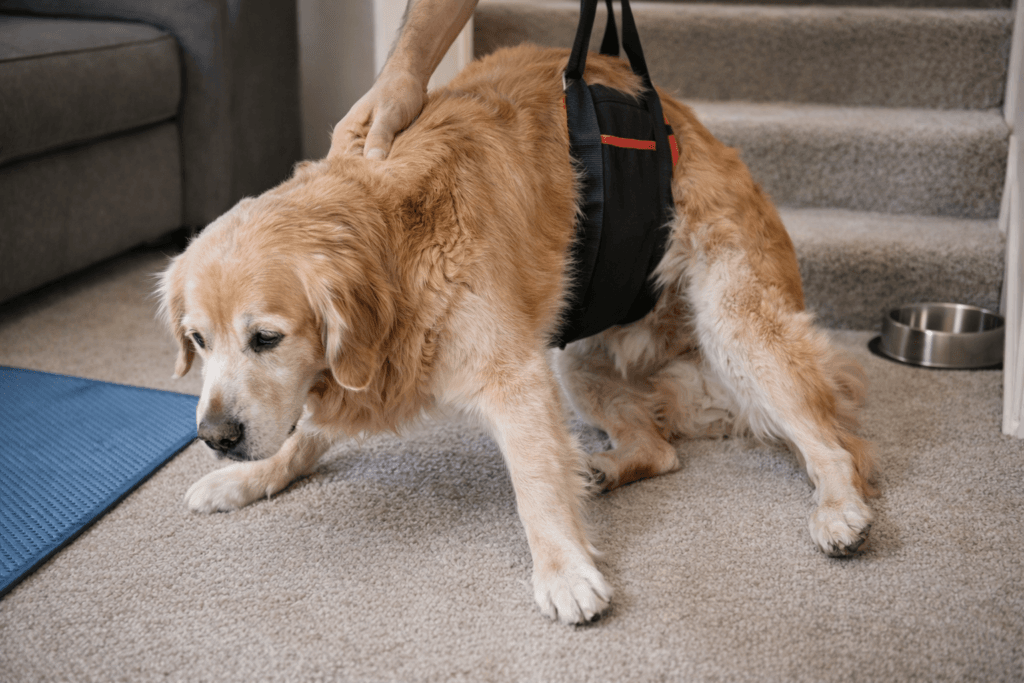
Dog hind leg weakness can look like slow rising, slipping, wobbling, paw dragging, or a sudden inability to stand or walk. Because these signs can come from different orthopedic, neurologic, spinal, or general health problems, the first step is not choosing a brace or harness. The first step is deciding how quickly your dog needs veterinary care.
If your dog suddenly cannot stand, cannot walk, drags both back legs, shows severe pain, loses bladder or bowel control, or becomes weaker quickly, contact a veterinarian or emergency clinic now. Keep your dog calm and limit unnecessary movement while following the clinic’s transport instructions.
Scope of this guide: This article explains red flags, safer handling, home traction, and mobility-support options after veterinary evaluation. It does not diagnose the cause of hind leg weakness or replace a treatment plan.
Key takeaways
- Sudden inability to stand or walk is an urgent veterinary problem, not a product-selection problem.
- While arranging care, reduce slipping, prevent stairs or jumping, and move your dog only as much as necessary.
- After evaluation, a rear-support sling, lift harness, traction setup, paw-protection aid, or joint-specific brace may help with a defined daily task.
- A brace should not be selected from the symptom “weak back legs” alone. The affected joint and support goal must be clear first.
- Support gear can assist handling and mobility, but it does not treat the disease or injury causing the weakness.
When dog hind leg weakness needs urgent veterinary care
Hind leg weakness ranges from a gradual mobility change to a sudden emergency. Do not wait for a product to arrive or test several support devices when the change is abrupt or severe.
Contact a veterinarian or emergency clinic now if your dog:
- Suddenly cannot stand or cannot walk
- Drags one or both back legs or walks on the tops of the paws
- Collapses, repeatedly falls, or becomes much weaker over a short period
- Shows severe pain, cries out, resists movement, or holds the back rigidly
- Loses bladder or bowel control or cannot urinate normally
- Develops weakness after a fall, collision, or other possible trauma
- Has weakness together with breathing difficulty, collapse, unusual behavior, or reduced responsiveness
Veterinary emergency guidance commonly treats inability to stand, dragging the hind legs, loss of coordination, and limb paralysis as reasons for prompt assessment. Spinal disorders can also produce wobbling, hind-limb motor loss, and urinary problems, so the visible sign alone cannot identify the cause.
For gradual or mild weakness
Even when your dog can still walk, arrange a veterinary appointment if the change is new, recurring, or worsening. Slow rising, reduced stair use, repeated slipping, muscle loss, paw wear, or a change in gait can still require examination. Record what you see instead of trying to diagnose the problem from one symptom.
What to do while arranging veterinary care
- Call first. Describe whether the weakness was sudden or gradual, whether one or both legs are involved, and whether your dog can stand, urinate, and respond normally.
- Reduce movement. Keep your dog in a small, quiet area with a non-slip surface. Block stairs and do not allow jumping or uncontrolled walking.
- Do not give medication unless instructed. Human pain medicines and leftover prescriptions may be unsafe or inappropriate for the current problem.
- Follow the clinic’s handling instructions. If trauma or a spinal problem is possible, avoid twisting the body. A blanket or firm support surface may be used for transport when the veterinary team recommends it.
- Use enough people. A large or distressed dog may require two adults so the chest and rear remain supported during a necessary transfer.
Important: Do not place a new brace on a dog with sudden paralysis, severe pain, or an unknown injury before veterinary assessment. A device can change movement without addressing the underlying emergency.
Why weak back legs do not identify one diagnosis
“Weak back legs” describes a movement problem, not a diagnosis. Similar signs can come from different body systems, and those problems may require very different care.
| Broad source of the problem | Changes an owner may notice | Why evaluation matters |
|---|---|---|
| Joint, bone, muscle, or soft-tissue problem | Limping, reluctance to load one leg, stiffness, difficulty rising | The affected structure and degree of instability must be identified before choosing joint support. |
| Spinal or neurologic problem | Wobbling, crossing the feet, paw dragging, knuckling, loss of coordination | These signs can require urgent assessment and are not solved by a general leg brace. |
| General or systemic illness | Weakness with collapse, appetite change, breathing change, or reduced responsiveness | The priority is diagnosing the underlying health problem, not adding mobility gear. |
| Post-operative or diagnosed mobility limitation | Difficulty with standing, transfers, stairs, or short controlled walks | The veterinary or rehabilitation plan can define where and how much assistance is appropriate. |
A dog may also have more than one limitation at the same time. For example, a joint problem may affect weight-bearing while age-related weakness changes balance. This is why product selection should follow a defined support goal rather than a broad symptom label.
Slipping that appears mainly on tile or hardwood may be made worse by poor traction, but improvement on carpet does not rule out pain, weakness, or a neurologic problem. Record which surfaces cause difficulty and share that pattern with your veterinarian rather than using a floor test as a diagnosis.
After veterinary evaluation: match the support tool to the daily task
Once the urgent cause has been assessed and your veterinary team has explained what movement is allowed, mobility products can support specific tasks. The safest choice depends on where assistance is needed, whether the dog can bear weight, and how the handler must guide the body.
| Mobility pattern after evaluation | Support goal | Tool that may be considered | Main boundary |
|---|---|---|---|
| Dog can bear weight but needs help rising or balancing at the rear | Brief hind-end assistance for standing or potty breaks | Rear-support sling or rear lift harness | Use only enough lift to steady the dog; do not suspend the full body from one narrow area. |
| Dog needs coordinated front-and-rear assistance | Broader support during necessary transfers or short guided movement | Full-body lift harness | Use after the support plan is defined; sudden inability to stand still requires veterinary care first. |
| Dog walks but slips on smooth floors | Improve footing and reduce repeated loss of balance | Non-slip runners, mats, or a suitable traction aid | Traction does not replace assessment when weakness is new or worsening. |
| Dog drags or knuckles a paw | Protect the paw and support a prescribed gait goal | Paw protection or an anti-knuckling aid | Incorrect devices can alter gait or create rubbing; use veterinary or rehabilitation guidance. |
| A specific knee, hock, or hip problem has been identified | Provide joint-specific support | Appropriately selected brace | Do not choose a brace solely because the dog has weak back legs. |
For a detailed comparison of support coverage, see rear lift versus full-body dog lift harnesses. A simpler under-body sling and a structured harness also serve different handling tasks; this support sling versus lift harness guide explains the practical differences.
Rear-only support versus full-body support
When rear-only assistance may be enough
A rear sling or rear lift harness may be suitable when the dog can control the front legs, can bear at least some weight, and mainly needs help with the hindquarters during a short task. Common examples include rising from a bed, maintaining balance during a potty break, or stepping over a low threshold under supervision.
The support should stabilize rather than hoist. If the sling rolls, presses into the abdomen, obstructs elimination, or causes the dog to rotate, stop and reassess the placement or product type.
When broader support may be needed
A full-body harness may be considered when the prescribed handling task requires support across the chest and rear, the dog has poor overall balance, or the handler needs more control during an approved transfer. Broader coverage can distribute handling across more than one area, but it also requires careful fitting and coordinated lifting.
“Cannot stand” should not automatically be interpreted as “needs a full-body harness.” It first means the dog needs veterinary assessment. The harness decision comes afterward, based on the diagnosis, allowed activity, body size, caregiver ability, and daily task.
Create a safer home setup for a weak or recovering dog
- Place non-slip runners or rubber-backed mats along the route between the bed, water, door, and potty area.
- Block unsupervised access to stairs, furniture, and slippery rooms.
- Keep food and water easy to reach without requiring sharp turns or repeated steps.
- Use a supportive, dry resting surface and keep the path free of cords, toys, and loose rugs.
- Keep nails and paw hair maintained so they do not further reduce floor contact.
- Introduce any sock or boot gradually and check that it does not rotate, retain moisture, or reduce the dog’s awareness of foot placement.
For room-by-room setup ideas, review these dog slippery-floor traction tips for hardwood and tile.
Safe fit and handling checks for slings and lift harnesses
- Confirm the support zone. A rear-only product should not be expected to control the chest, while a full-body product should not concentrate most of the load on one narrow strap.
- Check sensitive areas. Inspect the belly, groin, chest, underarms, and strap edges before and after use.
- Keep the body level. Uneven lifting can rotate the spine or shift the dog’s weight unexpectedly.
- Use the least assistance needed. When weight-bearing is allowed, the device should guide balance rather than remove all contact with the ground.
- Stop for warning signs. Remove the device and reassess if you see persistent redness, swelling, hair loss, sores, increased limping, panic, breathing difficulty, or reduced willingness to move.
- Follow the prescribed activity plan. There is no universal five-minute walk, four-times-daily potty schedule, or fixed wear progression that is appropriate for every dog.
Do not leave lifting gear on simply because the dog tolerated it once. Fit can change with posture, coat compression, swelling, weight change, and the amount of load placed through the handles.
When a brace is—and is not—the next step
A rear-leg brace is not a general solution for dog hind leg weakness. Knee, hock, hip, and broader hind-limb supports are built around different joints and movement goals. A brace placed on the wrong area may slide, restrict useful movement, or create pressure without supporting the actual problem.
Consider a brace only after the affected joint and intended function are clear. For example, a veterinary team may define a need for knee stability, hock control, or hip-area support. If the main problem is neurologic weakness, collapse, poor balance, or a systemic illness, a joint brace may not address the limitation at all.
Use the dog rear leg brace guide to compare knee, hock, hip, and other support types after the body area has been identified.
What to record before the veterinary visit
A short, factual record can help the veterinary team understand the pattern more quickly. Note:
- When the weakness started and whether it was sudden or gradual
- Whether one back leg or both back legs are affected
- Whether your dog can rise, stand, walk, turn, and squat normally
- Any paw dragging, knuckling, crossing of the feet, or repeated falling
- Signs of pain, vocalizing, trembling, or resistance to touch
- Changes in urination, bowel control, appetite, breathing, or alertness
- Any recent fall, collision, strenuous activity, surgery, or medication change
- A short video of the gait, recorded only if the dog can move without added risk
FAQ
What should I do first if my dog cannot stand or walk?
Contact your veterinarian or an emergency clinic immediately. Keep your dog calm, prevent unnecessary movement, and follow the clinic’s instructions for transport. Do not test a new brace or exercise routine first.
Can a lift harness help a dog with weak back legs?
It may help with a defined handling task after veterinary evaluation. Rear-support products are generally used when assistance is mainly needed at the hind end, while full-body products provide broader handling coverage. The harness does not diagnose or treat the cause of weakness.
Should I buy a knee or hip brace for hind leg weakness?
Not from the symptom alone. A knee, hock, or hip brace supports a particular body area. The affected joint and support goal should be identified before selecting a brace.
How can I reduce slipping at home?
Use stable non-slip runners, block stairs, keep pathways clear, and place food, water, and bedding where the dog can reach them with minimal turning. Traction socks or booties may help some dogs, but fit and paw condition must be checked closely.
How long should my dog wear a support device?
There is no single schedule for all dogs. Wear time and activity should follow the veterinary or rehabilitation plan, the device instructions, and repeated skin and gait checks. Stop use if the device causes rubbing, swelling, pain, or worse movement.
The role of mobility products
Dog hind leg weakness should lead first to appropriate veterinary assessment. After the cause and permitted activity are clearer, mobility products can make specific daily tasks more controlled: improving floor grip, steadying the rear during a potty break, supporting both ends during an approved transfer, protecting a dragging paw, or supporting a diagnosed joint.
GaitGuard’s dog lift harness range includes rear-support and full-body options for different assisted-mobility tasks. Compare the support area, fit, and handler control only after your veterinary team has clarified what movement is appropriate for your dog.
