
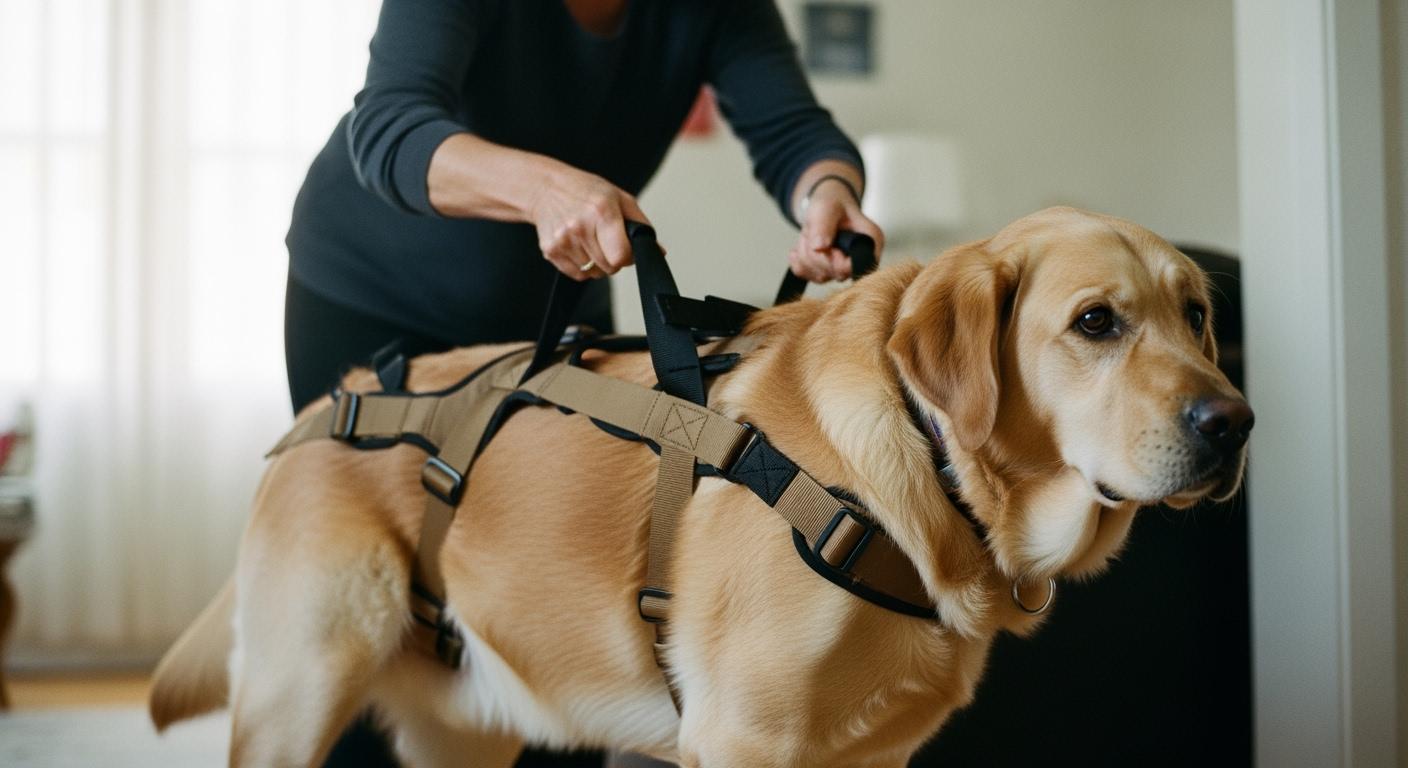
Lifting a heavy dog from a car seat to the ground looks straightforward. The real problem lives in the half-second between two stable positions — when the dog’s full weight hangs on the harness and nothing else. A rear-only strap lifts the hips but leaves the chest and shoulders uncontrolled. The front end drops. The dog twists, freezes, or swings sideways. That half-second collapse is not a handler error. It is a support structure that cannot handle sudden, asymmetric load.
The difference between a harness that keeps a heavy dog level through a short transfer and one that does not comes down to how force travels from the handles through the panels into the dog. When the structure routes all lift force through a single rear attachment and a narrow belly strap, the load concentrates along a thin line. When it distributes the same force across wide chest and belly panels with dual handle points, the load spreads. The dog feels the difference immediately — as pressure or as support.
Why Heavy Dog Short Transfers Fail Faster Than Normal Walking Support
Walking support and short-transfer lifting put fundamentally different demands on a harness. During a walk, the dog carries most of its own weight through four legs. The harness provides guidance, balance assistance, or partial support. The load is distributed, predictable, and shared. During a short transfer — car to ground, bed to floor, crate to door — the harness carries nearly all the dog’s weight at once. The load arrives suddenly and from a single direction.
This shift in load type exposes structural weaknesses that walking never tests. A harness that performs adequately during a slow walk can fail catastrophically the moment it is asked to support a heavy dog’s full body weight through a lift.
Sudden load concentrates force where narrow straps sit
When you lift, the force travels from your hands through the handles into the straps and panels contacting the dog. With narrow webbing — straps under an inch wide — that force lands on a thin strip of the dog’s belly or chest. Pressure equals force divided by area. Halve the strap width and you double the pressure on the tissue beneath it.
Under a sudden lift, the strap cannot spread the impulse. The load spikes along that narrow line. The dog feels a sharp dig rather than distributed support. The response is predictable: freezing, sitting down, or twisting to escape the pressure. None of this means the dog is uncooperative. It means the strap width is inadequate for the force it carries.
| Failure sign | Likely cause | Product design issue | Better support feature |
|---|---|---|---|
| Front end drops | Rear lifted first | No chest support structure | Front-and-rear handle system |
| Rear hips swing sideways | Uneven lift force | Narrow belly panel | Wide padded panels |
| Belly panel bunches | Sudden load spike | Thin straps without reinforcement | Broad, reinforced panels |
| Harness slides forward | Insufficient grip surface | No non-slip contact zones | Adjustable, non-slip zones |
| Dog freezes or sits down | Pressure-point pain | Concentrated load on narrow straps | Pressure-spreading panels |
| Handler jerks upward | Poor leverage geometry | Single rear handle only | Balanced front-and-rear handle placement |
| One handle carries all load | Tilted lift axis | Rear-only support design | Dual handles with level lift path |
Balance requires controlled load sharing, not just upward force
A heavy dog’s center of mass sits closer to the front. When you lift only from the rear, the front half pivots downward around the lift point. The harness does nothing to counter that rotation because it has no structural connection to the chest and shoulders. The handler compensates by pulling harder, which amplifies the tilt.
Dual handles change the lift geometry. A front handle controls the chest and shoulder position. A rear handle controls the hip position. Used together — whether by one person using both hands or two people each taking a handle — they create a level lift plane. The dog rises without rotation. This is why full-body lift harness balance depends on handle placement rather than strap tightness. When both attachment points sit above the dog’s natural center of mass at roughly equal distance, the lift force splits evenly. When only one point exists, the handler fights gravity and geometry simultaneously.
| Transfer task | Rear-only risk | Full-body advantage | When to use caution |
|---|---|---|---|
| Bed-to-floor transfer | Front end drops immediately | Level lift, less strain on handler | Dog resists or surface is slick |
| Car threshold exit | Dog tilts forward on descent | Balanced handles, controlled exit | Handler feels strain mid-lift |
| Crate-to-door transfer | Twisting and hip swing | Wide panels, controlled turn radius | Dog shows stress signals |
| Potty-break standing assist | Single-zone overload | Pressure spread across chest and belly | Dog cannot bear any weight |
| Vet clinic entrance | Slip on slick flooring | Non-slip zones, reinforced handles | Dog pants heavily or vocalizes |
| Narrow hallway turn | Harness slides, rotation increases | Adjustable fit holds position | Dog freezes mid-transfer |
When a short transfer should not be attempted
No harness design can make every transfer safe. If the dog cannot bear any weight, shows breathing distress, or vocalizes with pain during positioning, the transfer itself is the problem — not the harness choice. A harness that supports a 75-pound dog through a car-to-clinic transfer may be the wrong tool entirely for a dog in acute respiratory distress. The harness cannot fix what makes the transfer unsafe.
Before any lift, three checks matter more than which harness you use:
- Dog status: alertness, pain response, breathing pattern, willingness to accept handling
- Harness condition: handle attachment integrity, strap position, panel flatness, no bunching or seam separation
- Route: dry surface, clear path under 8 feet, stable landing zone, second person available for dogs over 70 pounds
| Signal level | What it looks like | What to do |
|---|---|---|
| Green | Dog stays level, accepts support, harness remains stable | Proceed with transfer |
| Yellow | Mild slide, brief hesitation, handler feels extra strain | Pause, readjust harness, reassess grip |
| Red | Pain vocalization, collapse, twisting, dropped front or rear, repeated sitting | Stop transfer, lower dog to stable surface, contact veterinarian |
What Rear-Only Support Cannot Control During a Lift
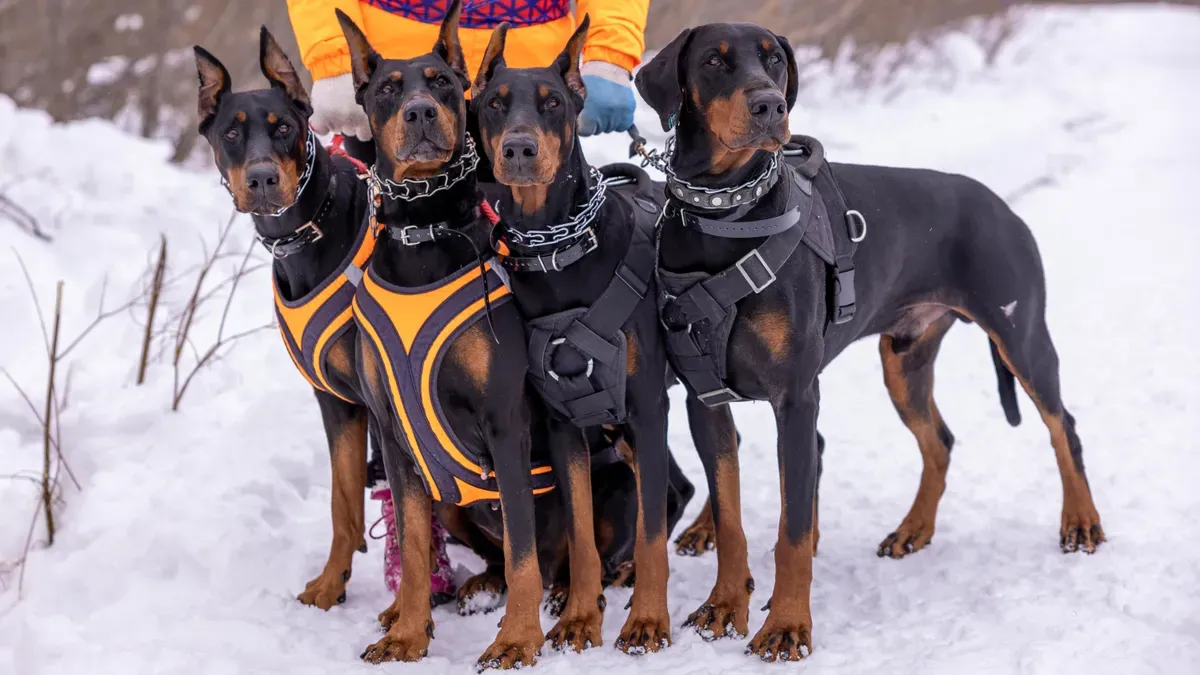
Rear-only harnesses serve a purpose — steadying a dog that can still bear weight through the front legs. But during a full short transfer where the dog’s body leaves the ground, the structural limits become visible immediately. Three specific failures repeat across different dogs and different handlers because they are designed into the product, not caused by misuse.
The chest and shoulders have no structural connection to the lift
A rear harness attaches behind the ribcage. The straps wrap the belly and hips. Nothing extends forward to the chest or shoulders. When the handler lifts, the rear rises but the front stays anchored by gravity. The dog’s spine forms a downward slope from hips to shoulders. The front legs — if the dog has hind-leg weakness or post-surgical weight-bearing restrictions — buckle because they cannot catch the sudden load transfer.
The product design issue is straightforward: a single lift point behind the center of mass creates a rotational moment that no amount of strap tightness can cancel. Only a second attachment forward of the center of mass — a chest handle or front support panel — provides the counter-force needed to keep the dog level. This is why rear-lift harness pressure points concentrate at the belly during short transfers: the narrow rear strap becomes the sole load path, and every pound of the dog’s weight channels through that single line of contact.
Narrow belly pressure intensifies under sudden load
The mechanical problem with a narrow belly strap is not the material — it is the surface area. A one-inch strap under a 70-pound dog during a lift exerts roughly twice the pressure per square inch that a three-inch panel does. The dog’s soft abdominal tissue, particularly near the groin, has little natural padding against concentrated pressure.
During a short transfer, the load is not static. As the handler lifts and the dog shifts, the narrow strap can roll, bunch, and dig. The dog’s freeze response — sudden stiffening, sitting, or refusal to move — is a pain reaction to that pressure concentration. The handler then compensates with a quicker, jerkier lift, which increases the pressure spike. The feedback loop runs: pressure causes freeze, freeze causes jerk, jerk increases pressure.
Observable check: After a practice transfer — even one that seems smooth — run your fingers along the underside of the belly panel or strap. A raised red line or a flinch when you touch that strip means the contact surface is too narrow for the dog’s weight. The skin is telling you what the harness design cannot hide.
A single handle tilts the dog instead of leveling it
One handle means one lift vector. Unless that vector passes exactly through the dog’s center of mass — which it almost never does, because the handler stands to the side or behind — the dog rotates as it rises. The hips swing toward the handler. The front end dips away. The handler adjusts by pulling harder or changing grip mid-lift, which introduces jerk.
Dual handles create two lift vectors. The handler — or two handlers — can balance them. The dog rises along a path closer to vertical, with less rotation. This matters especially in short transfers through narrow spaces like stair landings and clinic doorways, where rotation during a lift can swing the dog into a wall or doorframe.
Full-Body Structure That Changes How Weight Transfers
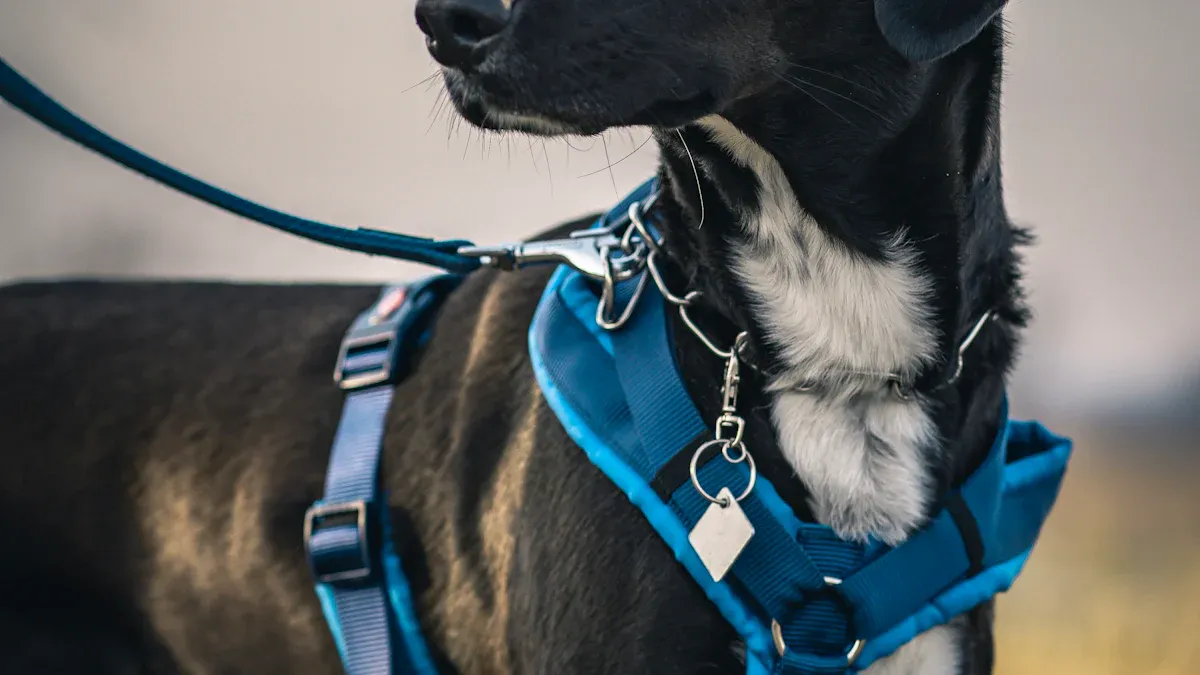
A harness designed for full-body lift support solves the problems rear-only designs create — not by adding more straps but by changing where and how force enters the dog. Three structural differences separate a harness that keeps a heavy dog level from one that does not.
Front and rear handles create a level lift plane
The front handle controls shoulder position. The rear handle controls hip position. Together they define the plane along which the dog rises. When both handles carry load, the dog’s spine stays closer to horizontal. The front does not drop. The rear does not swing. The handler does not need to jerk or correct mid-lift because the geometry works from the start.
This is not simply “two handles are better than one.” The handles must be positioned so that the lift force passes close to the dog’s natural center of mass — roughly behind the shoulder blades for most breeds. If the front handle sits too far back, it acts like a second rear handle and the chest still drops. If the rear handle sits too far forward, the hips swing. Handle placement relative to skeletal landmarks determines whether the lift stays level or tilts.
Wide panels spread pressure instead of concentrating it
Panel width is the single most consequential design variable for short-transfer comfort. A three-inch chest panel distributes the same lift force across three times the surface area of a one-inch strap. The dog perceives this as support rather than pressure.
The causal chain is direct: wider panel → lower pressure per square inch → less tissue compression → reduced pain signal → dog stays calm → handler lifts smoothly → load stays distributed. Narrow strap → high pressure concentration → tissue compression and pain → dog freezes or twists → handler jerks → load spikes → pressure spikes further. The width of the contact surface either stabilizes or destabilizes the entire transfer sequence.
Observable check: After completing a transfer, check whether the harness has shifted from its starting position. Mark where the chest panel edge sits before the lift. After the dog is set down, measure any movement. A shift of more than half an inch means the non-slip contact zones or panel anchoring are not holding under load. The harness is moving on the dog during the lift, which means pressure is redistributing unpredictably.
This distinction between full-body and partial harness design is visible across every structural dimension:
| Feature | Full-body harness | Partial / rear-only harness |
|---|---|---|
| Panel coverage | Chest, belly, and hips — load shared across three zones | Belly and rear only — chest unsupported |
| Handle count and placement | Two handles positioned near center of mass | One rear handle behind center of mass |
| Contact surface per pound | Higher — pressure diluted across wide panels | Lower — pressure concentrated on narrow straps |
| Lift geometry | Dual-vector, level plane | Single-vector, rotational tilt |
| Non-slip zones | Integrated grip panels resist slide | Often absent — harness drifts under load |
Non-slip contact zones and reinforced stitching hold under spike loads
A harness can have wide panels and dual handles and still fail at the seams. Short transfers generate impulse loads — the force spikes in a fraction of a second as the dog’s weight transitions from ground to harness. Standard single-stitch seams can stretch or separate under repeated impulse loading, particularly when the dog’s weight exceeds 60 pounds.
Reinforced stitching — double or bar-tack seams at high-stress junctions where handles meet panels — prevents seam failure under spike loads. Non-slip contact zones, typically a silicone or rubberized inner surface where the panel contacts the dog’s coat, prevent the harness from drifting forward or rotating during the lift. Without them, even a correctly fitted harness can slide under sudden load and reposition itself into a less stable configuration.
Full-body lift harness fit depends on contact stability — a panel that shifts under load cannot maintain the pressure distribution it was designed for. The non-slip zone and the stitch reinforcement work together: one prevents movement, the other ensures that if movement does occur, the structure holds.
When a Lift Harness Is Not the Right Support Tool
A full-body lift harness solves a specific problem: transferring a heavy dog between two stable surfaces a short distance apart, where the dog needs controlled, level support through the lift. It is not a walking harness. It is not a recovery brace. It cannot compensate for a dog that cannot tolerate any handling or a handler who cannot safely manage the dog’s weight even with mechanical advantage.
Knowing the limits of the tool prevents using it in conditions where it will fail.
- Full-weight suspension: A lift harness supports the dog through short transfers, not sustained hanging. The panels and straps are designed for impulse loads measured in seconds, not continuous suspension. Prolonged hanging concentrates pressure even with wide panels and can restrict breathing.
- Uncontrolled thrashing or panic: If the dog thrashes violently during handling, no harness design can prevent injury to the dog or handler. The harness is not a restraint device. Sedation or veterinary handling protocols apply here, not a different harness choice.
- Respiratory distress: Any chest compression — even from a well-designed front panel — can worsen breathing difficulty in a dog already struggling to breathe. A sling-style transfer or stretcher may be necessary instead.
- Stair climbing with full lift: Carrying a heavy dog up or down stairs in a harness introduces additional balance risk for the handler. Hind-leg weakness support during transfers works best on level, short-distance paths where the handler can maintain stable footing.
Disclaimer: These fit and performance checks assume a short-coated dog where panel contact and harness position are visible during the transfer. Double-coated or heavily furred breeds may show subtler rub marks or pressure signs that require hand-checking rather than visual inspection — run your fingers under the panels after each transfer to feel for heat, ridges, or tenderness. If the dog’s chest is unusually deep or the hindquarters are significantly narrower than breed norms, the panel coverage described here may leave pressure gaps that standard adjustment cannot close.
The decision to use a lift harness for short transfers also intersects with what the dog is recovering from. Lift harness designs vary in panel configuration and handle placement, and not every configuration suits every post-surgical restriction. A dog recovering from abdominal surgery may need a harness that routes pressure away from the incision site. A dog with shoulder arthritis may not tolerate a chest panel that sits directly over the joint. The harness type must match not just the transfer task but the dog’s specific pressure tolerances.
FAQ
Why does the front end drop when I lift my dog with a rear-only harness?
The rear-only harness has no structural connection to the chest or shoulders. When you lift from behind the dog’s center of mass, gravity pulls the front half down while the rear rises. The harness offers nothing to counter that rotation. A front handle or chest support panel provides the counter-force that keeps the dog level.
How wide should the belly panel be for a heavy dog?
Panel width determines pressure concentration. For dogs over 50 pounds, a panel under two inches wide concentrates enough pressure during a sudden lift to cause visible discomfort — freezing, flinching, or sitting. Panels three inches or wider spread the same force across enough surface area that most dogs accept the lift without resistance. The test is not the number on the label but whether you feel a raised red line along the strap path after a transfer.
Can one person safely lift a heavy dog with a full-body harness?
It depends on the dog’s weight relative to the handler’s strength, not just the harness design. Dual handles make a solo lift more controlled by letting the handler balance front and rear simultaneously, but they do not reduce the total weight the handler must manage. For dogs over 70 pounds, or any dog that cannot bear weight through the front legs, a second person using the second handle typically makes the difference between a controlled transfer and a strain injury — to dog or handler.
When should I stop a short transfer completely?
Stop immediately if the dog vocalizes in pain, collapses, twists violently, or shows breathing changes — panting that suddenly accelerates, open-mouth breathing with neck extension, or pale gums. These are not harness-fit problems. They signal that the transfer itself has become unsafe regardless of equipment. Lower the dog to a stable surface and contact a veterinarian before attempting another transfer.
