
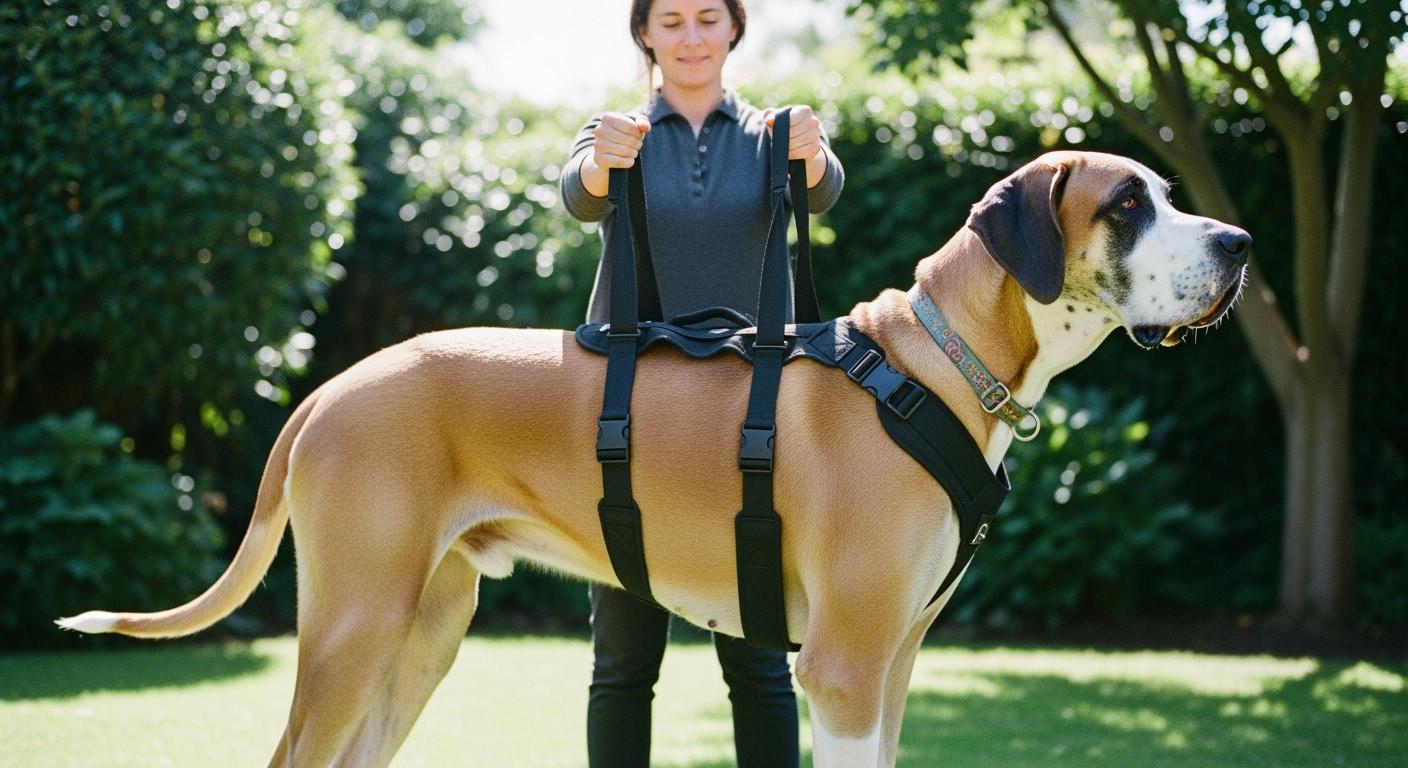
A tall dog needs help standing. You reach for the harness handle—and your hand drops six inches below where it should be. Your back rounds. The dog’s hips rise first. The chest stays low. The lift turns into a wrestle.
That six inches is the difference between a harness that works and one that strains both bodies. It is not about the handle being poorly made. It is about the handle sitting in the wrong place for a dog whose shoulders come up to your hip.
Handle placement on a dog full body lift harness for tall large dog is not a comfort feature. It is the difference between the dog rising level—or twisting out.
Handle Height Failure Signs During Real Use
The failure pattern is predictable once you know what to watch for. It starts with body position and ends with the dog refusing the harness.
The caregiver bends, the dog tilts
A fixed handle on a standard harness sits roughly at the dog’s mid-back. On a Labrador, that is manageable. On a Great Dane or an Irish Wolfhound, it sits far below the caregiver’s natural grip zone. To reach it, the caregiver bends forward at the waist.
That bend creates a lever arm. The distance between the handle and the caregiver’s center of mass forces the lower back to work as a fulcrum rather than letting the legs drive the lift. Every inch the handle sits below the ideal grip zone multiplies the compressive force on the lumbar spine. The arms straighten. The shoulders round. What should be a leg-driven upward motion becomes a bent-over arm pull.
At the same time, that angled pull changes the force vector through the harness. Instead of lifting straight up, the straps pull backward and upward. The rear of the harness rises first. The front half of the dog becomes dead weight. The chest drops, the dog feels like it is tipping forward, and the first response is to brace—or twist.
After one stand-up assist, check whether your back stayed straight and your elbows stayed slightly bent. If you had to straighten your arms fully or lean forward more than a few degrees, the handle height is wrong. Then check the chest strap. If it slid rearward by more than half an inch, the lift pulled from the wrong angle.
What the dog feels when the handle is too low
The dog does not know the handle is low. It knows the lift feels wrong. Hips rise. Chest stays down. Pressure concentrates under the belly. The harness bunches forward into the armpits. Within seconds, the dog hesitates or plants its feet.
This is not stubbornness. It is a mechanical response to uneven load. A dog whose front half drops during a lift experiences the same sensation a person feels when a chair tilts backward—the body locks up to prevent a fall. The wider and deeper the dog’s chest, the more pronounced the tilt, because more mass sits forward of the lift point. This is why the same harness that works for a lean, narrow-chested breed fails on a tall, deep-chested dog.
Common signs stack up fast: shoulder-heavy tilt, handle drift off-center, pressure buildup at the chest or groin within seconds of lifting, chafing under the front legs where straps bunch, and the dog pulling away or sitting down mid-lift. Each one traces back to handle placement and the lift angle it forces, not to the dog’s willingness. A harness where the handle sits too low changes the entire force pathway through both bodies.
| Failure signal | Structural cause | What fixes it |
|---|---|---|
| Caregiver bends forward, back strains | Fixed handle sits below natural grip zone | Adjustable strap length to raise grip point |
| Dog rises lopsided—hips before chest, or chest before rear | Single lift point creates a rotation pivot | Dual front-and-rear lift points for level rise |
| Harness slides toward armpits, bunches at chest | Narrow straps, chest panel too short for deep chest | Wide padded panels, chest strap anchored at sternum |
| Dog twists, hesitates, or sits down mid-lift | Uneven load distribution triggers stability response | Connected lift points to share weight front to rear |
| Pressure builds at belly or groin within seconds | Narrow or stiff strap edges concentrate force | Soft rolled edges, wide belly panel |
Structure That Prevents Handle-Height Failure in Tall Large Dogs
Adjustable lift straps change the force angle
A fixed handle sews the lift point into one position. An adjustable strap lets the caregiver move the grip zone to where their hands naturally fall—usually between mid-thigh and mid-chest, depending on the caregiver’s height and the dog’s shoulder height.
This matters because a grip at the right height keeps the lifting force nearly vertical. A vertical force vector drives the dog’s body upward as a unit. An angled vector splits the force: part lifts, part pulls backward. That backward component is what drags the rear up before the chest, tips the dog forward, and concentrates pressure at the front strap edges. The taller the dog, the larger the angle between a fixed low handle and the caregiver’s hands—and the larger that backward force component becomes.
Adjustable straps do not just accommodate different caregivers. They let the same caregiver shift grip position for different tasks—higher for stair assists where the dog needs more front-end clearance, lower for stand-up transfers where rear support matters more. A full-body harness with independently adjustable front and rear lift straps gives control over that angle task by task.
Dual lift points keep the dog level
A single lift point—whether at the rear, the mid-back, or the chest—creates a pivot. The dog’s body rotates around it. On a short-backed dog, that rotation is small. On a tall dog with a long body and a deep chest, the rotation is large and visible: hips swing up, chest swings down, or vice versa.
Dual lift points—one at the shoulders, one at the hips—eliminate the pivot. Force enters the harness at two points spaced across the dog’s length. The body rises as a platform rather than rotating around a single hook. The dog feels stable. The caregiver feels less resistance. The straps stay where they were placed because no single point takes the full load shift. Front-and-rear balance determines whether the dog trusts the harness on the first lift or braces against it.
Disclaimer: This fit assessment assumes a dog with breed-typical proportions. Dogs with angular limb deformities, very deep chests relative to body length, or unusual shoulder-to-hip ratios may show rub patterns that a visual strap check misses. Hand-check the skin under every strap edge after the first three wear sessions. If you feel heat, dampness, or a ridge where the strap edge sat, the panel width or edge finish needs adjustment—regardless of whether a visual check looks clean.
Panel width and edge finish determine skin tolerance
A narrow strap concentrates the dog’s body weight onto a thin line of contact. On a 120-pound dog, a one-inch strap under the belly during a lift can generate enough localized pressure to cause discomfort within seconds. The dog sits down. The owner assumes the dog is uncooperative. The real problem is pressure concentration.
Wide padded panels spread the same load across four to six times the surface area. The force per square inch drops. More importantly, a wide panel resists rolling. A narrow strap under lateral force twists, concentrating pressure onto one edge—the edge digs in, the dog flinches, the strap shifts, and the cycle repeats. A wide panel stays flat against the body and distributes force across its full surface.
Edge finish matters equally. A bound edge with raised stitching creates a ridge that rubs with every step. A rolled or smoothed edge eliminates the ridge. On a short-haired breed, the difference shows up as pink skin after ten minutes of use. On a double-coated breed, the same edge might leave no visible mark—but the dog still feels it. Hand-check the skin after the first use, not just the coat.
Deep-chest adjustment is the third piece. A harness cut for a moderate chest depth rides up on a deep-chested dog, pulling the belly panel forward into the narrowest part of the abdomen. The panel bunches. The straps lose their anchor. What looked like a good fit standing still falls apart after ten steps. A harness with multiple chest-panel adjustment points lets the panel sit flat against the sternum without riding up, keeping the entire support structure stable through motion.
In practice: After ten steps of assisted walking, slide a finger under each strap edge at the armpit and groin. If the skin underneath feels warmer or damper than the surrounding area, or if any strap has shifted more than half an inch from its starting position, the panel width or edge finish is concentrating pressure instead of distributing it.
When a Full-Body Lift Harness Is Not Enough
A harness changes how force transfers between bodies. It does not change what the dog’s legs can bear. Knowing where that line sits prevents injury—to both the dog and the caregiver.
Pain signals stop the process
If the dog yelps, collapses, or suddenly refuses to bear weight on a leg that was working moments earlier, the harness is not the issue. Stop. These are not fit problems. A dog that drags a leg, twists violently, or freezes mid-lift is signaling something that a strap adjustment cannot fix.
The harness amplifies existing instability. If a joint is already compromised, the lift forces that a harness transmits can trigger a pain response that was latent during stillness. This is not a harness failure—it is a harness revealing a problem that was already there. The right response is to stop, note exactly what movement triggered the reaction, and have a veterinarian assess the dog before resuming any assisted movement.
Stairs multiply risk
Stairs combine vertical lift with forward reach. The dog’s weight shifts forward as the front paws reach for the next step. If the harness has any tendency to slide, stairs will expose it within the first few steps. A harness that stays put during flat-ground walking can shift dramatically on an incline because the force vector rotates forward.
Tall dogs face a compounding problem on stairs: their stride length means each step covers more vertical distance, increasing the forward lean on each reach. The harness must hold position through a larger range of motion—and a larger angle change—than it does on flat ground. If the dog hesitates or freezes on stairs, do not push through. Stair-specific handle control matters more than flat-ground stability because the consequences of a slip are higher.
Disclaimer: If the dog’s leg conformation falls outside the breed norms this harness was patterned for—particularly dogs with angular limb deformities or very deep chests—the fit checks described here may not catch every pressure point. In those cases, a single harness design is unlikely to provide adequate support across all mobility tasks, and a professional fitting may identify pressure areas that a standard visual inspection misses.
When hind-leg weakness outpaces what a harness can manage
A full-body harness redistributes weight from the dog’s legs to the caregiver’s arms. But there is a threshold past which the dog’s remaining leg strength cannot contribute enough to make assisted walking safe. The dog hangs in the harness rather than walking in it. The caregiver carries more weight than they can sustain. The harness becomes a carrying sling rather than a mobility aid—and it was not designed for that.
Signs that this threshold is approaching: the dog’s rear legs cross or knuckle under during assisted walking, the caregiver cannot maintain an upright posture through a full stair climb, or the dog shows respiratory distress during assisted movement. Each signals that the load exceeds what the harness-and-caregiver system can safely manage. Solutions exist for hind-leg weakness that goes beyond what a harness alone can support, but they start with recognizing that the harness has reached its limit.
FAQ
Why does the harness slide forward on a deep-chested dog even when the straps are tight?
Deep chests taper inward behind the ribcage. If the belly panel sits behind the deepest point of the chest, forward body motion naturally drives the panel ahead into a narrower zone—like a wedge slipping forward. The fix is not tightening the straps. It is making sure the chest panel anchors at the sternum and the belly panel sits far enough back to stay behind the ribcage taper. A harness cut short in the chest panel will always migrate forward on a deep-chested dog, regardless of strap tension.
Can a full-body lift harness be used on a dog that weighs more than the caregiver?
It can, but with a hard constraint: the caregiver must keep the lifting force close to their own center of mass. Leaning out or bending forward to reach a low handle shifts the combined center of gravity away from the caregiver’s base of support. With a dog heavier than the caregiver, that shift can turn a controlled assist into a fall. Adjustable handle height becomes non-negotiable in this scenario—the grip point must sit high enough that the caregiver’s arms stay close to the body through the full lift.
How soon should strap position be checked after putting the harness on?
Check after the first stand-up assist and again after ten steps of walking. The first check catches initial fit problems. The second catches motion-induced shift. If both checks show the straps in the same position, the fit is stable. If the second check shows movement, adjust and repeat the two-step check. Do not assume a harness that looks right standing still will stay put in motion.
