
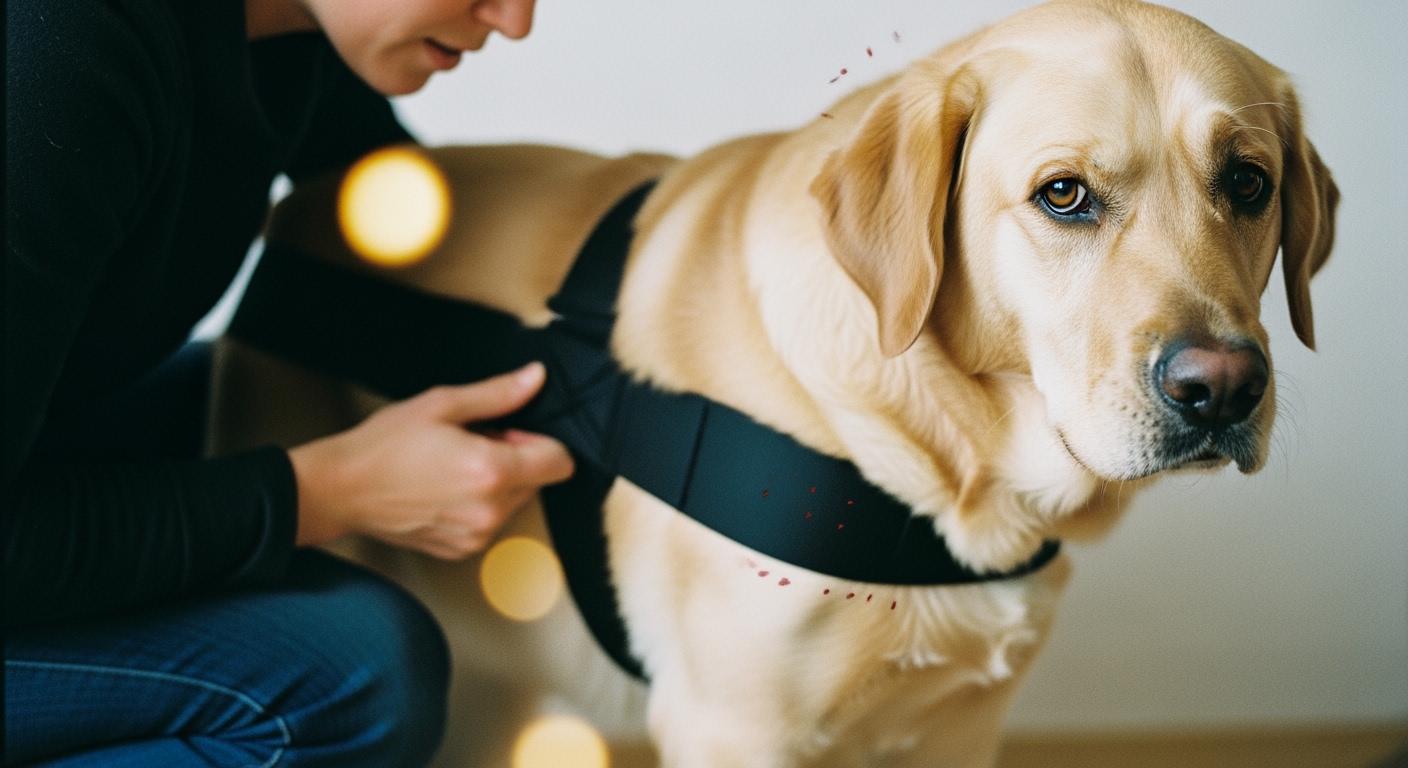
The sling goes under the belly, you lift, and the band rolls. Not shifts a little—rolls. It turns from a flat panel into something closer to a rope, and that rope digs into the abdomen of a dog that already has enough problems standing. A large dog lift sling belly band that is too narrow does more than feel unstable. It can concentrate upward force along a narrow line instead of spreading it across a broader surface, creating a pressure point during lifting. The issue is not how tight you pull. The issue is contact area, edge geometry, and what happens to padding under load. When those three factors fail on a large dog, the sling may become uncomfortable enough that the dog resists or avoids the lift.
Why a Narrow Belly Band Fails First on a Large Dog
A lift sling works by spreading the dog’s downward weight across the belly panel. The basic principle is simple: concentrating the same lifting force across a smaller contact area increases pressure. A wider panel generally spreads that force more effectively than a narrow band, provided the panel stays flat under load. But the failure is not just about raw pressure numbers.
The mechanics of a band that rolls under load
When a narrow band lifts upward against a large dog’s abdomen, the force does not distribute evenly across the fabric width. The center of the band carries most of the load first. As the handler lifts, that center section presses upward while the edges see less tension. The result: the edges curl inward, and the band cross-section changes from flat rectangle to near-circle. That is the moment support becomes a problem. A rolled band has no flat surface left to distribute force. More of the lifting force is then carried by a much smaller contact area. The dog may respond by flinching, shifting sideways, looking back at the sling, or refusing to step forward. These reactions can indicate that the panel is no longer distributing pressure comfortably. Large dogs place more total load on the panel, so rolling and edge pressure may become more noticeable. Short-coated dogs may show a visible line along the band path, while thicker coats can make early skin changes harder to see.
Padding that bunches instead of staying flat
Padding can make the problem worse if it is not stabilized. Loose fill padding shifts the moment the band goes under tension. It bunches toward the middle or slides toward one edge, creating a lump under the fabric. Now the dog has a narrow band plus a hard knot of displaced padding pressing into one spot. The handler may not feel this through the handle—the lift still feels “supported”—but the dog feels it with every step. Stabilized padding, stitched through or bonded to the panel backing, stays in place. The thickness stays uniform under load, and the contact surface remains flat. In production terms, this is the difference between a panel where padding is simply enclosed in a sleeve and one where the padding is quilted or laminated to prevent migration. The second may cost more to manufacture, but it can help the panel maintain a more even contact surface during repeated use.
In practice: After five minutes of assisted walking, remove the sling and run your palm across the belly panel. If the padding feels uneven—thicker in one area and thinner in another—it may have shifted under load and should be reassessed before the next lift.
Short lifts can still create pressure problems
A thirty-second potty break may still create concentrated pressure if the band rolls on the first lift and remains rolled. Repeated movement can add friction along the same strip of skin. If the fit problem continues across sessions, temporary redness may progress to hair disruption or skin irritation. This is not only a long-duration wear issue. A narrow or unstable contact area can create problems early in a session, so the panel should be checked during initial supervised use.
What the Dog Shows You When the Band Is Too Narrow
Dogs may show localized pressure or discomfort through changes in posture, movement, or willingness to continue.
The band rolls into an edge
Watch the band during the first lift. If the edges curl inward or the panel twists so that what was the flat underside now stands at an angle, the band has failed. It is no longer distributing force. The handler may not feel this through the handle because the overall tension feels the same. But the contact surface has changed completely. Check by noting the band’s position against a clear reference point on the dog’s body or coat. Walk ten steps. If the band has shifted noticeably from that reference point or begun to roll, reassess the panel position and stability. A support sling with reinforced anti-roll edges can help the panel maintain a flatter orientation as the dog’s gait shifts side to side.
Hesitation, freezing, shifting away
A dog that pauses the moment you apply lift tension is telling you the pressure is uncomfortable. A dog that leans away from the sling side is trying to unload the pressure point. A dog that turns its head back toward the handler or the sling is checking the source of the discomfort. Do not assume these reactions are stubbornness. For a brief check, apply the minimum support needed, hold steady for three seconds, and release. If the dog repeatedly relaxes after release or begins flinching before the next lift, reassess the fit or support type rather than continuing the test.
Red marks after a short session
Remove the sling after five minutes and check the belly in good light. Look for a distinct line that follows the band edges, persistent redness, unusual warmth, swelling, dampness, or hair disruption. That line means the edge, not the flat surface, carried most of the load. If the line is deeper red at the center than at the ends, the band not only rolled but also bowed—the middle carried more weight than the edges, which is a width problem specifically, not a tightness problem.
Disclaimer: This visual check assumes a short-coated dog where skin is visible without parting the hair. Double-coated breeds may show subtler rub marks that require hand-checking—run your fingertips along the band path and feel for heat or texture changes rather than relying on visible redness alone.
Slipping during stairs and potty breaks
A narrow band lacks the surface area to resist sliding when the dog changes posture. During a squat, the abdomen changes shape—it shortens and widens. A wide panel stays in contact through this shape change. A narrow band lifts off or slides backward toward the groin. On stairs, the alternating front-to-rear weight shift rocks the band out of position with each step. The handler compensates by pulling harder or lifting at a steeper angle, which makes the rolling worse. After three or four stair steps, check whether the band has migrated from its starting position. Moving support can feel unstable and may cause the dog to pause or freeze. Stop rather than pulling harder if the sling shifts on an incline. For dogs that need stair assistance regularly, the difference between a sling and a full-coverage lift harness is most visible on inclines, where posture changes amplify every fit weakness.
| What you see | Likely cause | What to change |
|---|---|---|
| Red line matching band edges | Band width insufficient for dog’s weight | Use a wider padded panel that maintains broad, flat contact under load |
| Band rolled into cord shape | Edge lacks anti-roll reinforcement | Choose a panel with bound or reinforced edges that resist curling |
| Sling slides backward during walking | Contact area too small to resist posture shifts | Use a longer belly panel with adjustable fore-aft strap positioning |
| Dog refuses to step forward | Localized pressure or discomfort at the contact line | Stop use, check skin, switch to wider panel before retrying |
| Handler feels need to pull harder | Band instability forces compensation | Use a panel that stays flat, reducing the handler’s lifting effort |
| Padding feels uneven after use | Unstabilized fill migrating under tension | Switch to quilted or bonded padding that stays uniform under load |
Why Wider Support Works
A wide panel is not simply a narrow panel scaled up. Its edge control, padding stability, and strap layout must also help it remain flat under load.
Contact area determines whether the dog feels supported or pinned
A broader contact area generally reduces how much force is concentrated at any one point. A narrow or rolled panel can create a pinching contact line even when the total lifting force has not changed. Wide panels convert the same total lift into lower perceived pressure. This matters from the beginning of a lift. If the first three seconds create discomfort or instability, later attempts may become harder because the dog begins to anticipate the same experience. A lift harness with a wide belly panel may feel more stable when it spreads contact across a broader area and stays flat during movement.
Edge shape controls whether the panel stays flat
A panel edge that is simply cut fabric curls under tension. A panel edge that is bound with a stiffened tape or folded and double-stitched resists curling. The difference is visible on the first lift: the bound edge stays perpendicular to the dog’s body, maintaining the full width of the contact surface. The raw edge rolls into the panel body, eating into the usable width from both sides. If unbound edges curl inward, the usable contact width can become much smaller than the panel’s static measurement. Rear-lift harness fit checks that only measure static panel width miss this entirely; the measurement that matters is effective width under the handler’s typical lift force.
Breathable lining is not a comfort feature—it is a repeat-use requirement
A dog that needs assisted standing several times a day may generate heat and moisture under the panel with each session. A low-breathability lining can keep that moisture against the skin and reduce tolerance to friction. Breathable linings—such as perforated materials, open-cell structures, or wicking knits—can help moisture escape between lifts. Allow the panel to dry before reuse and clean it according to the product instructions, because retained moisture or debris can increase friction.
Fit checks that catch problems before the dog pays for them
Before lifting, place the panel flat against the belly and check that the full width sits in contact, not just the center strip. Apply light support and hold for five seconds. Release and check whether the panel edges stayed flat or curled. Walk ten steps on a flat surface, remove the sling, and check for a distinct line, unusual warmth, swelling, dampness, or hair disruption along the contact path. If the panel passes all of these—flat under tension, no migration during walking, no line on the skin—the width and edge design are adequate for that dog at that activity level. If it fails any one check, the design is not matching the dog’s weight and movement pattern, regardless of what the size label says.
| Design feature | Narrow band failure mode | Wide panel behavior | Why it matters for large dogs |
|---|---|---|---|
| Contact area | Pressure concentrates in a thin line | Load spreads across a broad surface | Larger dogs place more total load on the panel, making distribution especially important |
| Padding stability | Fill bunches or shifts under tension | Quilted or bonded padding stays uniform | Uneven padding can create localized pressure points |
| Edge control | Fabric curls into a cord under load | Reinforced edges maintain flat orientation | Edge rolling can substantially reduce the effective contact width |
| Strap adjustability | Hard to center on different body shapes | Independent left-right strap paths | Deep-chested breeds need asymmetric adjustment that single-path straps cannot provide |
| Potty clearance | Band blocks or shifts during urination | Contoured cutaway maintains access | Male large dogs need clearance that stays aligned when the band is under tension |
| Front-rear balance | Rear-only lift can twist the dog | Full-body configuration balances the lift | Dogs with bilateral weakness need support that prevents rotation, not just elevation |
| Lining breathability | Heat and moisture accumulate between sessions | Perforated or wicking lining dries between uses | Repeated use can compound moisture and friction, making breathability important |
When a Rear-Only Narrow Sling Is Not the Right Choice
A rear-only lift sling assumes the dog has adequate front-leg strength to bear weight and balance independently. When that assumption is wrong, the sling creates problems that look like fit failures but are actually application mismatches.
Dogs that need more than rear lift
A rear sling may suit a dog that can still bear weight and balance through the front legs. A dog that also needs front-end assistance may require a broader support configuration. If front-end support is also limited, rear-only lifting can cause the body to tip forward. Pulling harder at the rear may increase the imbalance and concentrate more load through the belly panel. The result is exactly what a narrow band is least equipped to handle: sudden, concentrated, off-axis load. The band may roll, and the dog may become unstable or distressed. This is not a band-width problem anymore—it is a support-type mismatch. For dogs with generalized weakness, the full-body harness approach addresses the load distribution problem at the source by splitting lift between front and rear panels, so no single contact point sees the dog’s full weight.
Body shapes that defeat standard belly panels
Deep-chested dogs may have abdomens that taper sharply from ribcage to waist. A flat belly panel that works on a more rectangular torso may gap at the edges on a tapered body. The panel makes contact only along a center strip. That is functionally the same as a narrow band, even if the panel measures four inches wide on the table. Dogs with short torsos relative to their body mass may have less abdominal length available for support. In these cases, panel placement and contour matter because a smaller usable contact area can increase localized pressure.
Disclaimer: If the dog’s body conformation falls well outside the breed norms that standard sling patterns are built for—particularly dogs with angular limb deformities, very deep chests, or unusually short torsos—the flat-panel fit checks described here may not catch every pressure point. In these cases, hand-check the full contact path after every lift and verify that the panel maintains uniform contact from edge to edge, not just along the center line.
When to stop and reassess
Stop using the sling if the dog vocalizes during lifting, develops persistent redness or swelling, begins refusing the sling before positioning, or moves worse with support than without it. These signs indicate that the fit or support configuration—band width, panel type, or sling style—needs reassessment. An improvised towel sling may concentrate pressure and provide little edge stability. For repeated assistance, use a purpose-designed support device selected with guidance from the dog’s veterinary or rehabilitation team. The support path that matches the dog’s specific weakness pattern—rear-only, full-body, or stair-focused—matters more than any single product feature, because the right sling type on the wrong support path is still the wrong solution.
FAQ
Why does the belly band roll even when the sling is not pulled tight?
Edge rolling is a geometry problem, not a tension problem. A narrow band under any upward force sees its edges curl inward because the center fibers carry more tension than the edge fibers. Edge reinforcement—such as bound, folded, or stabilized edges—can help the panel maintain its shape. Raw or highly flexible edges may be more likely to curl under load, especially on larger dogs.
How quickly can a narrow band cause skin damage?
Check after the first five minutes of assisted walking because early redness or a distinct pressure line may indicate concentrated contact. The mechanism is friction plus pressure, not just pressure alone—the band edge moves slightly against the skin with each step, and the combination of concentrated load plus micro-movement accelerates skin irritation faster than static pressure alone.
Does a wider panel work for small dogs too, or is this only a large-dog issue?
The same principles apply across dog sizes: contact area influences pressure, and edge stability determines whether that contact area remains available under load. Larger dogs generally place more total force on the panel, but even a smaller dog can experience irritation if the band rolls or the fit is poor.
What if the dog needs hind-end support but also has a surgery incision on the belly?
Do not place a belly-band sling over an abdominal incision, surgical site, or wound unless the veterinary team has approved the contact area and support method. Pressure and friction may irritate healing tissue. A lift harness that routes support away from the belly may be considered when it matches the dog’s needs, but the appropriate lifting method should be confirmed with the veterinary or rehabilitation team.
