
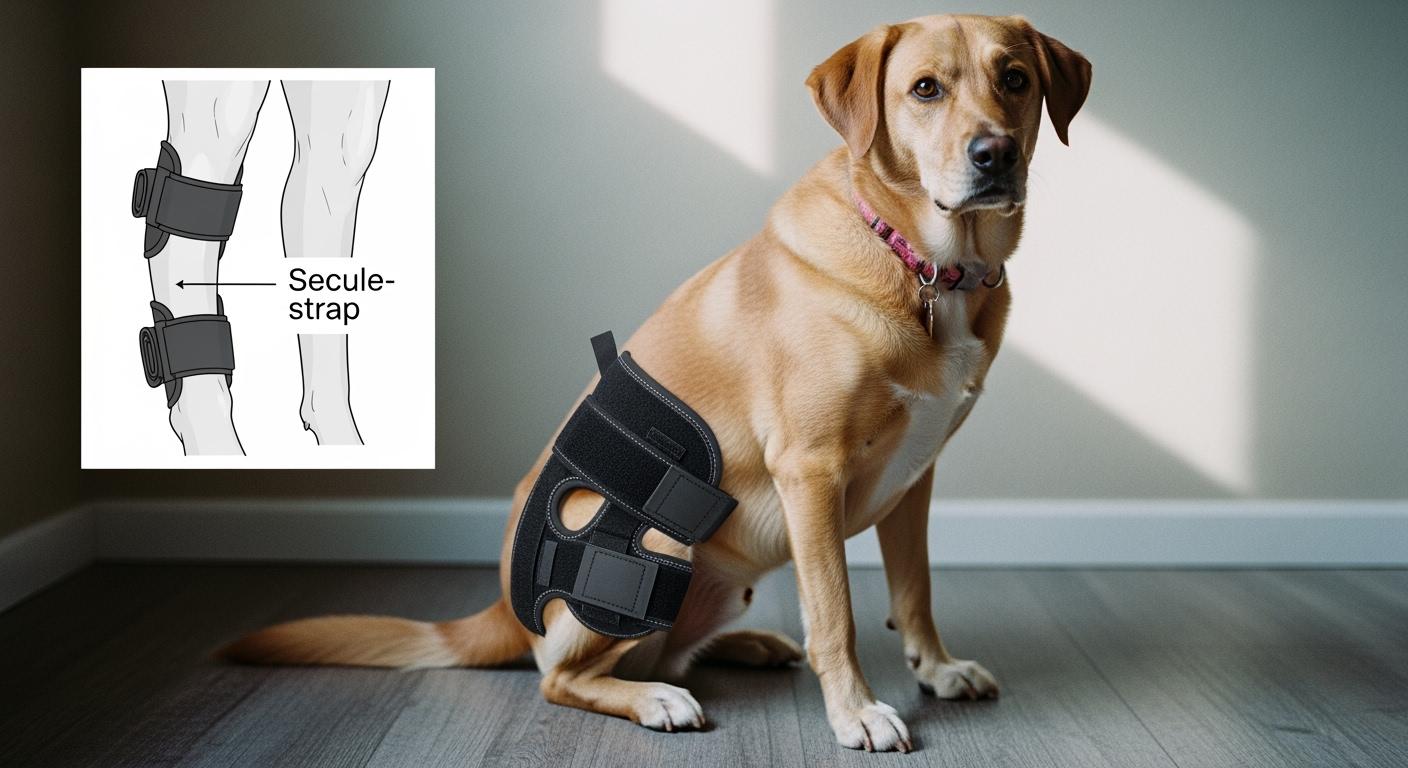
You fit the thigh strap of a dog ACL brace flat against the leg. It looks secure. Ten minutes into a walk, the strap has rolled into a narrow cord, the hinge has drifted off the knee, and your dog is taking shorter steps on that side.
This sequence happens because the strap is not designed to stay flat against a thigh that changes shape with every stride. The problem is not that you left it too loose. The problem is anchor geometry meeting moving muscle.
A thigh strap that stays wide and flat under dynamic load does something fundamentally different from one that relies on static tension alone. Understanding that difference is what keeps a brace working — or lets it fail mid-stride.
Why the Thigh Strap Rolls Even When It Feels Tight
Here is the causal chain: as the quadriceps and hamstring groups contract and relax, the thigh cross-section deforms. A narrow strap — especially one with a single load path — rides the changing contour instead of resisting it. The top edge catches less surface area than the muscle displacement demands, so the strap folds inward and rolls toward the path of least resistance. That folded edge then becomes a concentrated pressure line. The hinge, now unmoored at the top, drifts distally. Joint alignment is lost.
This is not a tightness problem. It is an anchor-width-to-muscle-displacement mismatch.
You can verify this without instruments. After ten minutes of walking, slide two fingers under the strap at its top edge. If the strap has narrowed — curled into a thinner band than when you put it on — the anchor width is insufficient for the muscle excursion happening underneath. That is the fail signal.
Fur Compression and the Grip Clock
Fur adds another variable. When you first secure the strap, the coat acts as a compressible filler layer that increases contact friction. After several minutes of movement, the fur under the strap compresses to its minimum thickness. That filler effect disappears. The strap now sits on a slicker, flatter surface with less mechanical grip. If the strap material is primarily elastic, it has been micro-stretching the entire time, losing preload without visibly loosening.
An elastic-only upper strap fails here because elasticity works against retention: the material stretches to accommodate muscle bulge, but the recovery force is too weak to pull the strap back to flat when the muscle relaxes. Each cycle nets a small loss of position. After a few dozen strides, the strap has shifted enough to roll.
Low-stretch materials — woven nylon, TPU-coated webbing — resist this cycle. They do not elongate under muscle load, so they hold their footprint. The difference shows up in how a knee brace maintains its upper anchor position from the first step to the fiftieth.
| Strap Design | Performance Difference | Main Limitation | Pass Signal | Fail Signal |
|---|---|---|---|---|
| Narrow single thigh strap | Rolls into a cord under lateral thigh expansion; loses flat contact within the first minute of walking | Insufficient surface area to resist muscle displacement — one load path cannot counter multi-axis movement | Strap width unchanged after 10 min of walking | Strap curled into rope-like band; red linear mark on skin |
| Elastic-only upper strap | Stretches with each muscle contraction; recovery force too weak to return to original position — net drift per stride cycle | Elasticity works against positional retention under cyclic loading; low-stretch materials resist this mechanism | Strap returns to original position after each stride cycle | Strap has migrated downward; brace hinge sits below knee joint line |
| Strap placed near groin fold | Inguinal skin movement adds a downward pull vector that accelerates rolling — strap rides the skin rather than anchoring above the muscle belly | Proximity to high-mobility skin zone introduces forces unrelated to brace function | Strap sits above the widest part of the thigh muscle | Strap bunches at the groin; dog licks or chews the area |
| Stiff or unbound strap edge | Concentrates force at the edge line; every step applies a shear point to a narrow band of skin — leads to pressure injury over repeated loading | Edge geometry determines whether force is distributed or focused; a sharp edge creates a stress riser in soft tissue | Skin under strap edges is uniformly pink, no linear marks | Sharp red line, swelling, hair loss, or open sore along strap border |
| Wide padded upper anchor | Spreads load across a broader contact patch; wider footprint resists the folding moment that initiates rolling — hinge stays centered on knee throughout gait cycle | Coverage depends on matching anchor width to thigh circumference range; oversized anchors can gap on lean dogs | Strap stays flat; hinge aligned with knee after walk, sit, and stand | — |
| Multi-point upper tension | Distributes retention force across at least two separate load paths; each path handles a different movement plane, so no single failure mode dominates | More adjustment points increase setup complexity; requires understanding of which strap controls which plane of movement | Brace does not rotate during turns or sitting; dog walks with even stride | — |
What Strap Rolling Does to Knee Brace Support
A knee brace hinge is designed to sit at the joint’s center of rotation. When the thigh strap rolls and the anchor shifts, the hinge moves with it. The hinge is now loading the joint at an off-axis angle.
The mechanics are straightforward. A hinge aligned with the knee’s natural axis transmits force along the joint’s intended load path — compression and shear stay within the ranges the joint structures are built to handle. An off-axis hinge introduces a bending moment that the knee is not shaped to resist. The tibia can translate forward relative to the femur in ways the damaged or healing ligament cannot control. What was meant to be a stabilizing device becomes a source of aberrant joint loading.
You can check for this. After a walk, palpate the hinge position relative to the femoral condyles. If the hinge center has moved more than half an inch from where you placed it, the upper anchor has failed. The brace is no longer providing knee-specific support — it is now a generic leg wrap with a misplaced rigid component.
Edge pressure is the second consequence. A flat strap distributes retention force across its full width — say two inches of contact. A rolled strap concentrates that same force into a band roughly a quarter-inch wide. Same tension, eight times the pressure per unit area. That narrow band acts like a tourniquet on the superficial tissues — compressing capillaries, irritating nerve endings, creating the sharp red line that owners find after removing the brace. Over repeated sessions, that pressure line can progress to skin breakdown.
The dog’s response to this is not subtle. Gait compensation begins the moment edge pressure crosses the discomfort threshold. Shorter stride on the affected side. Less knee flexion. More weight borne on the contralateral limb. Each compensatory pattern shifts load away from the structure that needs controlled loading to heal. A brace that rolls is not just uncomfortable — it redirects rehabilitation forces away from the target joint. Hinge alignment is the first thing to check when a dog starts guarding a braced leg.
| Signal Level | What Appears | What to Do Next |
|---|---|---|
| Green | Strap stays flat, hinge stays aligned, dog walks with even stride, skin looks normal after brace removal | Continue use; check fit after each walk session |
| Yellow | Mild strap curling, slight downward slide, short-lived pink mark that fades within 15 minutes, dog occasionally notices the brace | Re-adjust; monitor closely; check skin and hinge position after each walk |
| Red | Sharp pressure line, swelling, heat, hair loss, open sore, brace drops or visibly rotates, dog chews at the brace or limps worse than without it | Stop use immediately; consult your veterinarian; evaluate whether the anchor design matches this dog’s thigh shape and activity level |
Better Anchor Structure for a Thigh Strap That Holds
Wide Upper Anchor Zones
A wide contoured anchor panel — not a strap, but a shaped pad — spans enough of the thigh circumference to resist the off-axis forces that initiate rolling. The wider the contact patch in the proximal-distal direction, the larger the lever arm resisting the folding moment. A two-inch-wide anchor has roughly four times the roll resistance of a half-inch strap, because the force required to fold it doubles with width while the disruptive force from muscle displacement stays constant.
This is why a knee brace designed for CCL support places the upper anchor across the muscle belly, not at the narrowest part of the thigh. The position matters as much as the width: an anchor centered over the largest muscle cross-section has the most stable substrate to work against.
Low-Stretch Materials and Multi-Point Tension
Low-stretch materials solve the cyclic drift problem. When muscle bulges against a low-stretch panel, the panel does not elongate — so it does not need to recover. The retention stays constant stride to stride. Combine this with multi-point tension — at least two separate upper attachment paths — and the anchor controls movement in both the sagittal and transverse planes. A single strap can only resist force in one direction. Two straps set at different angles create a force couple that resists rotation.
You can observe this difference. With a single-strap brace, push gently sideways on the hinge while the dog stands. The brace rotates. With a multi-point anchor, the same push meets resistance — the second load path is constraining the rotation the first path alone cannot prevent.
Soft bound edges eliminate the stress-riser effect at the anchor perimeter. When the edge of the anchor panel is finished with a rolled, padded binding, the transition from brace to skin is gradual instead of abrupt. This matters most for dogs that wear a brace for extended daily sessions — edge irritation accumulates over hours, not minutes.
Where This Anchor Approach Works — and Where It Reaches Its Limits
A wide, multi-point upper anchor with low-stretch materials and bound edges performs well on dogs with a defined thigh muscle profile — breeds with visible quadriceps and hamstring development where the anchor has a stable contour to seat against. Medium to large breeds with moderate coats tend to get the most consistent anchor stability from this design.
The approach has limits. Dogs with very short, thick thighs — some bulldog and basset conformations — may not have enough proximal-distal space for a wide anchor to sit above the muscle belly without encroaching on the groin fold. Dogs with extremely heavy double coats can experience fur matting under a large anchor pad over multi-hour wear, which changes the contact surface independently of the strap design. Very small dogs with thigh circumferences under six inches may find a multi-point system physically larger than the available anchor zone.
Disclaimer: The fit verification methods described here assume a dog with a short to moderate coat where skin marks are visually apparent. Double-coated breeds — huskies, malamutes, chows — may develop pressure points under the fur that are not visible on surface inspection. For these dogs, hand-check the skin by parting the coat and feeling for heat or texture changes along the anchor edge after each wear session. Visual-only checks miss early pressure signs in dense-coated dogs.
Fit Verification That Catches Anchor Failure Before Skin Damage
A practical walk test reveals what a standing fit check hides. Put the brace on and walk the dog for ten to fifteen minutes — include at least one turn, one sit, and one stand. Then check three things:
First, the hinge position. It should sit within half an inch of where you placed it. If it has drifted, the upper anchor failed during movement. Second, the strap width. Run your fingers along the top edge of the upper anchor — if it has narrowed or curled, the anchor width is insufficient for the muscle displacement occurring underneath. Third, the skin. Remove the brace and look at the skin under the entire anchor footprint. A uniform light pink that fades within five minutes is normal reactive hyperemia from gentle contact pressure. A sharp red line that mirrors the anchor edge — especially one that persists beyond ten minutes — signals edge-pressure injury in progress.
A brace that passes the standing test but fails the walking test has an anchor design problem, not a sizing problem. Tension will not fix it. Only a wider, flatter, multi-point anchor will.
This dynamic check matters because fit problems that are invisible at rest become obvious under load. A strap that rolls predictably within ten minutes of walking will continue to roll — and the accumulated edge pressure over weeks of daily use is what leads to the skin damage, gait compensation, and brace abandonment that defeats the entire purpose of bracing.
FAQ
Why does the thigh strap roll down even when the brace was fitted by a professional?
Professional fitting typically assesses static fit — the dog standing still. It cannot predict how a specific strap design will interact with that individual dog’s thigh muscle excursion during walking. A narrow strap that passes a standing fit check can still roll once the quadriceps and hamstrings begin cycling through contraction and relaxation. The problem is geometric, not procedural.
Can a rolled strap cause permanent skin damage?
Repeated edge pressure over the same narrow contact line can progress from superficial redness to friction blisters, hair follicle damage, and in prolonged cases, pressure necrosis of the superficial tissue. The progression depends on wear duration, strap edge geometry, and individual skin tolerance. Checking skin after every session and stopping at the first persistent red line prevents the cascade from advancing.
Does fur length affect how quickly a strap rolls?
Yes, in two opposing ways. Very short coats provide less initial filler friction, so the strap reaches its minimum-grip state faster. Very long or dense coats resist initial compression but can mat under sustained pressure, creating uneven surface texture that may actually accelerate rolling once the fur compresses into a slick, flattened layer. Moderate-length single coats tend to provide the most stable substrate.
Is a wider strap always better for preventing rolling?
Wider is generally better for roll resistance, but there is a practical ceiling. An anchor wider than the available thigh length between the greater trochanter and the groin fold will either encroach on the groin — where skin movement pulls it down — or extend too far distally and interfere with knee flexion. The anchor needs to fit within the dog’s actual proximal thigh dimensions while maximizing contact area within that available space.
