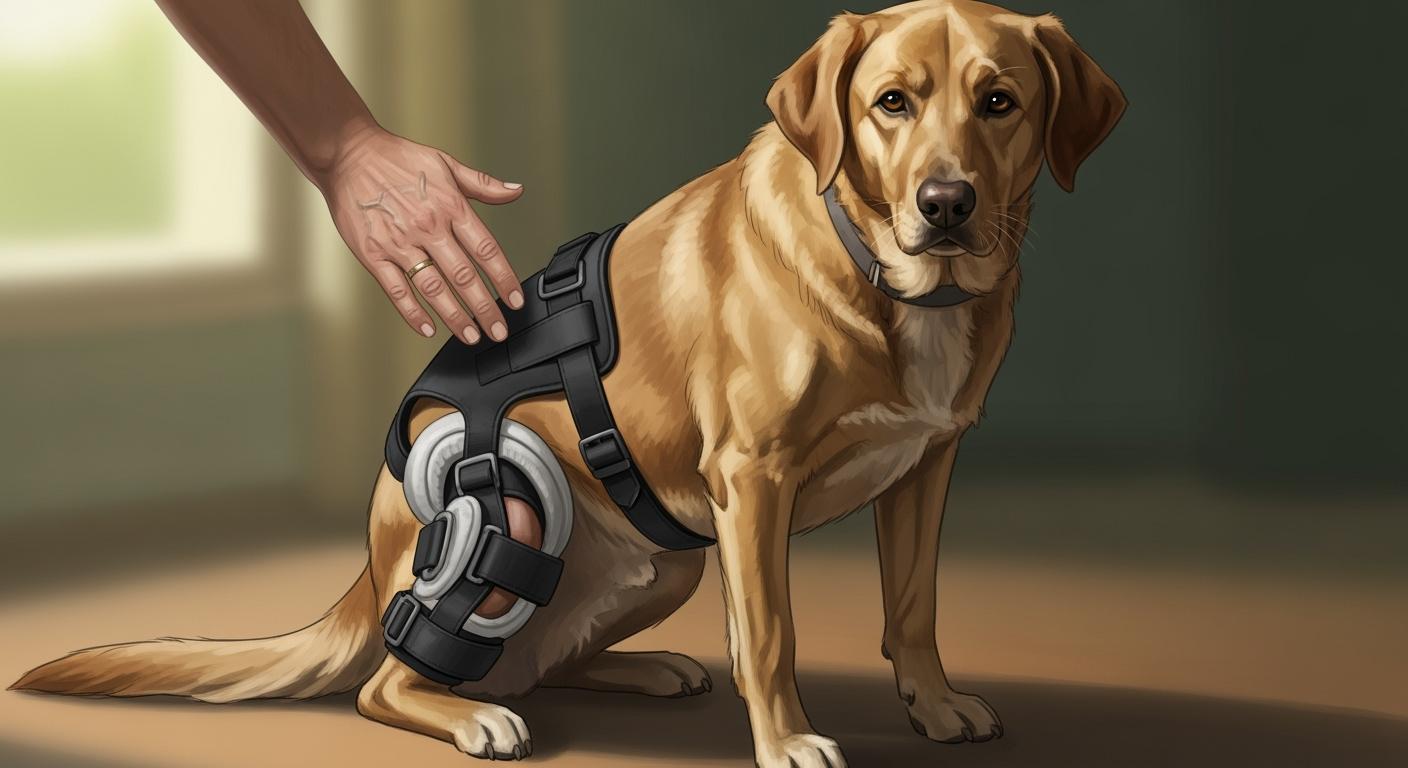
A dog hock brace is designed to provide external support around the hock, or tarsal joint, in the lower rear leg. It may be considered when a veterinarian identifies instability, excessive motion, or a need for added support during a defined recovery or mobility plan. Limping, swelling, a dropped hock, reluctance to bear weight, or sudden changes in movement should be assessed before a brace is selected.
This guide explains what a dog hock brace can and cannot do, how soft and rigid designs differ, how a hock brace compares with a rear-leg splint, and which fit, skin, and movement checks matter during daily use.
Key Takeaways
- A dog hock brace supports the hock joint from outside the leg, but it does not diagnose the cause of limping or cure arthritis, tendon damage, fractures, or ligament injuries.
- Brace type should match the diagnosed problem, the amount of motion that needs to be limited, the dog’s leg shape, and the intended wear plan.
- Good fit depends on alignment, strap position, skin clearance, and resistance to slipping—not simply on choosing the stiffest design. Review the main dog brace types and selection factors before comparing products.
- Remove the brace and seek veterinary guidance if redness persists, swelling increases, the paw becomes cold or discolored, gait worsens, or the brace twists and cannot be stabilized.
Dog Hock (Tarsal) Joint Basics
Where the Hock Is Located
The hock is the angled joint above the rear paw. Veterinarians may also call it the tarsus or tarsal joint. It contains several articulations rather than one simple hinge, so the required support can vary depending on which structure is affected and whether the problem involves instability, tendon injury, joint disease, trauma, or post-operative protection.
| Feature | Practical Meaning |
|---|---|
| Location | The angled joint between the lower rear leg and paw. |
| Function | Contributes to propulsion, shock management, and controlled rear-limb movement. |
| Brace challenge | The lower leg narrows toward the paw, so poor strap placement can lead to slipping or concentrated pressure. |
Signs That Need Assessment First
A brace should not be used to guess the cause of a new gait problem. Limping, swelling, heat, sudden refusal to bear weight, an abnormal hock angle, a dropped stance, wounds, or changes after trauma may require examination and imaging. Achilles tendon injuries, fractures, joint disease, and neurological problems can produce different support requirements.
Safety boundary: A dog hock brace is a support option, not a substitute for diagnosis. The veterinarian or rehabilitation team should determine whether motion should be permitted, limited, or immobilized.
What Is a Dog Hock Brace?
Brace Definition
A dog hock brace wraps around the lower rear leg to provide external support around the tarsal joint. Depending on its construction, it may allow controlled flexion while resisting unwanted side-to-side movement or hyperextension. The amount of control depends on the materials, reinforcement, length, closure system, and fit.
You may also see the terms canine hock brace, tarsal brace for dogs, or hock support. These labels do not guarantee the same structure or support level, so compare the actual design rather than relying only on the product name.
Structured Braces vs Simple Wraps
There are many types of dog braces and wraps. A soft wrap may provide compression and light contact around the joint. A structured brace uses shaped panels, stays, hinges, or semi-rigid reinforcement to control a defined range of motion. Neither category is automatically appropriate for every condition.
| Feature | Structured Hock Brace | Soft Wrap or Sleeve |
|---|---|---|
| Primary role | Provides more defined external support or motion control. | Provides light compression and flexible contact. |
| Construction | May include reinforced panels, stays, hinges, padding, and adjustable straps. | Usually made from flexible fabric with limited reinforcement. |
| Fit sensitivity | Alignment and strap path are critical. | Still requires skin and circulation checks, especially if compression is used. |
| Selection | Should match the required motion limit and diagnosed condition. | Should not be assumed to replace a structured brace or splint. |
Hock Brace vs Rear-Leg Splint
A hock brace generally centers support around the tarsal joint and may leave the paw free. A rear-leg splint extends farther down the limb and may support the paw or toes as well. The longer device usually limits more movement and may be selected when broader immobilization is required.
- Hock brace: focuses on the hock region and may permit more paw and toe movement.
- Rear-leg splint: supports a longer section of the lower limb and may restrict motion across the hock and paw.
The choice should follow the injury pattern and treatment plan. A device that allows too much motion may not provide enough control, while a device that restricts too much motion may interfere with the intended rehabilitation plan.
When a Dog Hock Brace May Be Considered
Sprains and Soft-Tissue Injuries
After a veterinarian identifies a soft-tissue injury, a brace may be considered when controlled external support is part of the management plan. The correct design depends on which movements need to be limited and whether the dog is allowed to bear weight.
Hyperextension and Instability
A hock that extends beyond its intended range or appears unstable may require a brace designed to resist that specific motion. Strap position, reinforcement angle, and brace length matter because a soft sleeve and a rigid orthosis do not provide the same control.
Arthritis and Chronic Joint Changes
For some dogs with chronic joint changes, a veterinarian or rehabilitation professional may consider external support as one part of a broader mobility plan. A brace does not reverse arthritis, and its usefulness depends on fit, tolerance, activity, and the condition of the surrounding tissues.
Post-Surgery Support
Post-operative brace use should follow the surgeon’s instructions. The timing, permitted joint motion, wear schedule, and skin checks may differ by procedure. Review broader rear-leg brace options and uses, but do not substitute a general guide for the discharge plan.
What a Hock Brace Can and Cannot Do
| A Brace May | A Brace Does Not |
|---|---|
| Provide external support around the hock. | Diagnose the cause of limping or swelling. |
| Limit selected movements when the structure is designed for that purpose. | Repair a torn tendon, fracture, ligament injury, or damaged cartilage. |
| Support a veterinarian-directed mobility or rehabilitation plan. | Guarantee pain relief, faster recovery, or a return to normal function. |
| Help maintain a repeatable joint position when it remains aligned. | Remain effective if it slips, rotates, compresses the skin, or is the wrong length. |
The practical goal is not to make the brace as tight or rigid as possible. It is to provide the amount and direction of support specified for the individual dog while protecting the skin and allowing the permitted movement.
Types of Dog Hock Braces
Soft, Semi-Rigid, and Rigid Designs
Soft braces rely mainly on flexible fabric and compression. Semi-rigid braces add stays or reinforced panels. Rigid designs use firmer shells, hinges, or shaped supports to limit a narrower range of motion. More rigidity is not automatically better; the structure must match the diagnosed problem and the dog’s permitted activity.
Short and Long Designs
Short designs concentrate support around the hock and usually leave more of the paw free. Longer designs extend farther up or down the leg and may improve leverage or motion control, but they also create more skin-contact area and may affect paw placement.
Custom and Standard Sizes
Standard braces use a preset size chart. Custom braces are produced from individual measurements, a mold, scan, or other fitting data. Custom construction may be useful when leg shape, alignment, support direction, or long-term fit cannot be handled reliably by a standard size. It does not remove the need for follow-up fitting and skin checks.
| Feature | Custom Hock Brace | Standard Hock Brace |
|---|---|---|
| Fit basis | Individual measurements or a leg model. | Preset size chart and adjustable straps. |
| Best use | Unusual leg shape, defined alignment needs, or complex long-term support. | Dogs that fit the available size and support range. |
| Main risk | Measurement or fabrication errors still require correction. | Gaps, rotation, or pressure if the dog falls between sizes. |
Features to Compare
- Support direction and permitted range of motion
- Brace length and joint alignment
- Strap path and resistance to downward slipping
- Edge finish, padding, moisture management, and cleanability
- Replaceable straps or liners for repeated use
Choosing and Fitting a Dog Hock Brace
Measurement and Sizing
Follow the measurement points required by the specific product. Typical measurements may include circumferences above and below the hock, brace length, paw-to-hock distance, and the distance between anatomical landmarks. Do not substitute one brand’s size chart for another because brace length and panel placement may differ.
Alignment and Strap Position
The brace should remain centered over the intended joint area while the dog stands and walks. Straps should lie flat without crossing sensitive structures, bunching behind the joint, or pulling the brace downward. Tightening a slipping brace is not always the solution; the length, taper, strap angle, or size may be wrong.
Skin and Circulation Checks
Inspect the skin before and after each supervised wear period. Watch for persistent redness, heat, swelling, hair loss, moisture buildup, pinching, edge marks, or licking. Also compare the paw with the opposite side for unusual coolness, swelling, or color change.
| Check | Action |
|---|---|
| Mild temporary pressure mark | Remove the brace, allow the skin to recover, and reassess alignment before reuse. |
| Persistent redness, hair loss, or broken skin | Stop use and request a fit review. |
| Cold, swollen, or discolored paw | Remove the brace and contact the veterinary team promptly. |
| Repeated slipping or twisting | Do not keep tightening; reassess size, strap path, and brace design. |
Activity-Level Match
A dog’s permitted activity should be defined by the veterinary or rehabilitation plan, not by how secure the brace looks. A more active dog may require stronger materials and better anti-slip control, but a brace does not make unrestricted running, jumping, or stairs safe during recovery.
Daily Use and Care
Introduce Wear Gradually
Follow the wear schedule provided for the product and the dog’s condition. When a gradual introduction is recommended, begin with a short supervised session, observe standing and walking, remove the brace for a skin check, and increase time only if the brace remains aligned and the skin remains normal.
Monitor Movement
Observe the leg from the front, side, and rear. Stop and reassess if the dog drags the paw, shortens the stride, swings the leg outward, refuses to bear weight, or develops more limping after the brace is applied.
Cleaning and Drying
Follow the manufacturer’s cleaning instructions. Remove loose hair and debris, use only compatible cleaning products, rinse away residue when required, and allow the brace and padding to dry completely before reuse. Damp liners and trapped debris increase friction and skin risk.
How Clinics and Rehabilitation Teams Use Hock Braces
A veterinary or rehabilitation team may include a hock brace in a broader plan that also involves activity restriction, controlled exercise, medication, wound care, or follow-up assessment. The brace should have a defined purpose: for example, resisting hyperextension, improving external stability, or protecting a permitted range of motion.
General findings from unrelated carpal, stifle, or other orthosis studies should not be treated as proof of a specific outcome for every hock condition. Product selection should be based on the diagnosed structure, the desired motion control, and the individual dog’s response. For a wider overview, see the guide to canine rehabilitation brace types and uses.
Example Decision Path: Brace or Longer Splint?
Consider a dog with a newly abnormal hock position after activity. The first step is not to order the strongest brace. The veterinary examination must determine whether the problem is a soft-tissue strain, tendon injury, fracture, joint disease, or another condition. If controlled hock support is appropriate and paw movement may remain free, a hock-focused brace may be considered. If the lower leg and paw require broader immobilization, a longer rear-leg splint may be more appropriate.
This is a general selection example, not a clinical case result. The correct device, wear schedule, and activity limit depend on the diagnosis and treatment plan.
Related Recovery and Product Resources
For a broader path covering braces, lift support, anti-lick protection, fit checks, and safe movement during recovery, visit the Dog Recovery Support Guide.
If rear-limb weakness includes paw dragging or knuckling rather than an isolated hock problem, review the dog knuckling brace guide before selecting a device.
Pet brands, distributors, and rehabilitation-product sourcing teams evaluating hock-brace structures, sizing systems, materials, or private-label development can review GaitGuard’s dog brace manufacturing and customization options.
FAQ
How long should a dog wear a hock brace each day?
There is no universal wear time. Follow the veterinarian’s instructions and the product-specific schedule. Remove the brace for skin checks and stop if alignment, gait, or skin condition worsens.
Will a dog hock brace cure arthritis or an injury?
No. A brace may provide external support or limit selected motion, but it does not cure arthritis, repair damaged tissues, or replace diagnosis and treatment.
Can I use a hock brace without seeing a veterinarian?
Assessment is recommended before using a brace for new limping, swelling, trauma, instability, or a changed hock angle. See the GaitGuard FAQ and help center for general product questions, but use your veterinary team for diagnosis and treatment decisions.