
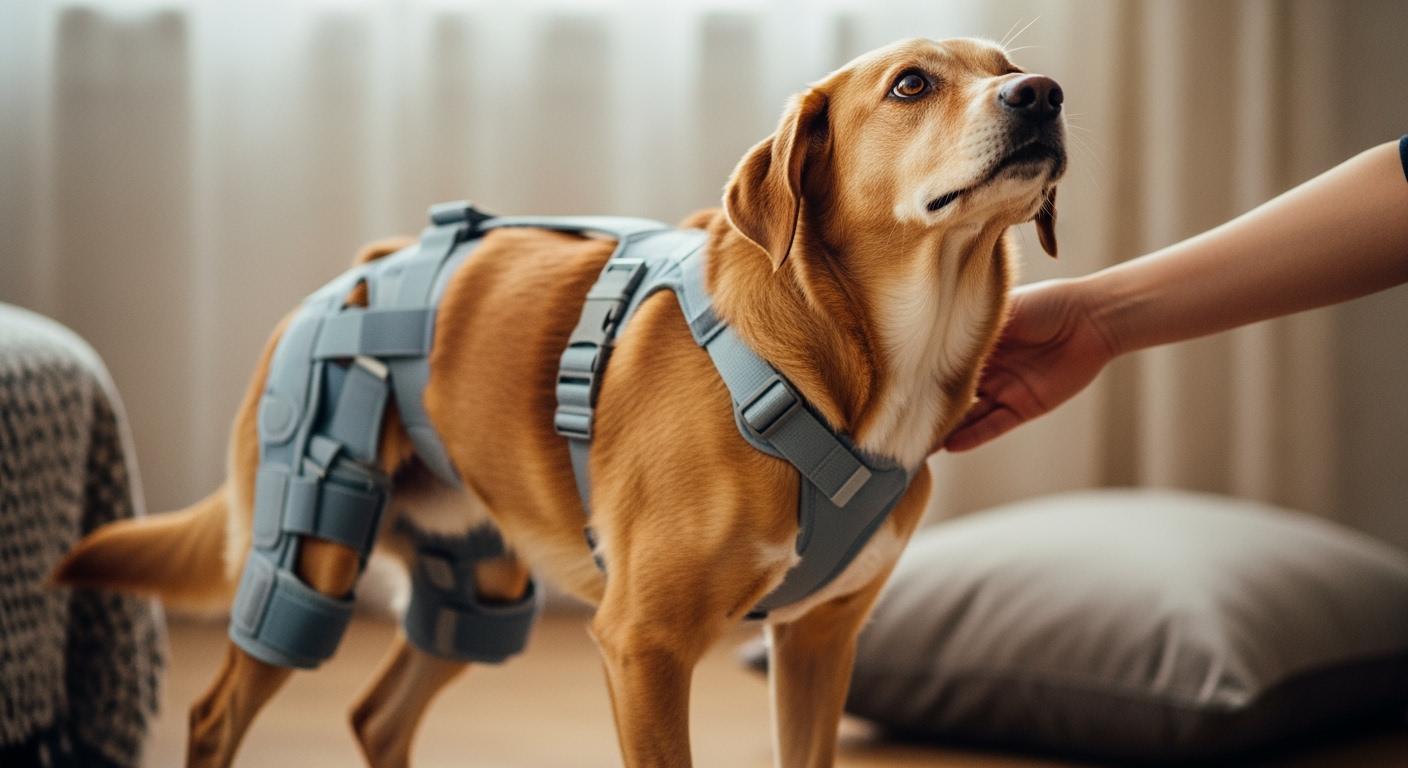
A dog with hip dysplasia struggles to stand. The owner reaches for a compression hip brace. The dog still cannot rise.
That failure is not about the brace being cheap. It is about the wrong support type for the movement problem the dog actually has. A hip wrap that squeezes and warms the joint does nothing for a dog whose hind end lacks the strength to push off the floor. The brace is well-made. It simply provides the wrong kind of help.
This pattern repeats across thousands of daily-use scenarios: a lift harness that slides backward because it has no chest anchor, a compression brace that traps heat and becomes intolerable after twenty minutes, a rear harness that stabilizes the walk but cannot assist a dog onto a car seat. The failure is always at the match — between what the product provides and what the dog’s movement demands.
The Three Ways a Hip Brace Fails in Daily Use
Most owners pick a brace by reading product descriptions. The descriptions list features. The features sound correct. But the failure shows up in the first week of use, not on the product page.
Compression wraps cannot lift
A hip dysplasia brace built around neoprene panels that wrap the upper hind legs does one thing well: compression and warmth around the hip joint. That compression can help a dog that walks with a swaying, unstable rear end — the gentle squeeze provides proprioceptive feedback and reduces joint laxity during stride.
But that same brace is useless when the dog needs to rise from a down position. There is no handle, no lift point, no structural path from the owner’s hand to the dog’s pelvis. The force a standing dog needs to generate through its hip extensors has nothing to do with circumferential compression. Two different mechanical demands, one product that addresses only one of them.
Put a compression wrap on a dog that cannot stand, and the dog stays on the floor.
Chest-anchor absence causes backward slip
A hip harness built without a chest anchor concentrates every lateral force through the hip straps alone. When the dog walks with a side-to-side sway — common in hip dysplasia — the hips shift laterally under the harness. That shift pushes against the inner edge of the strap. The strap edge, narrow and unsupported against rotation, rolls outward. Once the edge rolls, the entire harness rotates backward along the dog’s flank.
The sequence is predictable: lateral sway loads the strap edge → edge rolls → harness rotates → support position is lost → skin friction begins at the new contact line. Within a few hundred yards of walking, the brace has migrated far enough that the hip panels no longer sit over the joints they were designed to cover.
The mechanical countermeasure is a chest anchor that distributes side loads across a second fixed point, preventing any single strap edge from taking the full rotational force. A harness with a properly positioned chest piece spreads lateral displacement across two anchors instead of concentrating it on one. The hip panels stay put because the forces that would rotate them have nowhere to collect.
To check this at home: mark the position of the harness edge against the dog’s fur with a piece of tape before a ten-minute walk. If the harness edge has shifted more than half an inch from the tape mark afterward, the chest anchoring is either absent or insufficient for that dog’s gait pattern.
Lift harnesses provide zero joint compression
A rear lift harness solves the rising problem. The handle lets the owner assist vertical movement — standing from a bed, climbing a stair, entering a vehicle. But a lift harness designed purely for vertical assistance applies no circumferential pressure to the hip joint. During a walk, the harness holds the rear end up but does nothing to control the side-to-side sway that makes the gait unstable.
A dog that needs both lift assistance and walking stability is caught between two product categories. Using only a lift harness means accepting gait instability during walks. Using only a compression brace means accepting no help with rising. The design scope of each product defines which problem it can solve — and which it leaves untouched.
| Dog’s main movement problem | Design that matches | What fails with the wrong design |
|---|---|---|
| Cannot rise from lying down | Hip brace or harness with integrated lift handle | Compression-only wrap: dog stays on the floor |
| Rear end sways side-to-side during walks | Hip support harness with chest anchor and wide hip panels | Narrow-strap harness without chest anchor: slips backward, rotates |
| Short, controlled walks; mild instability | Compression hip brace with adjustable wrap panels | Lift harness: no joint compression, gait instability persists |
| Stairs and car entry are the main challenge | Rear lift harness with sturdy handle | Compression brace: no lift path, dog still cannot climb |
| Groin or inner-thigh rubbing after wear | Wide hip panels with soft edge binding and breathable liner | Narrow straps: pressure concentrates along strap line, skin reddens |
Chest Anchoring, Strap Width, and the Mechanics of Staying Put
A hip brace that migrates during use loses support in proportion to how far it moves. Half an inch of slip reduces joint coverage enough that the compression force no longer sits over the structures it was intended to stabilize.
The variables that control migration are not random. They are design decisions made during product development: strap width, edge finishing, anchor count, and material stiffness under sweat and friction.
Why narrow straps roll under side load
A strap that is less than one inch wide has a small contact patch against the dog’s coat. When the dog sways laterally, the force vector hits that narrow contact line at an angle. With no width to create an anti-rotation moment, the strap edge becomes the pivot. The edge digs in, the outer face lifts, and the strap rolls. Once it rolls, it slides.
Wide straps — two inches or more across the flank — resist this roll because the contact patch is broad enough to generate opposing friction across its width. The side load distributes across the strap face instead of concentrating at one edge. No edge concentration, no roll. No roll, no slide.
This is why strap width is not a comfort feature — it is a mechanical anti-migration feature. Comfort is the downstream result of the strap not moving.
Material choice under moisture and friction
Neoprene provides compression and warmth. But neoprene also traps moisture. A neoprene panel worn against the skin for thirty minutes on a warm day creates a microclimate of heat and humidity under the brace. That moisture softens the stratum corneum of the dog’s skin, reducing its tolerance to friction. A strap that was not rubbing at minute five may begin to irritate at minute twenty-five — not because the strap changed, but because the skin underneath became more vulnerable.
The design response is a breathable liner material that wicks moisture away from the skin surface while the neoprene outer layer still provides compression. This is a manufacturing tradeoff: a fully sealed neoprene panel maximizes compression consistency but guarantees moisture buildup; a lined panel trades a small amount of compression uniformity for skin tolerance over longer wear durations.
Observable check: after a twenty-minute wear session, lift the brace liner and place the back of your hand against the dog’s skin. If the skin feels damp or warm compared to an uncovered area on the flank, moisture is accumulating faster than the liner can manage. That dog needs either shorter wear sessions or a brace with higher breathability in the liner material.
Chest anchoring as a force-distribution system
A hip brace with a connected chest component converts a single-anchor system into a dual-anchor system. The hip panels handle vertical and circumferential forces. The chest anchor handles anterior-posterior displacement — the backward slide that happens when the dog moves from a walk to a trot or climbs an incline.
The two anchors work against each other mechanically: the chest piece pulls forward, the hip panels pull rearward, and the harness body between them stays in tension. That tension is what keeps the hip panels positioned over the joints. Remove the chest anchor, and the tension disappears — the hip panels are now free to migrate rearward with each stride.
For dogs with deep chests or pronounced tuck-up, the chest anchor must sit low enough on the sternum to avoid riding up into the throat when the dog lowers its head. A chest piece that rides up changes the tension vector from horizontal to diagonal — and a diagonal pull on the hip panels lifts them upward rather than holding them in place. That is a fit geometry problem, not a material problem. And it is not visible on a standing dog. It only appears when the dog drops its head to sniff the ground during a walk.
When Hip Support Alone Cannot Solve the Problem
Hip braces and support harnesses work within a specific performance envelope. The dog must be able to bear some weight on the hind legs. The dog must be able to stand, even if unsteadily. The dog must tolerate wearing a garment that wraps the hips and, in some designs, the chest.
Outside that envelope, a brace is the wrong tool.
If the dog cannot place any weight on a hind leg — the leg buckles immediately on contact — the problem is beyond what external compression and support can address. The brace may mask a neurological deficit or a fracture by preventing the leg from buckling visibly while doing nothing for the underlying structural failure. If the dog collapses suddenly during a walk, a brace does not solve the collapse. It adds a layer of fabric between the dog and the ground.
Rapid changes in movement — a dog that walked normally yesterday and drags a leg today — are a signal to stop and evaluate, not a signal to tighten the brace straps. The brace cannot correct a problem it was not designed to address, and using it in those conditions delays the evaluation the dog actually needs.
Disclaimer: The fit checks described in this article assume a short-coated dog where strap position and skin condition are visible by eye. Double-coated breeds may show subtler rub marks that require hand-checking — parting the coat and running fingertips along the skin under each strap line — rather than visual inspection alone. If the dog’s hind leg conformation falls outside the breed norms this brace type was patterned for, particularly dogs with angular limb deformities or very deep chests with extreme tuck-up, the chest-anchor positioning checks described here may not catch every pressure point.
| Condition | Why a brace is not the right tool | What to observe instead |
|---|---|---|
| Non-weight-bearing on hind legs | Brace compression cannot restore absent weight-bearing | Check if any leg can take weight for more than one second |
| Sudden collapse or dragging a leg | Rapid change suggests acute injury, not chronic instability | Note the time of onset and which leg is affected |
| Skin breaks, swelling, or heat under the brace area | Closed compression over damaged skin worsens tissue stress | Inspect skin fully before every wear session |
| Dog panics or freezes when the brace is applied | Behavioral intolerance prevents any functional benefit | Observe the dog’s body language during fitting, not just after |
Design Details That Decide Daily Tolerance
A brace can be mechanically perfect on paper. Correct panel width. Proper chest anchor. Adequate strap distribution. And the dog still will not tolerate it beyond ten minutes. Daily tolerance is not a footnote to design — it is the gate that determines whether any of the mechanical features ever get used.
Removability and skin-check access
A hip brace that takes two minutes to remove will be checked less often than one that comes off in fifteen seconds. Fast-release buckles positioned on the lateral panels, rather than buried under the dog’s belly, make the difference between a skin check that happens after every walk and one that gets postponed. Postponed checks miss early-stage rub marks — the faint pink line that, if left under compression for another hour, becomes an open sore.
Velcro closures are fast but collect hair and debris over time. A Velcro strap that no longer holds because its hook side is packed with shed coat is a strap that will open mid-walk. Buckles avoid this failure mode but add weight and bulk. The tradeoff is real: speed of removal versus long-term closure reliability in a shedding environment.
When bathroom posture and brace geometry collide
A hip brace that wraps too far down the hind legs interferes with the dog’s bathroom posture. The dog crouches, the wrap edge pulls against the thigh, and the dog either cannot complete the posture or urinates on the brace material. This is not a fit defect visible on a standing dog. It only becomes apparent during the crouch — and by then the brace is already on and in use.
The design check is simple: with the brace fitted, observe the dog during a bathroom break. If the dog alters its usual crouch depth or position, the rear edge of the brace is interfering with hip flexion range. A brace that clears the ischial tuberosity by at least an inch in the standing position typically provides enough clearance for a normal crouch.
For dogs navigating both hip dysplasia support and rear-leg weakness, the product decision becomes more nuanced. A dog that has hip laxity and diminishing hind-limb strength may benefit from a combined hip-and-leg support system rather than a hip-only brace. The distinction matters because hip-only designs assume the stifle and hock joints are stable — an assumption that does not always hold in dysplastic dogs where abnormal gait has secondarily stressed the lower joints.
Breed shape also shifts the equation. A dog with a deep chest and narrow waist — typical of sighthounds and some large working breeds — presents a different anchoring geometry than a broad, barrel-chested dog. The same brace that holds steady on a Labrador may rotate on a Greyhound because the taper from ribcage to waist creates a natural slide path that the chest anchor cannot fully counter. In these cases, a full-body harness design with both chest and rear anchor points may hold position more reliably than a hip-only brace.
FAQ
How quickly can a hip brace migrate out of position during a walk?
Migration speed depends on strap width and whether a chest anchor is present. A narrow-strap harness without a chest anchor can shift more than an inch within the first two hundred yards of a walk if the dog has a pronounced lateral sway. Wide straps with a connected chest piece typically hold position through a thirty-minute walk on level ground.
Does neoprene cause skin problems under a hip brace?
Neoprene itself does not cause skin problems. Moisture trapped under unlined neoprene does. The combination of compression, warmth, and trapped humidity softens the skin surface and reduces its friction tolerance. A breathable liner between the neoprene and the skin mitigates this by wicking moisture away from the skin surface.
What is the first sign that a brace is the wrong type for the dog’s movement problem?
The dog’s movement does not change — or it gets worse. If a compression brace is applied to a dog that cannot rise, the dog stays on the floor. If a lift harness is used on a dog that sways during walks, the sway persists. The brace type is wrong when the specific movement problem that prompted the purchase remains unchanged after a week of consistent use with proper fit.
