
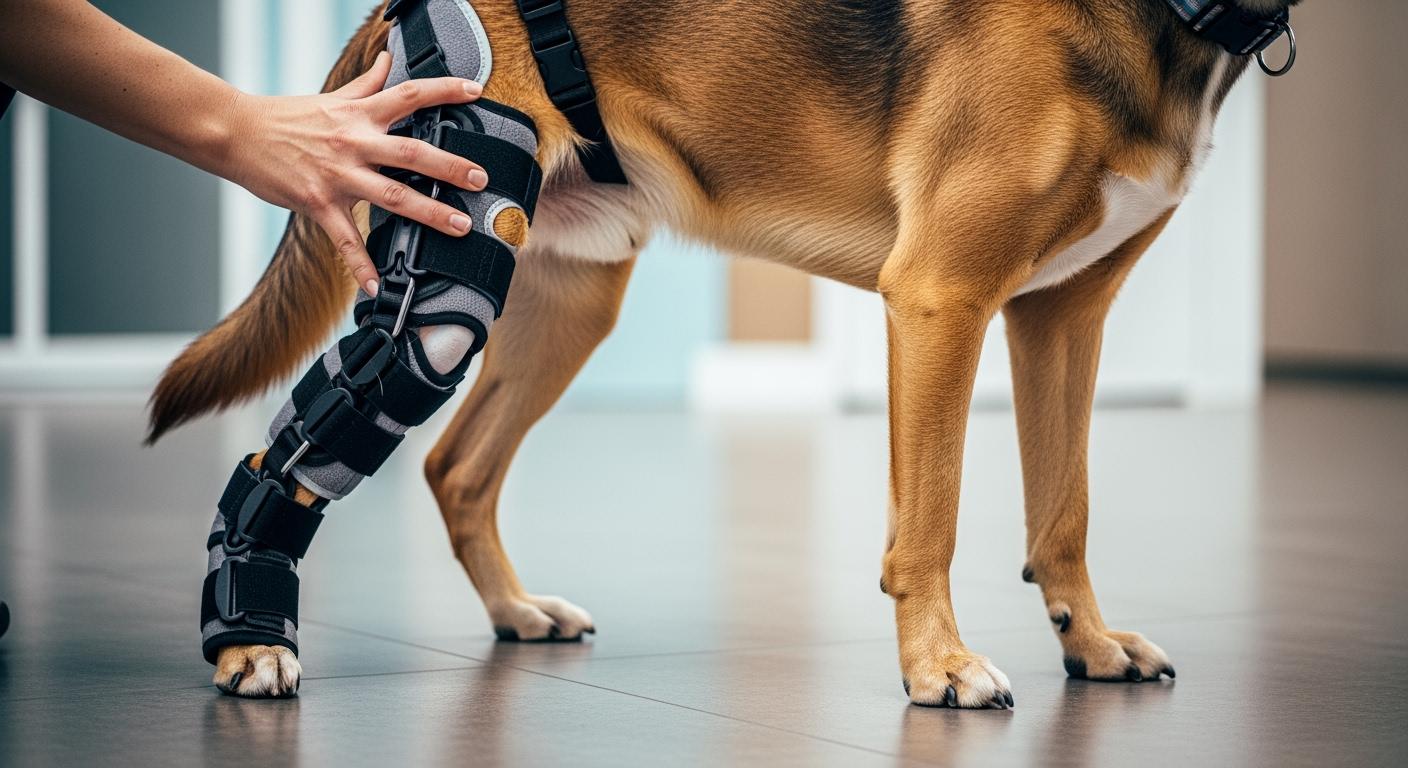
A dog walks steadily for the first ten minutes in a knee brace, then suddenly shifts to bunny-hopping on three legs. The brace looked right at rest. It failed in motion. A dog acl brace changes gait suddenly not because the owner missed a strap, but because something in the structure stopped working the moment the dog’s stride loaded it differently. This is a failure signal, not an adjustment phase.
Why a Knee Brace Fails in Motion When It Looks Correct at Rest
The most deceptive failure pattern in canine knee bracing is the static-fit illusion. A brace sits centered over the stifle joint, straps appear snug, the dog stands without visible discomfort. The owner assumes the job is done. Then the dog takes twenty strides, and the gait collapses.
What changes is the load vector. At rest, forces on the brace are minimal and vertical. In motion, every stride introduces a forward-and-down shear component as the femur drives over the tibia. If the brace’s anchor points cannot resist this shear, the entire structure migrates. The brace slides distally toward the paw, or rotates medially so the hinge drifts off the joint axis. That is the threshold where a functional device becomes an off-axis lever.
Once the hinge no longer tracks the knee’s true center of rotation, two failures happen simultaneously. The brace applies force where none is needed — behind the joint, across the tibial crest, into the soft tissue above the gastrocnemius. And it stops providing force where it is needed — against the anterior tibial translation that defines the unstable CCL-deficient stifle. The dog is now fighting both the underlying instability and an external device pushing at the wrong angle.
This is why the gait change is often sudden rather than gradual. The brace holds position through a narrow range of motion, then hits a stride angle where shear force exceeds the static friction of the strap-skin interface. At that threshold, the brace shifts. The dog compensates instantly — bunny-hopping to unload the leg, shortening stride to avoid terminal knee extension where misalignment bites hardest, or dragging the paw when distal strap pressure compromises proprioception.
Slipping, Rotation, and Joint-Line Drift
Two distinct failure motions dominate. Slipping is distal migration — the brace walks down the leg with each stride. This happens when the upper anchor, typically a thigh strap or cuff, cannot maintain purchase against the conical shape of the canine thigh. The taper works against retention: as the brace moves down, leg circumference narrows, and strap tension drops further. A single loose stride can cascade into complete loss of position.
Rotation is the more subtle failure. The brace stays at roughly the right height but twists around the limb, pulling the hinge off the sagittal plane. This is an anti-rotation design problem — narrow straps create a single line of contact, which offers almost no resistance to torsional forces. A brace with a wider contact patch or a multi-point anchor system resists rotation because the force must overcome a larger moment arm. Single-strap designs fail this test predictably.
You can observe both failures directly. After a ten-minute walk on flat ground, check whether the brace sits at the same height on the leg as when you started. A shift of more than half an inch means the anchor system is not holding. Run a finger along the brace’s hinge axis and compare it to the knee’s palpable joint space. If they do not match, the brace is no longer supporting the joint it was positioned for.
Hinge Misalignment as a Pressure-Point Generator
When the hinge drifts off the knee’s center of rotation, it does not simply stop helping. It starts hurting. The brace becomes a rigid lever arm with a fulcrum that no longer matches the biological joint. Each step forces the femur and tibia to push against the brace at angles the brace was never designed to accommodate. The result is concentrated pressure, typically at two points: behind the knee where the hinge assembly presses into soft tissue during flexion, and across the tibial crest where a displaced lower strap digs into bone with minimal soft-tissue cushioning.
This is the structural causality worth understanding. A polycentric hinge — one with multiple pivot points — tracks the knee’s shifting center of rotation through the full range of motion more accurately than a single-pivot hinge. Single-pivot designs force the joint to follow the brace’s arc, rather than the brace following the joint’s arc. In a living animal with variable stride patterns, that mismatch accumulates with every step.
In practice: After any session where the dog’s gait changed, do not simply re-tighten and continue. Remove the brace and check the skin over the tibial crest and behind the stifle. Red marks that follow a linear pattern suggest strap edge pressure. A circular or crescent-shaped mark directly over the joint line suggests hinge misalignment. The shape tells you which part of the brace failed first.
Support Level Mismatch: When the Brace Is Too Soft or Too Rigid
A second failure pattern is less visible but equally destructive. The brace stays in position, the straps hold, the hinge aligns — and the dog still limps. The problem is not fit but force. The brace is providing the wrong kind of support for the instability it is supposed to manage.
Too Soft: The Brace That Becomes Decoration
A soft sleeve-style brace with fabric side panels and no rigid frame can feel comfortable at rest. The dog tolerates it easily, which owners often read as success. But during weight-bearing, the anterior tibial translation that defines a CCL-deficient stifle generates forces a fabric panel cannot oppose. The brace deforms. The knee translates forward. The dog senses the instability and compensates — usually by bunny-hopping to keep the leg unloaded or by shortening stride so dramatically that the knee never reaches the range where translation occurs.
This is the fundamental tradeoff in knee brace design. Comfort drives compliance, but a brace that prioritizes comfort over structural resistance may offer no meaningful joint control. The dog wears it, the owner feels proactive, but the stifle continues to subluxate with every step. Gait deterioration under these conditions is often slow — taking days or weeks — because the failure is cumulative rather than acute.
You can identify this failure by watching the dog from the side during a slow walk on level ground. If the knee appears to buckle forward slightly at midstance — a subtle forward slide of the tibia under the femur — the brace’s anterior restraint is insufficient. The dog may not limp dramatically. But a shortened stance phase on the affected leg, compared to the sound leg, is a quantifiable sign the brace is not controlling instability.
Too Rigid: The Brace That Fights the Stride
The opposite failure happens when a brace overcorrects. A fully rigid frame with no flexion accommodation forces the dog to swing the leg from the hip rather than bending the knee. The stride becomes stiff, short, and mechanical. The dog may refuse to sit, avoid stairs, or freeze mid-walk when the brace’s resistance peaks at a particular joint angle.
The biomechanical problem is straightforward. A canine stifle does not rotate around a single fixed point — the center of rotation shifts slightly through the range of motion due to the femoral condyles’ geometry. A brace with a single-locking hinge or an overly stiff side panel forces the joint through one predetermined arc. When the dog’s natural motion deviates from that arc, the brace pushes back. The dog’s response is predictable: reduce the range of motion to avoid the conflict zone.
This is why a stifle brace’s hinge design matters more than its overall stiffness rating. A polycentric hinge that tracks the knee’s shifting center of rotation allows the dog to load the leg through a more natural range. A single-pivot hinge or a completely rigid side panel restricts it. The sweet spot is a brace that provides anterior-posterior restraint — stopping the damaging forward slide of the tibia — while allowing the knee to flex and extend through the dog’s natural arc.
| Performance difference | Why it matters for gait | Main limitation |
|---|---|---|
| Soft sleeve vs. hinged brace | Soft sleeves deform under shear during stance phase; the tibia translates forward and the dog compensates with a shortened stride or bunny-hopping | Soft sleeves cannot provide anterior tibial restraint — they function as compression garments, not joint stabilizers |
| Single-pivot vs. polycentric hinge | A single-pivot hinge forces the stifle through one fixed arc; if the dog’s natural center of rotation deviates, the brace generates resistance at end-range flexion or extension | Single-pivot hinges are simpler to manufacture but biomechanically less accurate across the full gait cycle |
| Narrow straps vs. wide multi-point anchors | Narrow straps concentrate retention force along a thin contact line; they roll under lateral load, shifting the brace and creating edge-pressure marks | Wider straps add bulk and heat retention — the tradeoff is thermal comfort versus rotational stability |
| Neoprene lining vs. breathable perforated padding | Neoprene retains heat and moisture; after 20+ minutes of walking, skin maceration under the brace increases friction and irritation risk | Breathable pads dry faster but may provide less impact cushioning — material choice depends on wear duration and climate |
When a Knee Brace Is — and Is Not — the Right Support
Where a Stifle Brace Can Help
A well-structured knee brace tends to provide the most meaningful support in two scenarios. First, partial CCL tears where some ligament integrity remains — the brace acts as a secondary restraint, reducing load on the damaged fibers during controlled walking. Second, as a post-operative adjunct after surgical stabilization has restored the primary restraint, where the brace limits excessive range-of-motion loading during early rehab before periarticular fibrosis matures.
The brace is also used for conservative management in dogs where surgery is not an option — typically due to advanced age, anesthetic risk, or comorbidities. In these cases, the brace’s role is to reduce the frequency and severity of instability events during supervised, controlled activity. It does not heal the ligament. It changes the mechanical environment so the dog can maintain some function while the body’s compensatory fibrosis develops over months.
Where a Brace Predictably Fails
There are conditions where a knee brace cannot provide meaningful support regardless of fit quality or construction. A complete CCL rupture with significant rotational instability — where the tibia not only translates forward but also rotates internally under load — exceeds the capability of most external braces. The forces involved in controlling combined translational and rotational laxity are difficult to transmit through soft tissue without causing pressure injury.
A key red-flag signal: if the dog’s gait worsens over three to five consecutive sessions despite consistent brace use and fit checks, the underlying instability may be beyond what external bracing can address. This is not a failure of the brace. It is a failure of the match between the device and the condition.
Dogs with angular limb deformities, very short-coated breeds where strap grip is inherently limited, and dogs with skin conditions that cannot tolerate prolonged brace contact also fall into challenging categories. The brace’s performance depends on transmitting force through skin and soft tissue — if that interface is compromised, the brace cannot function as designed.
Disclaimer: The fit and gait checks described here assume a dog with typical leg conformation for its breed. Dogs with angular limb deformities, very deep chests that alter hindlimb loading angles, or double coats thick enough to mask rub marks may not show the visual warning signs described. In these dogs, hand-checking the skin under the brace — rather than relying on visible red marks — is the more reliable method for detecting pressure. If the dog’s leg conformation falls outside typical breed norms, standard fit observations may miss pressure points, and a shorter supervised wear period with more frequent skin checks is warranted.
FAQ
Why does my dog walk normally at first, then suddenly start bunny-hopping in the brace?
This pattern — normal gait followed by sudden collapse into bunny-hopping — typically points to brace migration rather than a steady decline. The brace holds position through the first portion of the walk while strap tension and static friction hold. Then a specific stride — a slight turn, a change in speed, a step onto uneven ground — produces a shear force that exceeds the anchor’s grip. The brace shifts off the joint, and the dog instantly switches to a three-leg hop to unload the now-unsupported limb. After removal, check brace position relative to the knee joint: if it has drifted more than half an inch from the starting height, the anchor system needs reassessment.
How can I tell if the brace is causing pressure damage versus just fitting snugly?
Remove the brace after a supervised session and check three things in order. First, skin color: red marks that fade within 5 to 10 minutes of removal are typically normal compression; marks persisting past 15 minutes or appearing purple or dark indicate excessive pressure. Second, mark pattern: a uniform band around the leg is strap compression; a single focal point over the joint line or tibial crest suggests hinge misalignment. Third, temperature: compare paw pad temperature of the braced leg to the unbraced leg. A noticeably cooler paw on the braced side can indicate restricted circulation from distal strap tension.
When should I stop using the brace and call a veterinarian?
Stop immediately if the dog refuses to bear weight on the braced leg, if you find cold toes or a visibly swollen joint, if pressure marks persist beyond 20 minutes after brace removal, or if the dog vocalizes when the brace is applied or removed. These are not fit-adjustment issues — they are red-flag signals that may indicate deep tissue pressure injury, vascular compromise, or acute worsening of the underlying stifle pathology. A sudden gait change that repeats across sessions, even after fit corrections, is a pattern that warrants veterinary assessment rather than continued brace use.
| Signal level | What you see during or after wear | Action |
|---|---|---|
| Green | Brace stays centered, gait is stable, skin shows no marks or marks that fade within 5 minutes, dog tolerates full session | Continue supervised use, check position and skin after every session |
| Yellow | Mild brace slippage under half an inch, temporary red marks fading within 10 minutes, cautious stepping resolving after warm-up, slight hesitation during the first minute | Adjust strap tension, shorten session duration, monitor for pattern — if same issue repeats across three sessions, reassess sizing |
| Red | Sudden severe limp or non-weight-bearing, cold toes, joint swelling, heat, open sores, marks lasting over 20 minutes, repeated refusal to move, worsening gait over consecutive sessions | Stop brace use immediately, document observations, contact veterinarian |
