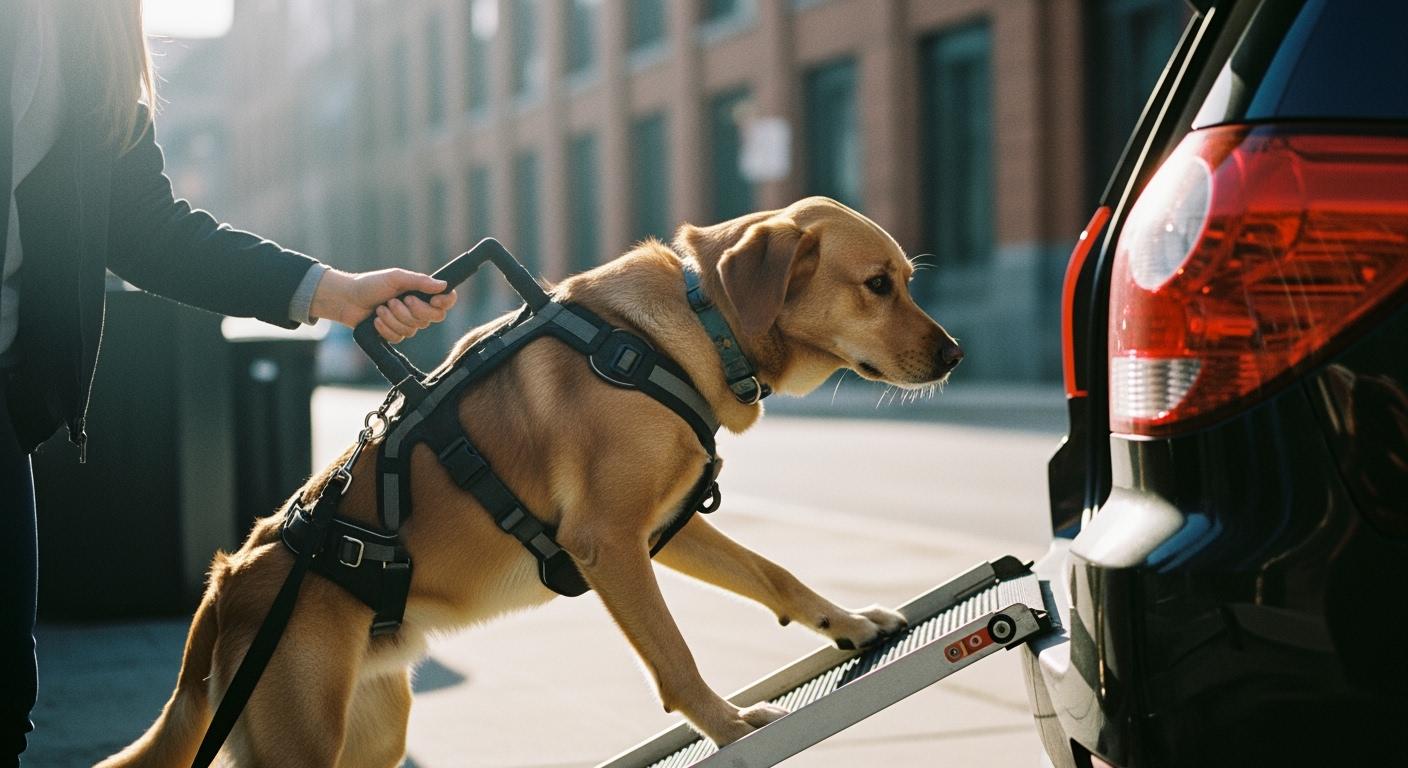
A dog that walks onto a flat surface without hesitation can freeze the moment the ramp tilts upward. The harness that worked perfectly on level ground suddenly rides into the throat. The chest panel slides forward. The rear legs stop pushing. The handler pulls harder. The dog braces. Nothing moves.
This is not stubbornness. It is a pull-vector problem that most front lift harness designs do not account for.
The difference between a harness that holds the line on an incline and one that collapses under the angle comes down to a handful of structural details—chest panel geometry, handle anchor placement, strap adjustability, and surface grip. When any one of them is off, the dog feels it immediately. And a dog that does not feel secure on a ramp will not climb it, no matter how much lifting force the handler applies.
Where Front Lift Support Fails on an Incline
A ramp changes the direction of force. On flat ground, lifting from a front handle pulls roughly along the dog’s body axis—the chest panel stays seated, the shoulders guide forward, the rear legs follow. On an incline, the handler’s pull tilts relative to the dog. The force vector no longer runs parallel to the spine. It angles upward and backward.
Here is the chain reaction that follows.
The handle pulls up and back. Because the chest panel is the only anchor point resisting that pull, the upward component drives the panel’s leading edge into the soft tissue below the throat. The backward component drags the entire harness toward the handler. The chest panel migrates forward. As it does, the pressure shifts from a distributed load across the sternum to a concentrated line along the front edge of the panel—functionally a narrow strap pressing into one horizontal band of tissue.
At this point the dog’s front end is being lifted while the rear end remains planted. The body axis breaks. The spine tilts. The rear legs, now angled relative to the ramp surface, lose their mechanical advantage. They cannot push. The dog either freezes in place or twists sideways to escape the throat pressure.
That is the moment most handlers mistake for fear or refusal. It is neither. It is the harness failing to manage the force geometry of an inclined pull.
You can see this failure before the dog even moves. Place the harness on the dog on flat ground. Have a second person watch the chest panel’s front edge while you lift the handle as you would on a ramp. If the front edge tips upward and presses into the throat before the dog’s weight begins to shift, the harness will only get worse on an actual incline. That is a pass/fail check that takes under ten seconds.
A separate observable check: after walking the dog up a moderate incline for 30 seconds with the harness on, look at the chest panel position relative to where it started. If the front edge has migrated forward by more than half an inch, the handle anchor point is too far forward for the ramp angle you are using. The harness is not stabilizing—it is drifting under load.
| Ramp-use problem | Likely harness or ramp cause | What the dog may do | Better support choice |
|---|---|---|---|
| Chest panel rides forward | Handle anchored too far forward, steep ramp amplifying pull angle | Coughs, pulls back, freezes | Wider padded chest panel, handle placed over mid-sternum |
| Dog slips halfway up | Narrow ramp surface, harness lining has no grip | Stumbles, claws for traction, loses balance | Anti-slip inner lining on harness, wider ramp |
| Dog twists sideways | Harness drifts under load, strap loosening on one side | Turns body, hesitates, steps off ramp edge | Multi-point adjustable straps, stable edge binding |
| Handler has to pull hard | Ramp too steep, dog’s rear legs cannot generate push | Resists forward motion, pants heavily | Longer ramp to reduce angle, add rear support |
| Front legs buckle | Chest-only support creates pivot, weak dog cannot compensate | Collapses forward, may yelp | Full-body harness distributing load to hips as well |
| Rear legs drag or stall | Only front end lifted, rear legs left without push platform | Dragging hind end, cannot complete the climb | Front-and-rear assist harness or second handler |
| Dog refuses the ramp entirely | Pain association, poor prior fit experience, steep angle | Freezes at base, backs away | Stop immediately, check fit, consult veterinarian if pain is suspected |
Not every failure mode applies to every dog. A dog with strong rear drive may compensate for moderate chest panel migration. A dog with even mild hind-end weakness will not. The ramp angle is the multiplier—a harness design flaw that is barely noticeable on a gentle 18-degree incline becomes unworkable at 25 degrees. The same harness, the same dog, the same handler. The angle changes everything.
| Harness type | Best fit for | Ramp-use limitation | When to avoid |
|---|---|---|---|
| Front lift harness | Dogs with adequate rear leg strength, moderate inclines | Pull angle shifts on steep ramps, chest panel may ride into throat | Rear weakness, steep ramps over 25 degrees |
| Rear lift harness | Dogs with strong front legs, hind-end assistance needed | No chest stabilization, difficult to steer on narrow ramps | Front-end weakness, anxious dogs needing forward guidance |
| Full-body lift harness | Dogs needing balanced support at both front and rear | Requires more fitting points, needs practice sessions | Very small dogs, extremely short ramps where full-body coverage impedes paw placement |
| Simple sling | Quick, temporary lift for a few steps | Slides easily under sustained pull, minimal directional control | Steep ramps, dogs needing more than momentary assistance |
In practice: A harness that passes a flat-ground fit check can still fail on an incline. Run the handle-lift test described above on the actual ramp angle you intend to use. What holds on level ground does not always hold at 20 degrees.
Design Details That Separate a Harness That Holds the Line From One That Does Not
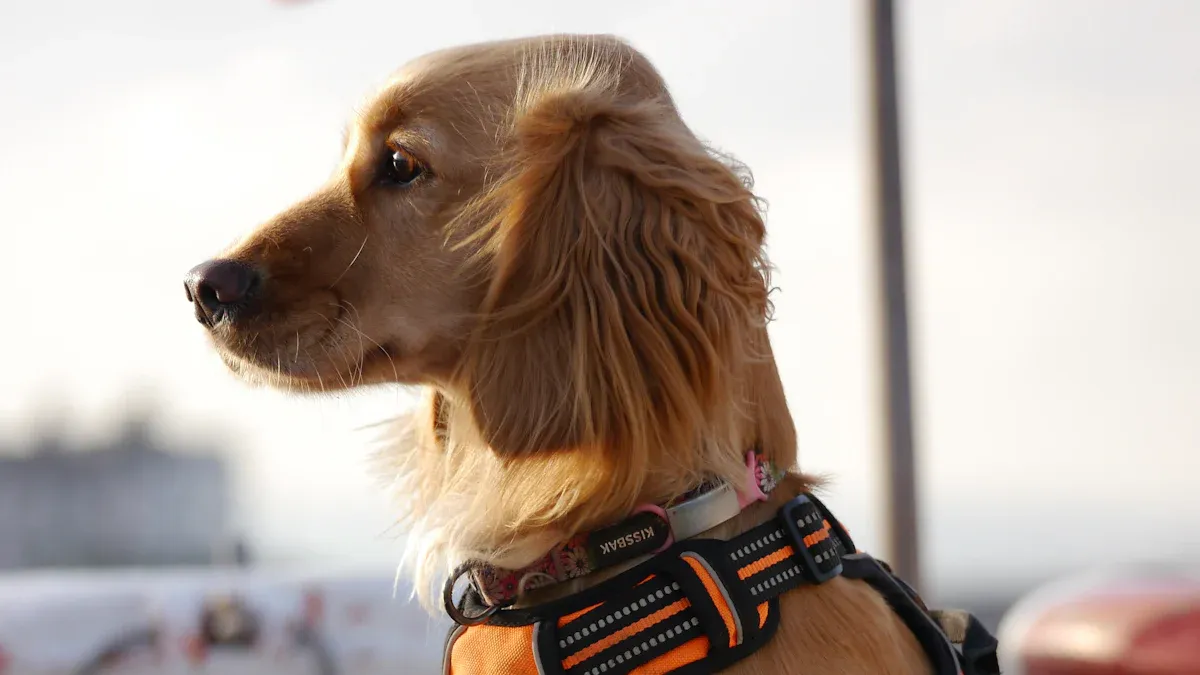
Not all front lift harnesses fail on ramps. The ones that work share a set of design decisions that directly counter the force-geometry problems described above. The differences are structural, not cosmetic.
Chest Panel Width and Load Distribution
A narrow chest strap concentrates the handler’s lift force into a line roughly the width of the strap itself—often an inch or less. On an incline, that concentrated force digs into one band of tissue. A wide padded chest panel, by contrast, distributes the same lift force across several square inches of surface area. The pressure per square inch drops. The panel stays seated. The dog does not feel a biting edge.
Padding thickness matters less than surface area. A thick but narrow strap still concentrates force. A thinner but broader panel spreads it. For dogs with thin coats or sensitive skin, the distribution difference is the difference between climbing the ramp and bracing against it.
The link between chest panel geometry and ramp performance also surfaces when handle placement is evaluated alongside chest coverage. A handle anchored too far forward will tip even a wide panel, because the lift point sits ahead of the panel’s center of pressure. The panel cannot do its job if the anchor point is working against it.
Handle Anchor Position and Pull-Vector Management
Where the handle attaches to the harness body determines the direction of force transmission. A handle anchored over the mid-sternum pulls roughly along the dog’s center of mass. A handle anchored forward of the shoulder pulls upward and backward relative to that center—exactly the vector that drives the chest panel into the throat on an incline.
Reinforced stitching at the handle anchor point keeps the attachment stable under repeated ramp loads. When the stitching stretches or the fabric around the anchor deforms, the effective handle position drifts forward over time. A harness that worked for the first month of ramp use may start failing after the anchor point loosens. This is a progressive failure mode—it does not announce itself until the dog starts hesitating again.
For handlers evaluating lift harness options, the handle anchor position relative to the chest panel is the single most consequential design variable. It determines whether the harness guides or chokes.
Strap Adjustability and Migration Resistance
A harness drifts under load when the straps cannot maintain tension evenly around the dog’s body. Two adjustment points—one shoulder, one girth—leave gaps. As the dog moves up the ramp, the body shifts, the straps loosen on one side, and the harness rotates. Multi-point adjustability at the shoulder, girth, and chest panel positions lets each contact zone hold its tension independently.
This is not about a tighter fit. It is about an even fit that stays even under dynamic load.
Edge binding—the reinforced seam along the perimeter of the chest panel and body straps—prevents the fabric from rolling or folding when the dog twists. A harness without stable edge binding can bunch into a cord under lateral force, functionally converting a wide panel back into a narrow strap. The failure is invisible until the dog moves on an angle.
Anti-Slip Lining and Surface Grip
An anti-slip inner lining keeps the harness body from sliding across the dog’s coat during ramp use. Without it, every step the dog takes can shift the harness a fraction of an inch. Over a full ramp climb, those fractions add up to a harness that sits inches away from where it started.
The observable check: mark the chest panel position against the dog’s coat with a piece of tape or a mental reference point before a ramp session. After one full climb, check whether the panel has shifted. More than half an inch of migration means the lining is not providing enough grip for the ramp angle and coat type in play.
Dogs with short, slick coats present a different grip challenge than dogs with dense undercoats. A lining material that grips well on a Labrador may slide on a Greyhound. The material-to-coat interface is specific—there is no universal anti-slip solution that works equally across all coat types. Harness fit and lining material selection are inseparable from the dog’s actual coat and body shape.
| Design feature | What it prevents | Fail signal | Pass signal |
|---|---|---|---|
| Wide padded chest panel | Pressure concentration, tissue digging | Red marks or indentations on chest after 5 min of wear | Smooth, even contact with no single pressure line |
| Mid-sternum handle anchor | Throat pressure, forward chest panel migration | Panel front edge tips into throat on handle lift | Panel stays flat, dog’s weight shifts without gagging |
| Multi-point strap adjustment | Uneven tension, harness rotation under load | One side loosens more than the other after a ramp climb | All straps hold equal tension before and after ramp use |
| Stable edge binding | Fabric rolling, panel bunching into cord under lateral force | Panel edges curl or fold when dog twists | Panel lays flat against body throughout range of motion |
| Anti-slip inner lining | Whole-harness migration across the coat | Chest panel shifts more than 0.5 inch after one ramp climb | Panel holds starting position through full climb |
Each of these features is independently verifiable. No one of them guarantees ramp performance on its own. A harness can have a wide chest panel and still fail if the handle anchor is too far forward. It can have anti-slip lining and still migrate if the straps cannot hold even tension. The features work as a system—any single weak point becomes the failure point under load.
When Front-Only Support Cannot Carry the Rear
A front lift harness assumes the dog can drive from the rear. If that assumption breaks, the harness cannot compensate. The front end lifts. The rear end stays. The dog’s body forms a pivot around the chest panel, and the spine bends at the point where supported meets unsupported. That is not a fit problem. It is a support-type mismatch.
Dogs with hind-leg weakness—whether from age, post-surgical deconditioning, or chronic joint deterioration—often cannot generate enough rear push to follow a front-only lift. The handler pulls harder to compensate. The chest panel rides higher. The rear legs dangle or drag. The dog’s stress response escalates. This cycle is predictable and, once recognized, avoidable.
A rear-assist or full-body harness changes the support equation by distributing lift across both the chest and the hips. The handler’s force is no longer concentrated at one end of the spine. The dog’s body stays more level. The rear legs maintain enough ground contact to push rather than being pulled off the ramp surface entirely.
The tradeoff is complexity. Full-body harnesses have more contact points, more straps to adjust, and more surface area that can trap heat. They require more practice sessions before the dog moves comfortably. For a dog that only needs mild front guidance on a gentle ramp, a full-body harness adds unnecessary bulk and fitting time. But for a dog whose rear legs falter halfway up, the added complexity is what keeps the climb from ending in a collapse.
A second handler positioned at the rear can serve the same function as a rear harness—stabilizing the hind end while the front handler guides—but this requires coordination and space on the ramp that is not always available with narrower ramp widths.
Some handlers turn to lift harness solutions designed specifically for hind-leg weakness when the mismatch between front-only support and rear-drive deficit becomes clear. The recognition point is usually the same: the dog made it up the ramp last week, but this week it stalls or twists. Progressive weakness exposes a harness limitation that was always there—it just was not triggered until the dog’s rear strength dropped below the threshold.
Disclaimer: The support-type assessments described here assume a dog with roughly symmetrical limb strength and a body conformation within typical breed norms. Dogs with angular limb deformities, significantly asymmetrical weakness, or very deep or narrow chests may not show the standard failure signals described above—pressure points can develop in locations a visual check will miss, and hand-checking along the full contact perimeter of the harness is necessary after each ramp session. If the dog has a neurological condition affecting proprioception, the observable checks for hesitation and freezing may be confounded by motor-control deficits rather than harness fit. Veterinary guidance on ramp safety is essential for dogs with diagnosed orthopedic or neurological conditions.
| Component | What to check | Frequency | Replace if |
|---|---|---|---|
| Buckles | Click security, release smoothness, no grit in mechanism | Weekly | Cracked, stiff, or will not release cleanly under tension |
| Webbing straps | Fraying at edges, discoloration from UV or moisture, permanent stretch | Weekly | Visible fraying, thinning, or straps that no longer hold their set length |
| Stitching at load points | Thread separation at handle anchor, chest panel attachment, and buckle points | Monthly | Any thread gap or loosening at a load-bearing seam |
| Metal hardware | Rust, corrosion around D-ring welds, sharp edge development | Monthly | Any rust, pitting, or edge roughness detectable by fingertip |
| Padding integrity | Permanent compression, odor retention, surface cracking at skin-contact zones | Monthly | Padding that stays compressed after use or shows surface degradation |
| Overall fit | Gap between harness body and dog when loaded, shoulder-clearance check | Every use | Dog can slip one shoulder through the harness opening under light tension |
Stop the ramp attempt if the dog freezes, pants heavily with no physical exertion, yelps, twists repeatedly, or the harness rides into the throat or armpit despite adjustment. These are not training issues. They are signals that the support configuration does not match what the dog needs on that ramp, at that angle, on that day.
FAQ
Why does the same harness work on flat ground but fail on a ramp?
The incline changes the direction of pull. On flat ground, lift force runs roughly along the dog’s body axis and the chest panel stays seated. On a ramp, the handler’s pull tilts upward relative to the dog, creating a vector that lifts the front edge of the chest panel into the throat. The harness structure did not change—the force geometry did.
How do you tell if the chest panel is migrating during use?
Mark the panel position against a visible reference point on the dog’s coat before the ramp climb. After one full ascent, check whether the panel front edge has moved forward. More than half an inch of migration means the anti-slip lining, strap tension, or handle anchor position is not holding against the ramp angle.
Can a front lift harness work for a senior dog with some rear stiffness?
It depends on whether the dog can still push from the rear. If the rear legs generate enough drive to follow the front lift, a front harness may be adequate on moderate inclines. If the dog stalls or the rear legs begin to drag during the climb, the support type no longer matches the deficit—a full-body or rear-assist configuration is the more appropriate match.
What is the most common design detail that causes a harness to fail on a ramp?
Handle anchor position. When the handle is attached forward of the mid-sternum, any incline turns a guiding lift into an upward-and-backward pull that drives the chest panel into the throat. A wide chest panel and anti-slip lining cannot fix a handle anchored in the wrong place—the force vector starts wrong and every other feature works against it.
How often should harness hardware and stitching be inspected for ramp use?
Buckles and webbing weekly. Stitching at load points and metal hardware monthly. Ramp use applies repeated directional loads that flat-ground walking does not—the handle anchor stitching and buckle mechanisms take more stress per use. A stitch that looks intact on inspection can separate under the specific pull angle of an inclined lift.