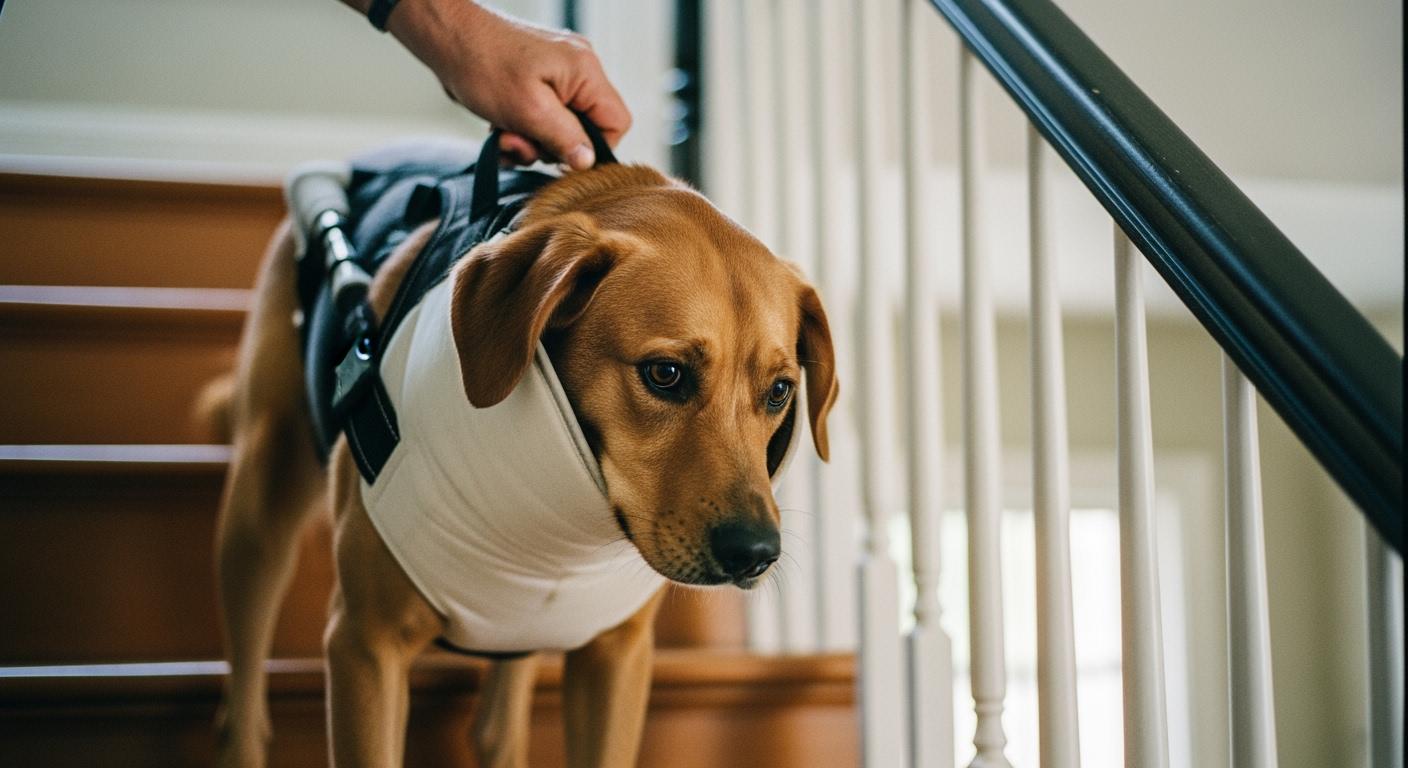
The chest pad looked centered at the top of the stairs. Three steps down, it was pressing against the throat. This is not user error. It is a geometry problem built into the harness.
A short chest pad on a front support harness for stairs down rides up because the sternum coverage is too small to resist forward weight shift. When a dog descends stairs, the center of mass drops forward. The front legs reach down. The chest angles toward the ground. The pad — if it covers only the upper half of the sternum — has no counter-surface to push against. So it translates upward. The handler feels the harness shift. The dog shortens stride or coughs. The flat-ground fit is not the stair fit.
Why a Short Chest Pad Cannot Hold Position During Stair Descent
Picture the force pathway. On flat ground, body weight presses roughly straight down through the sternum into the chest pad. The pad distributes load across its contact area. The straps see vertical tension. Nothing pulls the pad toward the neck.
On stairs, the geometry changes entirely. The dog drops its chest forward. The front legs reach down. The weight vector tilts — it now has a forward component that pulls the chest away from the pad and a downward component the pad must resist. If the pad is short, the downward force concentrates near the upper edge instead of spreading across the full sternum. The upper edge becomes a fulcrum.
Here is the causal chain: forward weight shift during descent → force concentrates at the upper pad edge because no lower sternum contact exists to distribute it → the pad acts like a short lever pivoting at its upper edge → upward translation begins → the pad migrates toward the throat with each step → airway pressure or discomfort forces the dog to hesitate or gag. A longer pad changes the mechanical equation. More surface area below the force line gives the pad structural resistance against upward rotation. The pad stays planted because it has somewhere to push.
You can observe this directly. Place a strip of tape at the bottom edge of the chest pad before stairs. Descend three steps. Check the tape. If it has moved upward relative to the sternum by more than half an inch, the pad length is too short for the dog’s body geometry during dynamic movement. The flat-ground fit gave a false pass — it tested a force condition the harness never sees during actual stair use.
Handle anchor position amplifies the problem. When the handle sits high on the back or too far rearward, lifting or steadying the dog pulls the chest pad upward and backward — toward the throat — instead of pressing the pad into the sternum from below. The lift vector angles across the chest rather than driving the pad into the bone surface it is supposed to brace against. You are not supporting the dog. You are levering the pad into its neck.
A handle anchored low and positioned over the chest center keeps the lift force roughly perpendicular to the sternum. The pad presses in, not up. That is the difference between a support platform and a choke point. Handle placement changes whether the pad stays planted or migrates with every step — low and forward anchors resist migration; high and rearward anchors cause it.
Design Decisions That Separate a Stable Harness from One That Creeps
| Design feature | Weak version | Better version | Why it matters |
|---|---|---|---|
| Chest pad length | Covers upper sternum only | Extends to lower sternum | Longer contact patch resists upward rotation during forward weight shift |
| Sternum coverage | Pad sits high, upper edge near throat | Pad sits below throat, full sternum contact | Lower center of pressure keeps the pad from pivoting into the airway |
| Side strap angle | Loose horizontal straps | Angled straps with opposing tension | Opposing vectors prevent the harness from rotating around the chest barrel |
| Underarm clearance | Narrow, pad edge cuts into fold | Wide opening with rolled or padded edge | Upward pad movement concentrates pressure at the underarm; wider clearance spreads it |
| Handle anchor | High on back or too far rearward | Low, chest-centered | Lift vector stays perpendicular to sternum instead of angling toward the throat |
| Inner lining | Smooth, low-friction fabric | Textured or low-slip surface | A slick lining lets the pad slide; grip keeps it planted during stair descent |
Chest pad length is the dominant variable, but it does not work alone. Side straps create anti-rotation — when angled to produce opposing tension vectors, they prevent the pad from twisting around the chest barrel even as the dog’s body angle changes with each stair. Underarm clearance matters more during descent than any other movement. Pad migration upward drives the underarm edge into the leg fold with concentrated pressure. A rolled or padded edge at the opening reduces this pressure concentration when the pad shifts.
Inner lining choice has an outsized effect that is easy to miss during a static fit check. A smooth lining feels fine on flat ground. On stairs, forward lean plus low friction equals pad slide before any other failure becomes visible. A low-slip lining adds passive grip — the pad resists the first millimeter of migration, which often prevents the full cascade. Pad material and strap geometry determine whether a harness holds position under dynamic load or drifts within the first few steps of descent.
To check underarm clearance after stair use, slide two fingers under the harness edge at the underarm fold. Feel for heat or indentation lines. If the skin is warmer than surrounding areas or shows a crease that does not fade within a minute, clearance is too tight for the pad travel that occurs during descent. This check catches dynamic pressure the flat-ground fitting missed entirely.
Not every lift harness anchors the front support path the same way. Pad geometry, strap angle, and handle position all shift how force routes through the harness during stair descent. The differences are in the construction details, not the product category label.
When a Front Support Harness Makes Stairs Harder, Not Easier
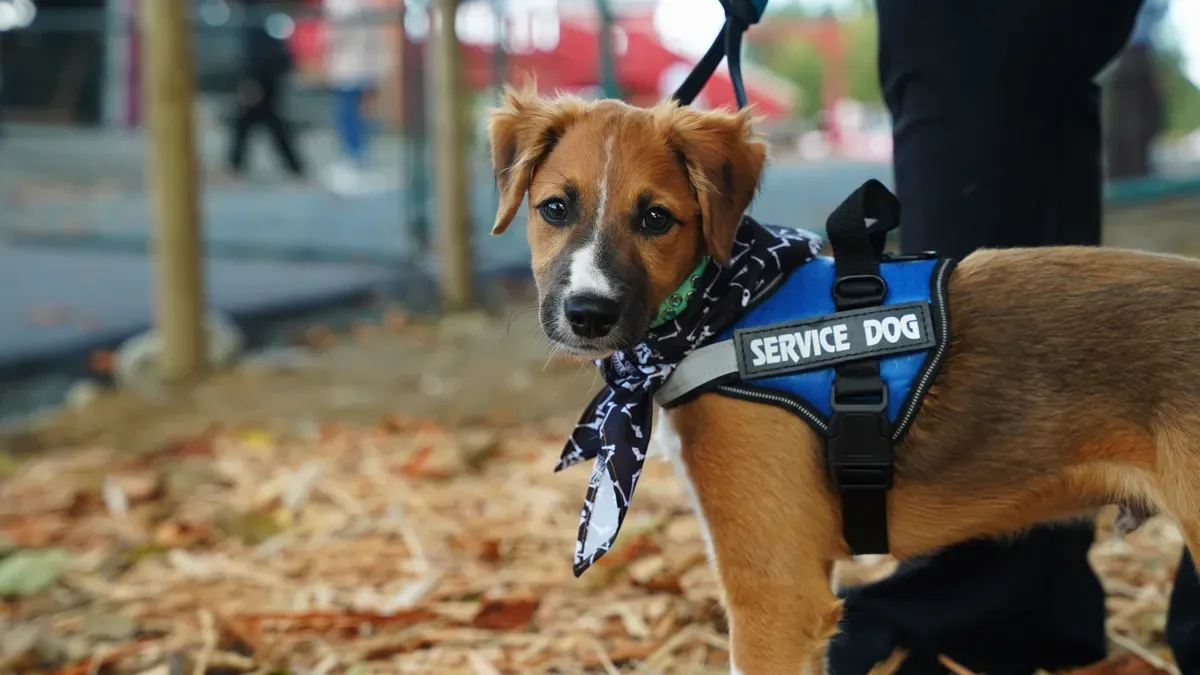
A front support harness is built for a specific use envelope. The dog needs enough front-leg weight-bearing capacity to control its own descent — the harness supplements stability, it does not replace it. If the dog cannot place any weight through the front legs, the harness becomes a suspension system it was not designed to be. The pad loads unevenly. The straps take forces at angles the stitch pattern was not laid for. Failure follows.
Brachycephalic breeds face a tighter margin. These dogs already manage airway resistance at rest. Any upward pad migration creates throat pressure that compounds the existing respiratory constraint. What is a fit annoyance for a long-snouted breed becomes a breathing obstruction for a short-faced one. The handle anchor position carries higher stakes when the airway starts close to the chest pad’s upper edge.
Disclaimer: This fit analysis assumes a dog with standard limb proportions and an average-length coat. Double-coated breeds may show subtler rub marks that require hand-checking beneath the fur rather than visual inspection of the skin surface. If the dog has angular limb deformities or a very deep chest that falls outside the breed norms this harness geometry was patterned for, the fit checks described here may not catch every pressure point. Verify with a veterinarian familiar with the dog’s specific conformation before relying on these checks for daily stair use.
Dogs that panic on stairs create a different failure mode. A panicking dog twists, lunges, or scrambles. The harness — regardless of design quality — was not built to manage sudden lateral loads or rotational forces from a thrashing animal. Side straps can slip. The pad can rotate past its anti-migration limit. A harness that tests perfectly during calm, controlled descent may fail rapidly under panic loading. If the dog has a history of stair-related panic, mobility support approaches need to account for the full behavior pattern, not just the physical descent mechanics.
Steep stairs stretch every design limit further. Stair pitch changes the forward lean angle. A steeper stair forces the chest further forward and concentrates more weight into the upper edge of the pad. What holds on a standard residential staircase may not hold on a steep basement stair or outdoor deck steps. Pad length that passes a 30-degree stair test can fail at 40 degrees. There is no universal pad dimension that works for every stair angle.
Testing Harness Fit Before Relying on It for Daily Stair Use
Fit testing on flat ground predicts nothing about stair performance. The load direction changes. The pad forces redistribute. The strap tensions shift. A stair-specific test sequence is the only way to know whether the harness will hold.
Start on flat ground. Fit the harness so the chest pad sits below the throat and across the full sternum. Walk the dog for five to ten minutes. Watch for any pad creep. If the pad shifts on flat ground, it will fail faster on stairs. Fix the flat-ground fit first.
Move to the stairs. Use one to three low steps. Keep the dog slow. Keep your hand steady on the handle — do not lift; support. The dog should place each foot itself. After two or three repetitions, stop and inspect. Mark the pad position with tape before the first descent. Check whether the tape has migrated after the last one.
Choosing a harness for stair support means verifying it under the actual load pattern it will see in daily use. The signal table below gives a read on whether the harness is holding or failing:
| Signal level | What you see | What to do |
|---|---|---|
| Green | Pad stays centered on sternum, dog moves without hesitation, no throat contact, skin under pad is cool and unmarked after use | Continue with monitored sessions, recheck weekly |
| Yellow | Pad has shifted upward less than half an inch, dog pauses briefly between steps, light pinkness under pad edge that fades within two minutes | Refit harness, shorten session to one descent, recheck after each use |
| Red | Pad reaches throat area, coughing, gagging, dog plants feet and refuses to move, shoulder twisting, furrowed pressure lines that persist, panic or vocalization | Stop immediately, do not finish the stairs, consult veterinarian before reusing any harness |
The half-inch tape check after three stair descents is the most reliable field method available. It catches pad migration before the dog registers discomfort and before throat pressure builds. Run the check at the start of every session until you have five consecutive green results. Then move to weekly checks. Coat changes, weight changes, and strap stretch all shift fit over time — a harness that passed last month can fail this month without visible wear.
Stop-use rules are non-negotiable. Coughing, gagging, freezing, stumbling, twisting, or vocalization mean the session ends immediately. Do not finish the stairs. Do not assume the dog will adjust. Each of these signals means the harness load path has deviated from the intended support geometry into a zone where the forces stop helping and start hurting. The right response is to stop, inspect, and if the pattern repeats, acknowledge that this harness is not matching this dog’s descent mechanics.