
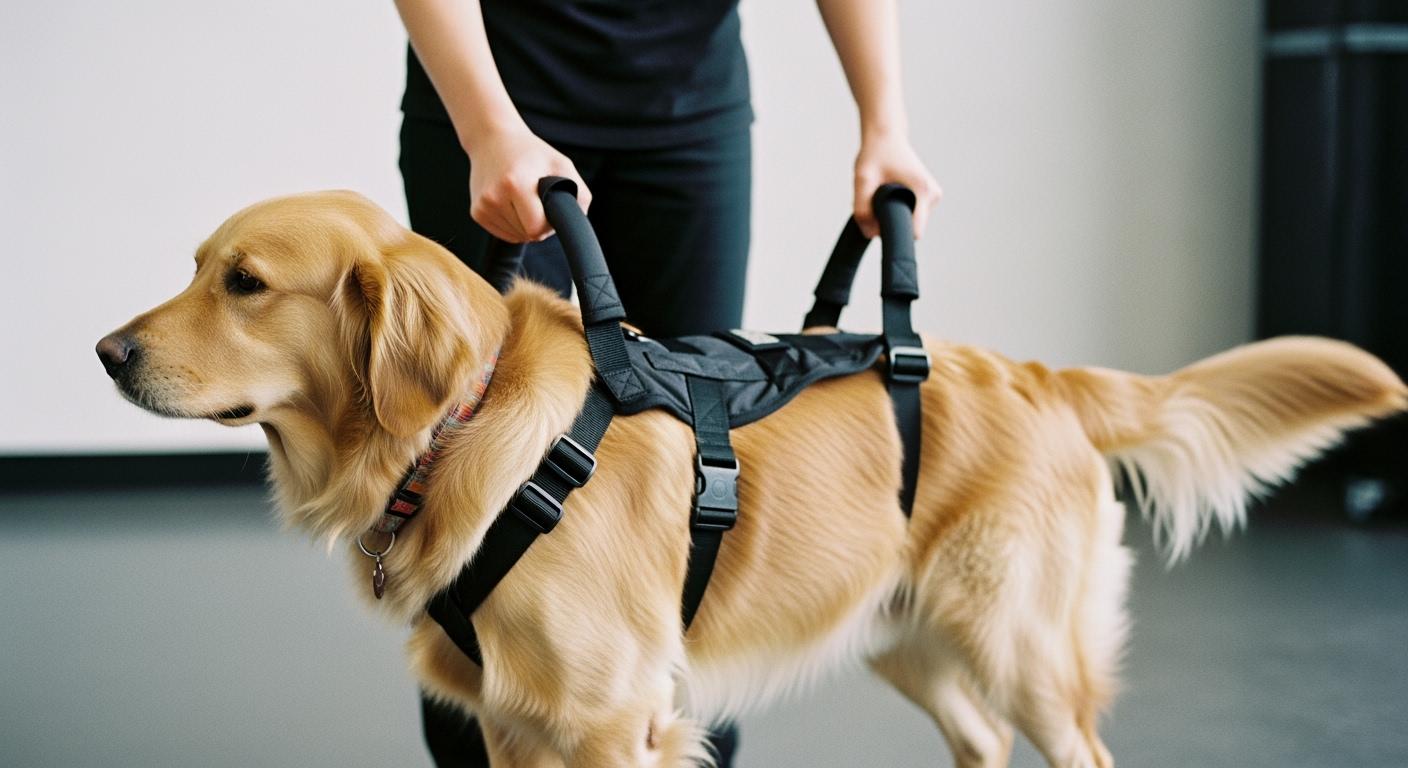
You grip both handles. You lift. One side rises first. The dog twists, the rear sinks, and the belly panel rolls sideways under the ribs.
This is not always handler error. In most cases the harness itself sets up the failure. Handle height differs between front and rear. The chest panel sits wider than the belly band. Strap tension pulls unevenly from side to side. And the panel that should cradle the underside is simply too narrow to resist rolling when force comes in at an angle.
What unfolds is a force-balance collapse. Whichever handle carries more tension becomes the primary lifting point. The dog’s body rotates around that point instead of rising as a unit. The harness shifts before the dog can place a controlled step. That half-second of rotation is where the rear drops, the chest hikes, and the belly panel rolls.
Why Uneven Handle Pull Turns a Lift Harness into a Rotation Problem
The core problem is not grip strength or coordination. It is geometry. When a full body lift harness has two handles set at different effective heights relative to the dog’s center of mass, the higher handle takes more load the instant you begin lifting. That side accelerates upward. The lower side lags. The dog rotates.
Here is the causal chain: handle height asymmetry → uneven load distribution at the moment of lift → one side of the harness accelerates faster → the dog’s body rotates around the stronger pull vector → the harness shifts on the dog’s torso → the belly panel, now angled relative to gravity, loses its perpendicular contact patch and rolls. Half an inch of handle mismatch at the hand becomes several inches of displacement at the dog’s midline. That is why a harness that looks symmetric on the hook can still produce a twisted lift on the dog.
The failure plays out faster with dogs that have muscle atrophy or neurological weakness. A dog with full strength can micro-correct against small rotational forces by bracing a leg or shifting weight. A weak dog cannot. The rotation goes unchecked. The harness slides. The rear drops. Within two or three repetitions the dog learns that lifting means instability and braces or panics before you even pull.
You can observe this directly. Do a five-second micro-lift—just enough to take a few pounds of weight off the dog’s legs without moving. Watch the backline. If the spine stays parallel to the floor and the harness panels remain centered, the handle height match is working. If the hips sag within those five seconds, one handle is pulling harder than the other. Adjust the strap length feeding that handle before attempting a full walk.
| Real use failure | Why it happens | What design works better | What the handler should check |
|---|---|---|---|
| rear drops during lift | rear handle too low or under-tensioned | matched front and rear handles with adjustable strap length | both handles level, rear supported before pull |
| chest pulled up first | front handle set higher | equal handle height, wide chest panel distributing force | chest and hips rise together |
| belly panel rolls | side pulling force on a narrow panel | wide padded belly panel with anti-slip lining | panel stays flat and centered under belly |
| dog twists toward one side | one handle pulled with more force | stable side buckles, wider panel resisting rotation | spine stays straight during lift |
| handler bends or pulls backward | handles too short, forcing an angled pull | longer or adjustable handles allowing upright stance | handler stands upright, lifts vertically |
| sling cuts into belly | uneven lift, narrow support band | full body panel distributing force across a wider area | no pinching, folding, or rolling under belly |
Where the Harness Structure Fails First During Real Use
Three structural decisions in a full body lift harness determine whether the dog rises level or rotates: handle height match, panel width, and strap-path symmetry.
Handle height mismatch. When the front handle sits an inch higher than the rear relative to the dog’s topline, the front chest panel engages first on lift. The sternum rises. The hips stay planted for a fraction of a second. That lag is long enough for the dog to brace with the front legs and stumble with the rear. The harness does not just lift unevenly—it changes the dog’s weight distribution mid-stride, which makes forward movement harder rather than easier.
Narrow panels that roll under side load. A belly panel that measures three inches wide on a sixty-pound dog has very little rotational resistance. The moment side force enters—because one arm pulls slightly harder or because the dog shifts weight to one leg—the narrow contact patch acts like a pivot, not a stabilizer. The panel rolls. The edge digs into the belly. The dog sidesteps to escape the pressure, which pulls the harness further off-center. A wider panel increases the contact patch and the friction area that keeps the panel flat. The wider the panel, the more side force it takes to initiate a roll.
Check this after ten steps of assisted walking. Stop. Run a hand under the belly panel. If the panel edge has migrated more than half an inch from its starting position, the panel width or strap tension symmetry is off. Harnesses that slip or rub during walking almost always trace back to a panel that is too narrow for the dog’s torso width.
Short handles that force a backward pull. If you have to bend at the waist or lean backward to grip both handles, the lift vector tilts. Instead of pulling upward—which keeps the harness panels perpendicular to the dog’s body—you pull at a diagonal. The rear handle rises. The front handle pulls the chest panel upward and backward, collapsing the front support zone and transferring all the load to the rear. The dog’s chest panel lifts away from the sternum and the hips carry the weight. Within a few lifts the dog anticipates the backward drag and resists before you even start. Full body lift harnesses with adjustable handle length let the handler maintain a vertical pull path regardless of their own height relative to the dog.
When a Full Body Lift Harness Is the Right Choice—and When It Is Not
A full body lift harness is not a one-size decision. The distinction that matters most is whether the dog needs front support, rear support, or both.
| Dog support need | Rear support harness | Lift sling | Full body lift harness |
|---|---|---|---|
| short potty break | ✓ | ✓ | ✓ |
| stairs | △ | △ | ✓ |
| car entry | △ | △ | ✓ |
| front and rear weakness | ✗ | ✗ | ✓ |
| dog twists during lifting | ✗ | △ | ✓ |
| repeated daily assisted movement | △ | △ | ✓ |
A rear-only sling works for dogs that still have front-leg strength and only need help keeping the hind end up for short transfers. But when the dog leans, stumbles, or shows front-end weakness, a rear sling creates a pivot point at the belly band. The front half drops while the rear half lifts. The difference between rear-only and full-body support is not about more coverage—it is about whether the dog can stabilize its own front end when the rear is elevated. If it cannot, the sling becomes a lever that tips the dog forward.
Full body lift harnesses become the correct choice when both ends need support, when stairs or ramps require the dog to stay level through an incline change, or when the dog twists during lifting on a rear-only setup. Lift harness solutions for hind leg weakness address the rear-end problem specifically, but when weakness extends to both ends, only a design with independent front and rear support zones keeps the spine aligned during the lift.
Disclaimer: The fit checks described here assume a short-coated dog where harness position is visible. Double-coated breeds may show more subtle rub marks that require hand-checking under the fur rather than visual inspection. If your dog’s leg conformation falls outside typical breed proportions—particularly dogs with angular limb deformities or barrel chests—the panel alignment checks described may not catch every pressure point. Stop lifting and seek veterinary guidance if the dog vocalizes, freezes, or shows new pain during assisted movement.
Fit Checks Before Every Assisted Movement
A harness that fit correctly yesterday may not fit correctly today. Weight loss, muscle atrophy, coat changes, and strap stretch all shift the geometry. Three checks run in under a minute catch most failures before the dog takes a step.
Standing fit. Put the harness on while the dog stands square. Slide two fingers under each strap. Consistent resistance without pinching across every strap means the tension is even. If one strap is tighter than the rest, that is the first point that will dig in under load. Redistribute the tension.
Micro-lift. Grip both handles and lift just enough to unweight the dog’s legs for five seconds. Do not step. Watch the backline. The spine should stay parallel to the floor. If the hips sag or the chest rises first, adjust the strap feeding the handle on the low side. Repeat the micro-lift until the dog rises as one unit.
Ten-step check. Walk ten steps at a slow, steady pace. Stop. Check whether the belly panel has shifted from its starting position. Check whether either handle strap has lengthened by slipping through its adjuster. Check whether the chest panel still sits centered on the sternum. Any deviation of more than half an inch means something in the strap path or panel width is not holding under dynamic load.
These checks matter most before stairs, ramps, or car transfers where an incline amplifies small asymmetries. A half-inch panel shift on flat ground becomes a two-inch shift on a thirty-degree ramp. A daily fit routine that includes all three checks catches the drift before the harness becomes a rotation source instead of a lift aid.
- Fit the harness while the dog stands square and calm.
- Equalize strap tension across every contact point.
- Micro-lift for five seconds. Watch the backline and panel position.
- Adjust the low-side strap if the hips sag or the chest rises first.
- Walk ten slow steps. Stop. Check panel position and strap tension.
- Re-adjust before stairs, ramps, or inclines.
- Stop if the dog twists, braces, vocalizes, or shows new pain.
FAQ
What causes uneven handle pull in a full body lift harness?
Handle height asymmetry is the most common structural cause. When the front and rear handles sit at different effective heights relative to the dog’s center of mass, the higher handle takes more load on lift, becomes the primary pivot point, and the dog rotates. Narrow belly panels amplify the problem because they lack the contact area to resist side force once rotation begins. Strap tension that is tighter on one side than the other produces the same effect even with perfectly matched handles.
How do I know if my harness is lifting level?
Do a five-second micro-lift. If the spine stays parallel to the floor and the belly panel remains flat and centered, the lift is balanced. If the rear sags, the chest hikes, or the panel rolls within those five seconds, the handle height or strap tension is off. After a ten-step walk, check whether the belly panel has shifted more than half an inch from its starting position.
When should I switch from a rear sling to a full body lift harness?
Switch when the dog shows front-end weakness, twists during rear-only lifting, or cannot maintain a level spine through stairs and ramps. A rear sling creates a pivot at the belly band—if the dog cannot stabilize its own front end when the rear is elevated, the sling tips the dog forward instead of supporting it.
Can a lift harness eliminate all risk during assisted movement?
No. Even a well-designed harness can shift if strap tension drifts, if the dog’s body condition changes, or if an incline amplifies a small asymmetry. The three checks—standing fit, micro-lift, ten-step panel position—catch most failures before they become hazards, but no harness removes the need for close observation during every lift.
