
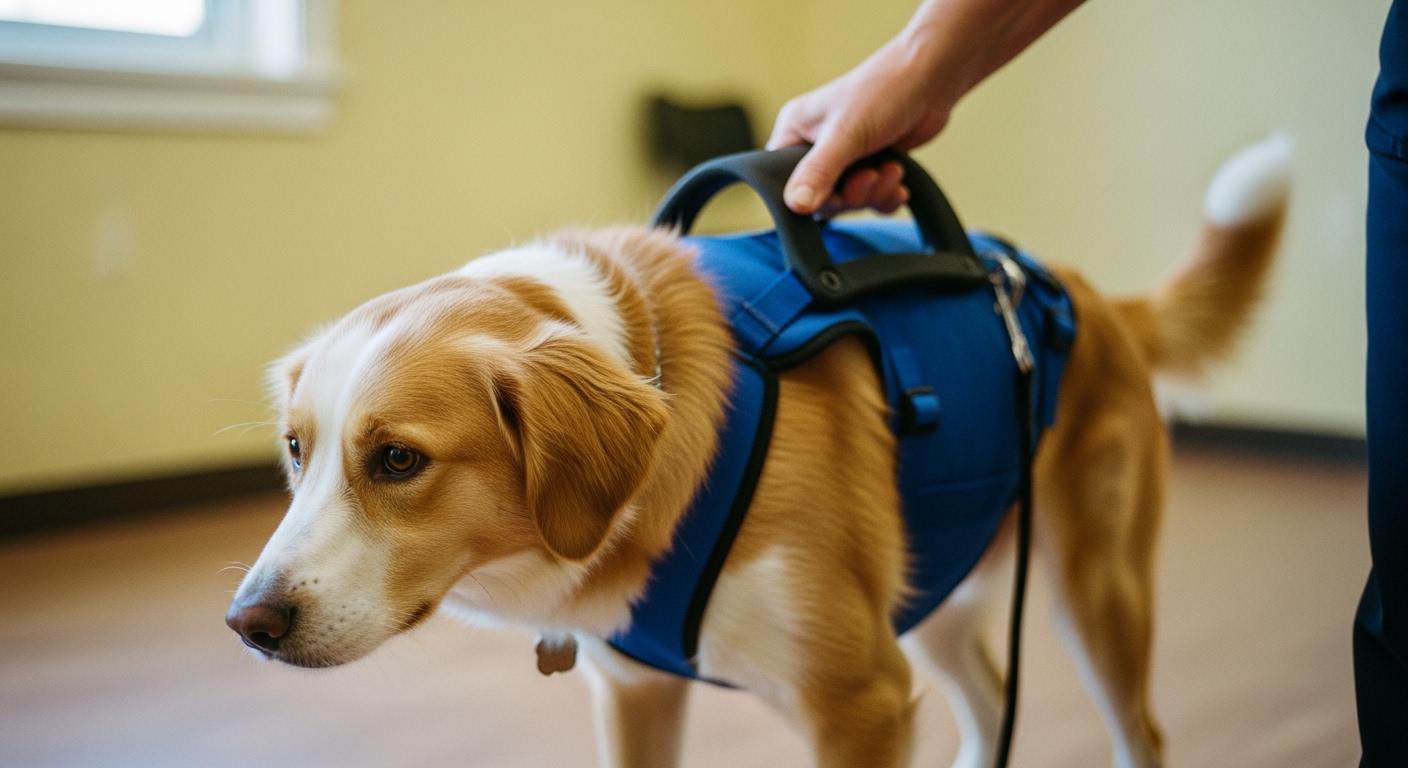
When a dog needs help standing and the first assisted steps feel uneven — front drops, rear lifts, the body twists sideways — the instinct is to grip harder and pull up more. That misses the problem. The handle is not too weak. The lift force is entering the body at the wrong point, traveling through too narrow a contact patch, and pulling the dog off its natural balance line.
A dog harness with handle for lifting fails not because of stitch strength but because of where and how the lift force meets the body. Handle position relative to the dog’s center of mass determines whether the body stays level. Panel width and placement determine whether that force spreads across muscle or concentrates on a two-inch strap edge. These two variables — lift geometry and load distribution — decide whether a session ends with stable steps or a twisted, frozen dog. Most handlers discover the failure in the first ten strides.
Why a Single Handle Pull Tips the Dog Forward
A handle sewn into the back of a harness seems simple: grab, lift, guide. But a single attachment point creates a single force vector. If that handle sits forward of the dog’s mid-back — roughly where the center of mass lives in a standing dog — the upward pull converts into forward-rotational torque.
Here is the chain. Handler lifts upward. Force enters at one point on the dorsal line. If that point is anterior to the center of mass, the front half receives a downward component while the rear receives an upward component. The chest drops, the hindquarters rise. The dog’s natural righting reflexes fire against the harness. The dog stiffens, freezes, or lurches forward.
The problem compounds with each step. A dog that already has weak hind legs cannot compensate for a front-heavy tilt. What begins as a subtle forward lean becomes a full forward tip within three or four strides. The handler tightens their grip — which increases the rotational force — which makes the tip worse. That is the failure loop.
This is not about handle length alone, though a shorter handle positioned closer to the dog’s body reduces the lever arm and gives the handler more direct control over the lift angle. The real variable is where the handle anchor point sits relative to the dog’s balance line. A handle centered over the thoracolumbar junction — roughly the middle of the back — keeps the lift vector closer to vertical. Paired with a chest panel that prevents the front from dropping and a rear panel or rear-support strap that catches the hind end, the lift distributes across three zones instead of one.
An observable check: after 10 assisted steps on a level floor, stop and look at the dog from the side. Is the back line parallel to the floor? If the shoulders sit lower than the hips, the handle is pulling from too far forward — the lift vector has a forward component. If the hips sit lower, the handle anchor is too far back. Either way, the body is not level, and continuing means the dog is fighting the harness with every step.
| Real-use problem | What the handler sees | Why the harness fails | Better structure or design |
|---|---|---|---|
| Forward tipping | Front drops, rear lifts | Handle too far forward | Shorter handle, wider chest, rear support |
| Belly hanging | Belly sags, dog looks limp | Narrow strap or no rear support | Wide belly panel, rear-body support |
| Harness rotation | Harness twists during steps | Loose straps, soft panel rotation | Adjustable side straps, anti-slip lining |
| Armpit pressure | Dog limps, rubs armpits | Narrow straps, poor fit | Wide padded panels, better fit |
| Dog freezing | Dog stops, resists moving | Imbalance, pressure in wrong spot | Lighter guidance, adjust fit or support |
Where the Harness Panels Need to Sit for Level Support
A handle transmits force. Panels distribute it. When a panel is too narrow, the distribution fails at the edges.
Take a belly strap that is one inch wide. Under partial lift load during assisted walking, that one-inch band presses into the abdomen along a concentrated line. The edges of the strap become focal stress lines. As the dog takes a step sideways or shifts weight, the strap edge rolls. That roll initiates harness rotation around the dog’s torso. Once rotation starts, the chest panel migrates toward the armpit, the back panel twists off-center, and support shifts to soft tissue that was never meant to bear load.
A wide belly panel — four to six inches across, padded, with enough internal structure to resist edge-roll — changes how force enters the body. The same lift load now spreads across a much larger contact area. Pressure per square inch drops significantly. More importantly, the wider contact patch creates resistance to rotation: the panel has to physically travel farther to roll, and the friction surface area doubles or triples. This is why harness designs that prioritize panel coverage over minimal strap weight tend to stay in place across longer assisted-walking sessions.
Chest support follows the same principle. A wide chest panel that sits flat across the sternum and pectoral region — not riding up into the armpit — keeps the front of the dog from dropping during the lift phase. When the chest panel is too short or sits too high, it pulls into the axillary region. That is a high-friction, low-tolerance zone. Rub there for even a few minutes and the dog starts limping from surface irritation, not from the underlying condition the harness was meant to help with.
Rear support is the third zone. For dogs with hind-leg weakness, the rear half drops without active lift. A rear support strap or panel — sometimes a separate leash loop that runs under the hindquarters — provides lift at the back. The key design distinction: rear support that attaches independently lets the handler adjust lift per half of the dog. A single-piece harness with a rear panel built in is simpler to put on but offers less fine control than a two-point system where front and rear lift are separate. Full-body harnesses that split lift between front and rear attachment points give the handler zone-by-zone adjustment that a single dorsal handle alone cannot provide.
Observable check: after 10 minutes of assisted walking, remove the harness and run a hand under the chest panel area and along the belly. Warmth is normal. Red marks that stay visible for more than two minutes after removal indicate concentrated pressure — the panel is too narrow or positioned wrong. Dampness under the lining that does not dry within five minutes of removal suggests the liner material is trapping moisture rather than ventilating it.
| Signal level | What it looks like | What to do |
|---|---|---|
| Green | Dog stays level, panels flat, light support needed | Continue, monitor comfort and adjust as needed |
| Yellow | Mild shifting, hesitation, uneven steps, loose belly | Pause, check fit, adjust support zones |
| Red | Tipping, twisting, slipping, pain, panic, collapse | Stop, remove harness, seek veterinary advice |
Note: A lifting harness provides controlled physical assistance, not medical treatment. If the dog shows pain, panic, sudden weakness, or collapse, stop and contact a veterinarian.
When a Lifting Harness Is Not the Right Tool
A dog harness with handle for lifting works when the dog can still bear some weight, initiate some forward movement, and respond to guidance. It fails when those conditions are not met.
Dogs with severe bilateral hind-leg weakness — where both back legs collapse on standing and the dog cannot push up at all — often need more than a mid-back handle. A rear-only lift harness that cradles the hindquarters directly, sometimes paired with a wheelchair frame, targets the failing zone more precisely. Rear-lift-specific harnesses distribute force across the hindquarters in a way that a single dorsal handle pulling through a full-body panel cannot match for this level of weakness. Applying full-body lift from a single dorsal handle in these cases tends to pull the dog into a vertical hanging position — stressful for the dog and not productive for forward movement.
Dogs whose body proportions fall far outside breed norms — very deep-chested breeds like Greyhounds or Dachshunds, or dogs with angular limb deformities — may not get a stable panel fit from standard harness geometries. The chest panel sits too high or too low. The belly panel gaps. The handle ends up offset from the true center of mass. Lift harness solutions matched to specific hind-leg weakness patterns can reduce the mismatch, but in some conformations a standard full-body design simply will not sit flat across all three support zones simultaneously.
Then there is the behavioral signal. A dog that freezes, resists, or panics on every assisted attempt — after fit has been checked, after the lift force has been reduced to the minimum, after the environment has been moved to a non-slip surface — is communicating how the harness feels. It may be pressing on a sensitive area. It may be restricting a joint range the dog reflexively protects. Continuing through repeated freezing tends to build avoidance behavior that outlasts the harness session. Selecting a lift harness with the right panel configuration for the dog’s specific weakness pattern matters more than picking the highest weight rating.
Disclaimer: The panel-position and back-line checks described here assume a short-coated dog where the harness contacts skin or a thin undercoat directly. Double-coated breeds (Huskies, Malamutes, Shepherds in full coat) may show subtler rub marks and heat buildup that require hand-checking rather than visual inspection — run fingers under each panel edge after removal rather than relying on what is visible.
Disclaimer: If the dog’s leg conformation falls outside the breed norms this harness was patterned for — particularly dogs with angular limb deformities or very deep chests — the fit checks described here may not catch every pressure point. A rear-lift-only or custom-fit harness often matches atypical body geometry more safely than a standard full-body design.
Design Details That Change Daily Use
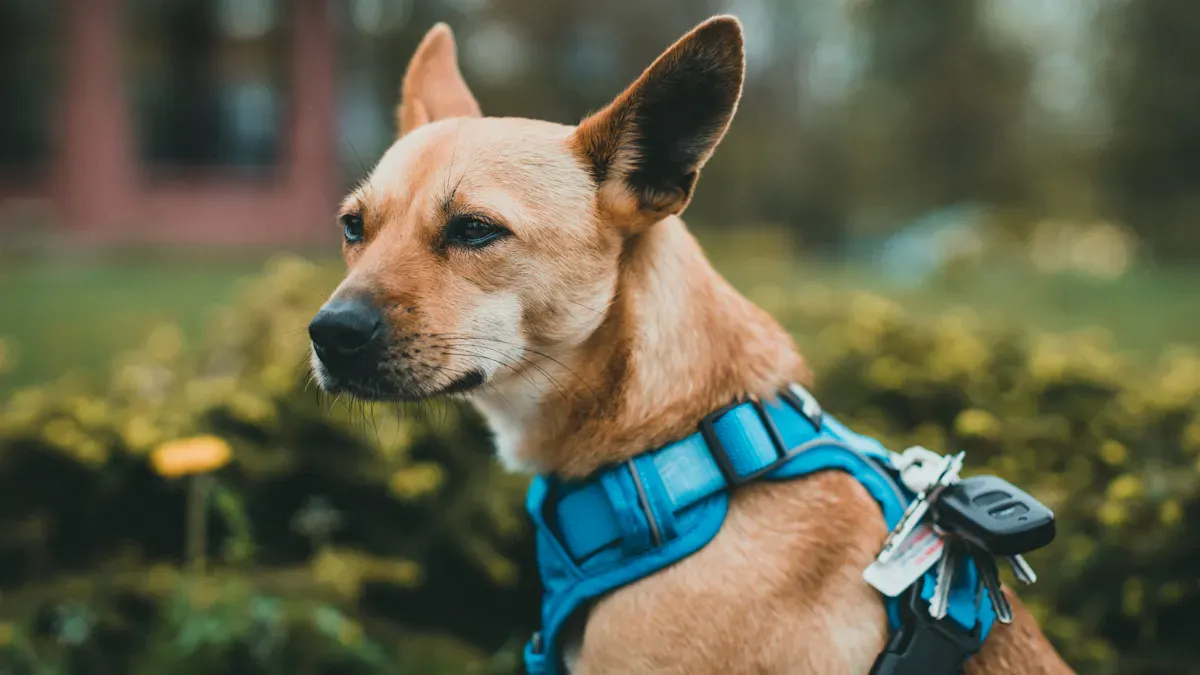
Three design details separate a harness that works on the first session from one that requires constant readjustment.
Non-slip lining on the inner face of the panels. During assisted steps, the dog’s skin and coat shift slightly with each stride. A smooth inner liner lets the harness micro-slide. After 20 or 30 steps, those micro-slides accumulate into a half-inch or more of panel migration. The chest panel drifts toward the armpit. The back panel rotates off the spine. Non-slip lining — typically a rubberized or silicone-dotted textile — grips the coat and resists that incremental drift. It does not need to be aggressive; it just needs a higher coefficient of friction than a smooth nylon shell.
Reinforced stitching at lift-load points. The handle attachment zone takes concentrated force every time the handler lifts. A standard single-needle seam at this junction carries the full load on one stitch line. Under repeated loading — hundreds of lift cycles over weeks — that single line can elongate. The handle develops play. The lift feels mushy. A box-stitch or bar-tack reinforcement at each handle anchor point spreads the same load across multiple stitch lines. In production, this changes the failure mode from “seam tears out suddenly” to “wears gradually with visible fraying,” which gives the handler a warning window.
Adjustable side straps that create multi-point tension. A harness with only front and rear adjustment tightens in one plane. Add side straps — adjustable points along the ribcage — and the harness tensions in two planes simultaneously. This cross-tensioning resists rotation better than single-plane tightening because the harness has to stretch or shift against tension in two directions to twist. The same principle applies to sternum straps and rear straps: more independent adjustment points mean the handler can tailor tension zone by zone instead of cranking one strap tight and hoping the rest follows.
FAQ
How do I know if the handle position is wrong for my dog?
After 10 assisted steps on a level floor, stop and view the dog from the side. If the shoulders sit lower than the hips, the handle anchor point is too far forward — the lift vector has a forward component tipping the front down. If the hips sit lower, the anchor is too far back. Either asymmetry means the body is not level and the harness geometry does not match the dog’s balance point.
Why does the harness rotate around my dog’s body during assisted walking?
Rotation starts at the strap edge. A narrow strap under side-load rolls at its edge, and that roll initiates a twist that propagates through the entire harness. Wide panels create more friction surface area and a longer rotation path, both of which resist twisting. If rotation persists despite wide panels, check whether side straps are tensioned evenly — uneven side-strap tension pre-loads the harness for rotation before the dog takes a step.
Can a lifting harness replace a rear-leg support harness?
Not for dogs with severe bilateral hind-leg weakness where both back legs collapse fully. A single dorsal handle pulls the dog upward from one point, which in these cases tends to create a vertical hanging position rather than supported forward movement. A rear-lift harness that cradles the hindquarters directly provides more targeted lift where it is actually needed.
What is the difference between a short handle and a long handle for lift control?
A short handle positioned close to the dog’s back reduces the lever arm between the handler’s hand and the lift anchor point. This gives more direct force transmission — less play, less delay, less overshoot. A long handle introduces a longer lever arm that amplifies small hand movements into larger harness displacements, which makes it harder to keep the lift vector vertical during dynamic steps.
