
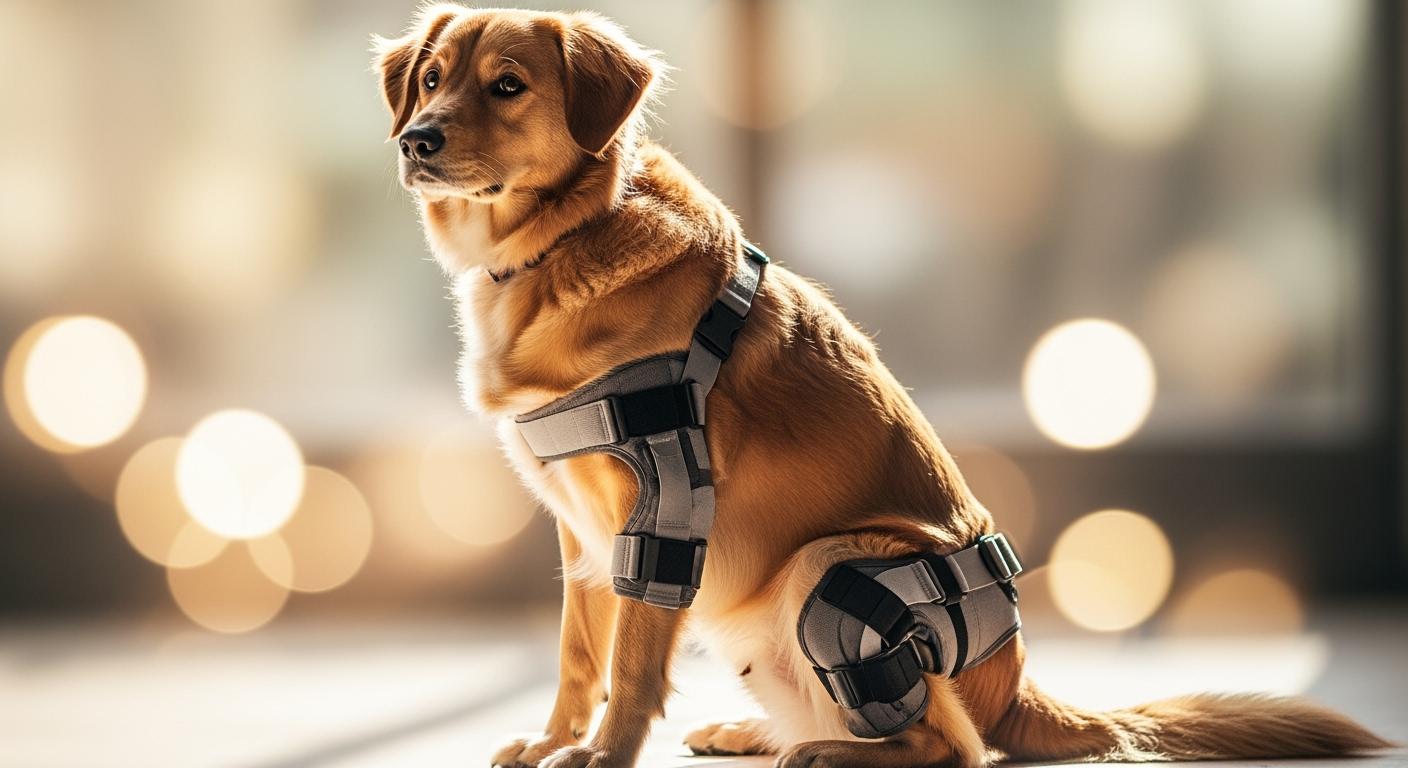
A dog knee and hip support brace can look secure when you first strap it on. Then the dog walks ten steps. The hip strap has drifted backward. The knee pad is no longer centered on the joint. The edge of a strap has left a pink line that was not there before the walk started.
This is not about strap tightness. It is about two joints that move in fundamentally different ways — and a brace structure that cannot keep up with both at once.
Why a Combined Knee and Hip Brace Slips During Real Use
A combined brace that wraps the rear leg from hip to below the knee has to manage two separate motion arcs simultaneously. Most designs treat the leg as a single unit. The leg is not a single unit during gait — and that mismatch is where the slipping starts.
The Two Joints Pull Against Each Other
During each stride the knee flexes and extends in a sagittal plane — forward and back. The hip moves through rotation, abduction, and a shifting weight-bearing angle that changes with every footstrike. When a single unified strap system spans both joints, it cannot independently tension for each.
Here is the chain: the hip strap sits over soft tissue that compresses and rebounds with each step. As the tissue changes shape under load, the strap loses its static grip. That loosening transmits tension downward. The knee pad, now pulling against a slack anchor above, begins to drift. Because the knee joint itself is moving through flexion and extension at the same time, the pad walks itself down the tapered shape of the thigh. Within minutes the knee support is below the joint — and the brace is no longer supporting anything.
A brace with a fixed strap path that cannot adjust for how the stifle rotates under load will drift predictably on any dog with a tapered hind leg. The solution is not a tighter strap — it is an anchoring system that holds position independently of the tissue movement beneath it.
Why Tighter Straps Do Not Fix the Problem
Tightening the straps is the instinctive response to slippage. It usually makes things worse.
When a narrow strap is cranked down, the force concentrates along the strap edge. Under side load — the kind produced when a dog turns or stands up from a sit — that edge has no surface area to resist rotation. The edge rolls. Rolling shifts the entire strap. The brace migrates. And now there is a compressed, irritated strip of skin under a strap that has moved from its original position.
Walk your dog for ten minutes with the brace on, then check each strap against its starting position. If a strap has shifted more than half an inch from where you placed it, the anchoring geometry — not the tension — is the problem. A brace that fits the dog’s leg taper and muscle shape will hold position with moderate tension. One that does not will slip regardless of how hard you pull the straps.
Note: If your dog shortens its stride, drags its toes, or refuses to place weight on the leg while wearing the brace, the alignment is off — not the tightness. Remove the brace and reassess fit before the next session.
What Structures Keep a Rear-Leg Brace Stable
Hip Anchoring That Stays Put
The hip strap is the foundation of the entire brace. If it moves, everything below it moves. A narrow band placed over the pelvis concentrates the entire anchor load on a strip of tissue maybe an inch wide. That strip compresses under pressure, the band loses friction, and the slide starts.
A wider pelvic anchor spreads the same load across three to four times the surface area. The tissue underneath compresses less because the force per square inch is lower. Less compression means less shape change under the band. Less shape change means the anchor stays where it was placed.
The table below shows how common real-use problems trace back to structural causes — and what to look for instead.
| Real-use problem | Likely cause | Why it matters | Better structure |
|---|---|---|---|
| Hip strap slides backward | Narrow or loose pelvic anchor | Knee pad drifts downward | Wide waist or pelvic anchor with non-slip backing |
| Knee support drops below joint | Weak thigh anchor, leg taper | Loss of joint stabilization | Adjustable thigh-to-knee connection that follows leg shape |
| Brace rotates outward during turns | Side straps cannot resist twist | Joint misalignment under load | Centered knee support with bilateral strap control |
| Strap edge leaves a red line | Pressure concentrated on narrow edge | Skin breakdown, chewing | Wider straps with rolled or beveled edges |
| Dog walks worse with brace on | Misaligned hinge or knee pad | Reduced mobility, compensation gait | Joint-centered design with independent strap adjustment |
A knee brace built around joint-centered anchoring treats the hip and knee as separate stabilization points rather than a single fixed path. That independent adjustment is what prevents the hip-anchor-to-knee-pad cascade failure.
Knee Centering That Does Not Drift
The knee pad has one job: stay on the joint. It fails at that job when the connection from thigh to knee is a fixed strap path that cannot account for the leg’s natural taper. A dog’s thigh is wider at the top and narrows toward the stifle. A strap that runs straight down will follow the path of least resistance — which is down and off.
An adjustable thigh-to-knee connection lets the tension path angle inward to match the leg’s contour. This creates a mechanical lock: the strap pulls slightly upward and inward against the taper, counteracting the downward drift force that gravity and motion produce.
| Weaker design | Why it fails in real use | Stronger alternative |
|---|---|---|
| Narrow upper strap | Force concentrates on a small contact patch; tissue compresses, strap rolls | Wider strap with distributed pressure and edge bevel |
| Loose or single-point hip band | Anchor shifts on pelvic contour during gait | Multi-point waist anchor with non-slip inner surface |
| Fixed vertical strap path | Cannot follow leg taper; knee pad walks downward | Adjustable thigh-to-knee connection with angled tension path |
| Thick non-breathable padding | Traps heat and moisture; skin softens, friction increases | Breathable, moisture-wicking padding with air channels |
| Generic rear-leg sleeve | No joint-specific centering; knee and hock confused | Joint-specific knee support with independent anchor points |
Knee pads designed with joint-centered geometry use the stifle’s bony landmarks as positioning references — not just the soft tissue that shifts during movement. That reference-based placement is what keeps the pad from walking itself down the leg.
Padding, Pressure Spread, and Why Material Choice Changes Wear Tolerance
Padding is not about softness. It is about heat management and pressure distribution — two things that directly determine how long a dog will tolerate the brace before chewing at it or refusing to walk.
Thick, dense foam padding traps body heat against the skin. After fifteen to twenty minutes of walking, the skin under the pad warms up, moisture builds, and the outer layer of skin softens. Softened skin is more vulnerable to friction damage. The same strap that was comfortable at minute one begins to rub at minute twenty — not because the fit changed, but because the skin’s condition changed underneath it.
Breathable padding with air channels allows evaporative cooling. The skin stays drier and maintains its normal surface integrity through the full wear session. The result is not just comfort — it is a longer safe wear window before skin irritation begins.
Check this yourself: after a twenty-minute walk, lift the edge of the knee pad and touch the skin underneath. If the skin feels damp or noticeably warmer than the surrounding coat, the padding is trapping too much heat. If it feels dry and close to ambient temperature, the padding is managing moisture adequately. Hip support braces that pair breathable materials with wider pressure distribution consistently produce fewer red-mark complaints than designs that prioritize thick padding over airflow.
Disclaimer: This fit-check approach assumes a short-coated dog where pressure marks are visible on the skin surface. Double-coated breeds may show subtler rub marks that need hand-checking — run your fingers under strap edges and along the knee pad border rather than relying on visual inspection alone. If the dog’s leg conformation falls outside the breed norms this brace was patterned for — particularly dogs with angular limb deformities or very deep chests — the fit checks described here may not catch every pressure point.
When a Knee and Hip Support Brace Is Not the Right Tool
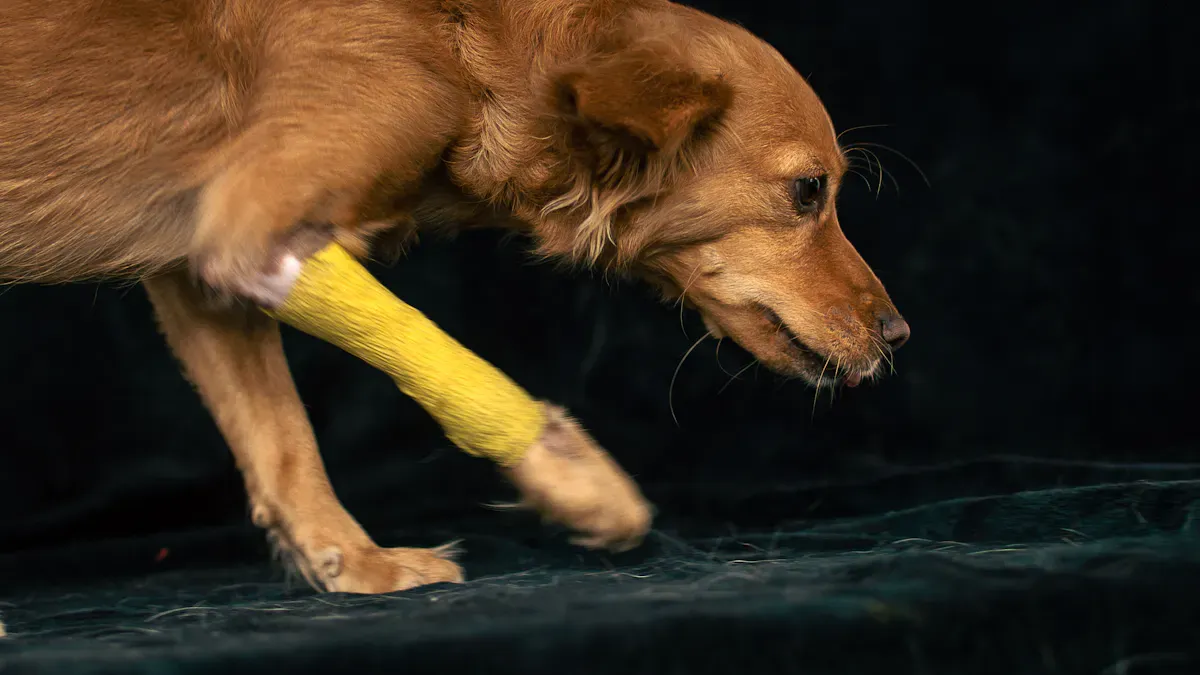
A brace supports a joint that can still bear weight and move through a functional range of motion. It does not replace structural stability when the joint itself cannot hold position. Knowing where that line sits prevents a brace from becoming a source of harm.
Signs the Brace Is Working Against the Dog
Some dogs adapt to a brace within days. Others show clear signals that the brace is not matching their condition. The signals to watch:
- The dog’s gait visibly worsens with the brace on — shorter strides, toe-dragging, or a head-bob that was not present before
- Red marks or indentations from straps that do not fade within twenty minutes of brace removal
- The dog stops, refuses to move forward, or repeatedly turns to chew at the brace during walks
- Swelling, cold toes, or any new limp that persists after the brace comes off
If the dog limps more with the brace on than off, the brace is not helping. Remove it. A properly fitted orthopedic knee brace tends to improve gait within the first few supervised sessions — not degrade it. Deterioration means the fit, the condition match, or both are wrong.
When Lift Support or Veterinary Assessment Is the Safer Path
A knee and hip brace depends on the dog being able to bear some weight through the leg. If the dog cannot stand or take a step without assistance, a brace will not create stability where none exists. A lift harness that lets you take a portion of the dog’s weight through your hand is the safer tool for that situation.
Dogs with a suspected complete CCL rupture, hip dysplasia with severe pain, or neurological deficits affecting leg placement need a full veterinary workup — not a brace trial. Braces can assist during rehabilitation and help restrict damaging movement patterns, but they do not address the underlying structural failure in these cases.
Disclaimer: If your dog cannot bear weight on the leg at all, or if you see acute swelling, a dangling paw, or signs of severe pain, skip the brace fitting and go directly to a veterinarian. A brace is a support tool — it is not a diagnostic device and cannot determine whether a joint injury needs surgical intervention.
FAQ
How long should a dog wear a knee and hip support brace during the first week?
Start with 15 to 20 minutes of supervised wear — enough time to check for strap shift and skin response. If no red marks or gait changes appear, add 10 to 15 minutes per session over the next several days. The goal is not to hit a target duration but to find the point where the brace stays centered and the skin stays clear.
What is the fastest way to tell if the fit is wrong?
Mark each strap’s position with a small piece of tape on the fur at the start of a session. Walk the dog for ten minutes. If any strap has moved more than half an inch from the tape mark, the fit needs adjustment — regardless of how secure the brace felt at the start.
Can a dog sleep in a knee and hip support brace?
No. Skin needs unpressured time to recover. Remove the brace before bedtime. Overnight wear traps heat and moisture against the skin for hours with no movement to circulate air, which accelerates skin softening and increases the risk of pressure sores by morning.
How should the brace be cleaned without damaging the materials?
Most braces use removable padding that can be hand-washed with mild soap and water. Air-dry all components fully before reassembly — damp padding against skin multiplies friction and microbial growth. Check the specific care tag; some outer shells can be wiped down but should never be submerged if they contain metal hinge components.
