
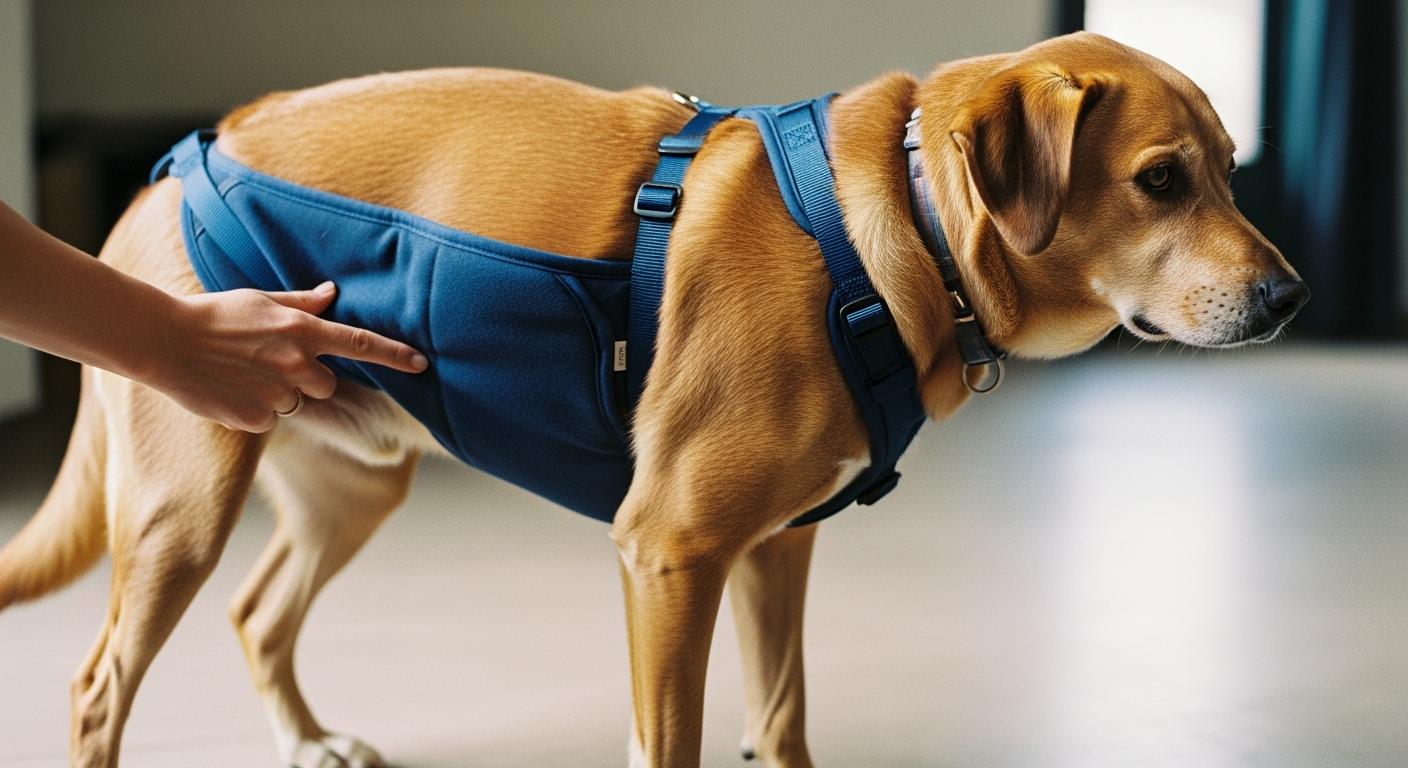
The harness looks correct when the dog stands still. Straps are snug. The belly panel sits flat against the abdomen. Then you lift—and the panel folds. Not shifts slightly. Folds into a narrow ridge that concentrates every pound of lifting force into a strip maybe an inch wide.
That is not a fit quirk. It is a support failure.
When a rear harness belly panel folds under load, the wide contact patch that should distribute pressure across the lower abdomen collapses into a pressure line. The dog feels it immediately—freezes mid-step, short-steps, sits down without warning, or starts leaning away from the lift. These are not training issues or stubbornness. They are the dog telling you the harness hurts.
When the Panel Folds — What Actually Changes Under Load
A belly panel has one job: stay flat and wide while under tension. The panel spans the abdomen between the rear legs, and when you pull upward on the handle, every pound of lift force travels through that panel into the dog’s underside. If the panel holds its shape, that force spreads across the full width of the fabric—typically four to six inches of contact. The dog feels distributed pressure, not a single hot spot.
If the panel folds, the physics flips.
The fold line becomes a hinge. Tension that was supposed to run across the full panel width now converges at the crease. The panel edge rolls inward, and instead of flat fabric against the belly, the dog feels a rounded ridge of compressed material digging upward. The contact patch shrinks from several square inches to a linear strip. Same lifting force, one-tenth the surface area. The pressure per square inch jumps by an order of magnitude.
This is not a material defect in the sense of torn stitching or broken hardware. It is a load-path failure: the force entering the handle has to exit through the belly panel into the dog, and when the panel lacks the crosswise stiffness to resist buckling, the load path collapses into the path of least resistance—a single crease line. The harness is still physically intact. It just is not doing its job anymore.
You can verify this yourself. After 10 slow assisted steps, run your hand under the belly panel while maintaining light lift. If the panel feels like a flat band, the load path is intact. If your fingers find a distinct ridge or rope-like edge where the fabric has rolled, the panel has folded and the harness is concentrating pressure instead of spreading it.
Checklist: Failure Signs When the Belly Panel Folds Under Load
- Belly panel forms a narrow ridge instead of staying flat.
- Panel slides toward the groin or rear legs during lifting.
- Dog’s body tips forward or sideways when you lift.
- Handler has to pull harder to keep the dog level.
- Dog short-steps, freezes, sits suddenly, or resists movement.
- Skin shows pressure lines, redness, heat, or rubbing after harness removal.
Design Details That Decide Whether the Panel Holds or Creases
Panel Width and Crosswise Stiffness
A panel that is too narrow has no leverage against buckling. Think of folding a piece of paper: a wide sheet resists creasing because the material on either side of the fold line braces against it. A strip one inch wide folds with almost no force. The same principle applies to harness panels. A panel narrower than roughly three inches—depending on the dog’s size—lacks the geometric resistance to stay flat once lifting tension exceeds the fabric’s buckling threshold.
But width alone is not enough. Crosswise stiffness matters more than most handlers realize. A wide panel made from soft, unsupported fabric folds just as easily as a narrow one—it just folds into a wider ridge. The material needs enough body to resist the compressive force that develops perpendicular to the lift direction. In practice, this means a multi-layer construction where an internal stiffening layer—dense foam, laminated fabric, or structured mesh—prevents the panel from collapsing into itself when tension pulls the edges inward.
| Design detail | Failure design | Better design | Why it matters |
|---|---|---|---|
| Belly panel width | Too narrow, folds easily | Wide, resists folding | Wide panel spreads load, prevents pressure line |
| Belly panel padding | Thin, compresses under load | Thick, stays soft and stable | Padding protects skin and comfort |
| Panel stiffness | Soft, bends into a ridge | Firm, holds shape under load | Stiffness keeps support even |
| Handle position | Off-center, tips dog sideways | Dual, balanced for level lift | Balanced handles keep dog level |
| Strap adjustability | Loose, allows shifting | Secure, holds position | Good straps prevent panel migration |
| Edge finish | Rough, causes rubbing | Soft, smooth edges | Soft edges reduce skin marks |
| Rear-only vs full-body balance | Rear-only, tips dog forward | Full-body, supports both ends | Full-body keeps dog steady |
Strap Tension and Panel Creasing
Strap tension directly controls whether the panel folds. Overtighten the straps, and the panel is pre-loaded with compressive stress before you even lift—it starts closer to its buckling point and creases under less force. Leave straps too loose, and the entire harness shifts during movement, allowing the panel to migrate into a position where folding is inevitable.
The relationship between strap adjustment and panel behavior is not linear. There is a window—firm enough to prevent migration, loose enough to avoid pre-loading the panel into a crease—and that window changes with the dog’s coat thickness, body condition, and activity. A fit that works on a dry dog standing in the living room may fail on the same dog after 10 minutes of assisted walking when the fabric settles and body heat softens the padding.
Handle Position and Rotational Torque
A single handle sewn into the back of a harness creates a single force vector. When that handle sits forward of the dog’s mid-back—roughly where the center of mass lives in a standing dog—upward pull converts into forward-rotational torque. The chest drops, the hindquarters rise. The dog’s righting reflexes fire against the harness. The dog stiffens, freezes, or lurches forward.
That rotational imbalance amplifies panel folding. As the dog tips forward, the belly panel angle changes relative to the lift direction. What was a perpendicular pull becomes an angled pull that encourages the panel edge to roll. Handle placement is not about convenience for the handler—it determines whether the force vector passing through the panel stays perpendicular to the panel surface or goes oblique and induces a fold. Dual handles reduce this problem by distributing lift force across two attachment points, keeping the panel flatter under asymmetric loading.
After ten assisted steps, check whether the dog’s back stays parallel to the floor. If the shoulders drop or the hips sag, the handle position is converting lift into tilt—and the belly panel is taking the consequences.
When a Rear-Only Harness Is the Wrong Call
A rear harness supports the hindquarters. That is what it is designed for. When a dog needs help only with the back legs—post-surgical hind-limb support, gradual rear weakness without front-end involvement—a well-designed rear harness with a wide, stiffened belly panel works.
But when the dog needs full-body balance, a rear-only harness becomes the problem. It cannot control the front end. The dog’s chest and shoulders are unsupported, so when you lift the rear, the front drops. The dog tips forward, and the belly panel—designed for perpendicular rear lift—now takes load at an angle it was never meant to handle. The panel folds. The support fails. The dog learns that the harness means instability.
This is not a design defect in the rear harness. It is a type mismatch—using a tool designed for one support scenario in a scenario that demands a different tool. A full-body lift harness controls both ends, keeps the spine level, and eliminates the forward-tipping torque that collapses the belly panel in the first place. The decision between rear-only and full-body support is not about which is “better”—it is about which matches the dog’s actual balance needs.
Disclaimer: This assessment assumes a dog with typical body proportions for its breed. Dogs with angular limb deformities, very deep chests, or significant muscle atrophy may distribute load differently across the belly panel. In those cases, the visual checks described here—watching for panel ridging and skin marks—still apply, but the panel may fold at different tension thresholds. If the dog’s conformation falls well outside breed norms, hand-check the panel flatness under light lift before every use rather than relying on a single fitting session to predict behavior under load.
A Field Check That Catches Folding Before the Dog Pays for It
The panel looks fine when the dog is standing. Folding only appears under load. That means the only way to verify fit is to test under real lifting conditions—and to do it every time, because fabric relaxes, straps settle, and a fit that worked yesterday may not work today.
Step-by-Step Field Test
- Fit the harness while the dog stands naturally. Check strap comfort with two-finger clearance at each contact point.
- Apply light lift-assist—just enough to take a few pounds off the hind legs. Watch whether the belly panel stays flat.
- Walk 10 slow steps. Check whether the panel has twisted, migrated toward the groin, or started to ridge.
- Try a controlled turn or a single stair step only if the dog is stable enough. Panel behavior often changes during direction changes.
- Remove the harness and inspect all skin contact zones. Run your hand along the belly, chest, and armpits. Pressure lines, heat, or redness that was not there before means the panel folded at some point during use.
- Stop use if folding, pressure marks, pain signals, or instability appear and repeat after re-adjustment.
| Signal level | What you see | What to do |
|---|---|---|
| Green | Panel stays flat, dog stays level, no skin marks, movement remains controlled | Continue use, monitor fit |
| Yellow | Slight panel bunching, minor shifting, handler needs more correction, dog hesitates | Adjust harness, retest, watch for changes |
| Red | Panel folds into a ridge, dog tips, skin marks appear, dog resists or shows pain | Stop use, switch to a harness with a wider, stiffer belly panel or full-body support if balance is the root cause |
You can verify panel flatness during use without stopping the dog. While walking, glance down at the panel edge closest to you. A flat panel maintains a clean, straight edge against the dog’s side. A folding panel shows a curved or rolled edge where the fabric has begun to bunch. This observable check takes one second and catches the failure as it starts, not after the walk is over and the skin is already marked.
Another quick verification: after removing the harness, press your palm flat against the belly area where the panel sat. Hold for five seconds. Remove your hand. If the skin underneath is uniformly cool and shows no pattern, the panel distributed pressure evenly. If you see a distinct warmer stripe or a visible line where the skin looks compressed, the panel spent part of the session folded into a ridge. Pressure points that leave marks after short use are not random—they trace the exact path where the panel failed.
| Pressure Area | What to Check |
|---|---|
| Lower belly support zone | Check for concentrated upward pressure, bunching, or visible discomfort. |
| Groin and inner thigh area | Watch for crowding, rubbing, or strap contact during walking. |
| Rear strap edges | Look for hot spots, red marks, or shifting after short use. |
| Transition points | Confirm the harness does not pinch when the dog sits or turns. |
A rear harness belly panel that folds under load is not a minor inconvenience. It is the difference between a harness that supports and a harness that concentrates force into a narrow band of discomfort. Panel width, crosswise stiffness, strap tension, handle position, and matching the harness type to the dog’s actual balance needs are not separate considerations—they are the same problem, viewed from different angles. Every one of them determines whether the panel stays flat or folds. And whether the harness works or not.
FAQ
Why does the belly panel fold when I lift but look fine when the dog is standing?
Folding is a load-dependent failure. When the dog stands still, the panel is under zero tension—fabric weight alone does not trigger buckling. The moment you lift, tension enters the panel. If the panel lacks the crosswise stiffness or width to resist buckling under that tension, it folds. The visual inspection that matters is under lift, not at rest.
Can I fix panel folding by tightening the straps more?
Tightening straps usually makes folding worse. Overtightened straps pre-load the panel with compressive stress, bringing it closer to its buckling threshold. The panel then folds under less lifting force than it would with correctly adjusted straps. Two-finger clearance at each strap contact point is a better starting point than maximum tightness.
What is the single biggest design factor in whether a panel folds?
Crosswise stiffness. A panel can be wide and padded and still fold if the material has no internal structure resisting compression perpendicular to the lift direction. Multi-layer panels with a dense internal layer resist buckling far better than single-layer fabric panels, regardless of how wide the single layer is.
Does a full-body harness prevent belly panel folding?
It reduces one of the main causes—rotational torque from a single rear handle tipping the dog forward. But a full-body harness with a narrow or soft belly panel can still fold under load. The harness type addresses the balance problem; panel design addresses the folding problem. Both need to be right. Lift harnesses vary significantly in belly panel construction, and the panel width and stiffness matter regardless of whether the harness is rear-only or full-body.
