
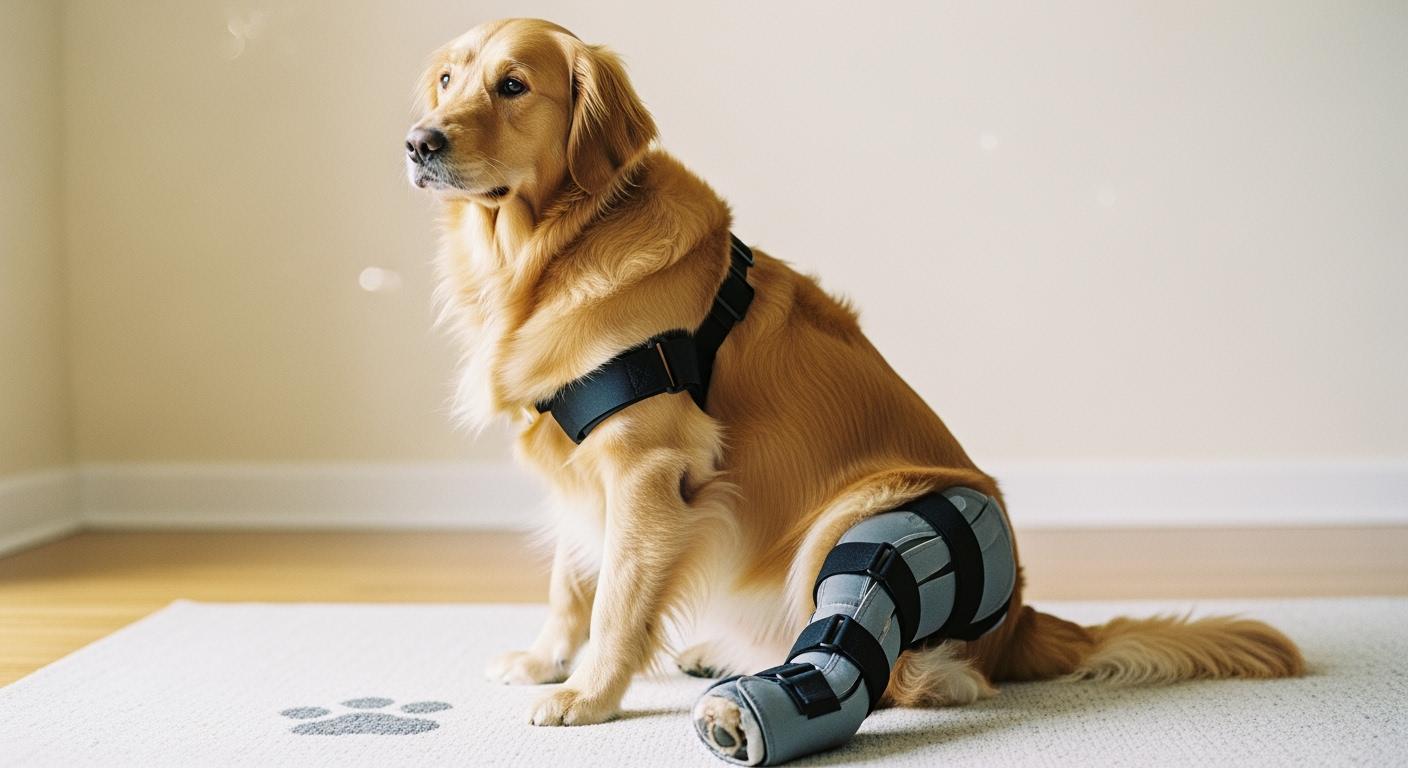
A dog rear leg brace for torn acl sounds straightforward: wrap the leg, support the knee, done. But most braces grip the lower leg and never reach the stifle at all. They slide. They rotate. They miss the one joint that actually needs to be controlled. When a brace cannot anchor above the knee, every step pushes it further out of position—and a brace that is not where the load is does nothing. Worse, it can create a false sense of stability while the joint keeps shifting underneath.
The difference between a brace that holds and one that drifts comes down to where the top of the brace sits and how the strap path routes force. This is not about how tight the straps are pulled. It is about whether the structure itself can resist the rotational and linear forces a dog’s leg generates during even a slow walk.
A Torn ACL Needs Knee Control, Not Just Leg Coverage
A torn ACL strips the stifle of its primary stabilizer. The cranial cruciate ligament normally checks tibial translation and internal rotation—without it, the femur and tibia shift relative to each other under load. A brace can only compensate if it physically bridges the joint and resists those two motions. That demands structure above and below the knee.
Braces that stop at the lower leg cannot do this. The stifle sits above the hock, and a wrap that ends mid-tibia applies force in the wrong place. The knee continues to translate and rotate inside the leg, brace or no brace.
Why hock wraps feel snug but leave the knee unprotected
A hock wrap compresses the lower leg and can feel secure to the hand. But compression at the hock does nothing to control the stifle. During weight-bearing, the hock wrap tends to slide upward or twist as the gastrocnemius and hamstring groups fire. The wrap rides into a position where it covers neither joint effectively. The dog may look supported. The brace is not doing the job.
Think of it in lever terms: the stifle is the fulcrum of the hind limb during stance phase. A brace anchored only below the fulcrum has no mechanical advantage against tibial thrust. Force enters at the paw, travels up the tibia, and meets no resistance at the knee—the brace is simply not in the load path. That is why a dog can wear a lower-leg wrap and still show the same tibial translation on palpation as an unbraced leg.
| Brace structure | Where it anchors | Where it fails for a torn ACL | Pass signal |
|---|---|---|---|
| Lower-leg wrap | Mid-tibia to hock | No stifle control; slides upward under load | — |
| Hock brace | Hock joint only | Knee continues to translate; false stability | — |
| Rear-leg knee brace with thigh anchor | Above and below stifle | Needs daily position checks; hinge alignment matters | Brace stays within half an inch of original placement after 10-minute walk |
| Rear support sling | Body weight only | Does not control joint rotation or translation | — |
A hock wrap misapplied to an ACL case is one of the most common product mismatches. The wrap itself may be well-made for its intended purpose. It is simply the wrong structure for the wrong joint.
Why the Top Anchor Slips and What That Does to the Knee
The thigh is a challenging anchor point. After an ACL injury, muscle atrophy sets in fast—the quadriceps and hamstring groups lose mass within the first week of reduced loading. The thigh circumference shrinks. Coats add another variable: a double-coated breed can hide half an inch of gapping between brace and skin. A brace that measures correctly at fitting can be loose three days later, not because the brace changed, but because the leg did.
The causal chain: thin strap → edge loading → roll → drift
Here is the failure sequence that plays out when a brace uses narrow straps without a structured thigh cradle.
A narrow strap under tension concentrates force along its edges. During stance phase, the femur rotates externally while the tibia rotates internally—this is normal canine gait mechanics. But a narrow strap has almost no surface area to resist that rotational torque. The strap edge catches the rotational force, rolls inward, and the entire brace twists around the leg. Once the brace rotates a few degrees off-axis, the hinge or support panel no longer aligns with the joint center. Every subsequent step drives the brace further out of position.
This is not a tightening problem. Crank the strap down harder, and now you have edge-loading with higher pressure—same roll, plus skin damage. The fix is structural: a wider thigh cradle that distributes rotational force across more surface area, so no single edge carries the full torque.
You can observe this directly: after a ten-minute walk on a flat surface, check whether the brace’s top edge has shifted more than half an inch from where it started. Any lateral rotation or downward slide means the anchor is failing. Adjusting the strap tighter will not stop it—the structure needs more contact area above the knee, not more tension.
How slipping redirects pressure to the wrong structures
When a brace slides down, the support panel that was centered over the stifle now presses into the tibial crest. Pressure that was meant to be distributed across the thigh and upper calf concentrates on a bony prominence. The hock takes load it was never designed to carry from a brace. Within days, the dog may start toe-tapping, shortening stride on that leg, or refusing to walk on slick surfaces—not because the ACL pain returned, but because the brace is pressing where it should not.
The reverse can also happen. A brace that rides upward bunches behind the stifle, restricting flexion. The dog compensates by externally rotating the entire limb, which changes the loading pattern through the hip and lower back. What started as a knee support problem becomes a gait compensation problem, and the owner sees the dog moving oddly but cannot trace it back to brace position.
A rear leg brace solution for a torn ACL succeeds or fails on whether the thigh anchor stays put through the full stance-to-swing cycle. That demands a structure that accounts for changing thigh volume, coat compression, and rotational force—not just a strap pulled tight.
| What shifts | What breaks | Observable check |
|---|---|---|
| Brace slides down | Support panel hits tibial crest; hock overloaded | After 10 min walk, top edge has dropped ≥0.5 inch |
| Brace rotates laterally | Hinge misaligns; joint force concentrates on one condyle | Strap buckle position rotates ≥15 degrees from midline |
| Brace rides upward | Bunching behind stifle; restricted flexion | Dog shortens stride or externally rotates limb |
When a Rear Leg Brace Is the Wrong Call
A rear leg knee brace with a thigh anchor is designed for one thing: external stabilization of the stifle when the cranial cruciate ligament can no longer do that job. It works best when the dog still has some controlled weight-bearing capacity and the primary problem is joint instability, not pain that prevents any loading at all.
There are clear scenarios where this structure is mismatched to the problem:
- Non-weight-bearing lameness. A brace cannot make a dog walk. If the dog holds the leg up entirely, the instability is not the limiting factor—pain or mechanical blockage is. Bracing adds weight to a limb the dog already refuses to use.
- Concurrent hock instability. A stifle brace does not control the hock. If the dog has both an ACL tear and hock laxity, a single-joint knee brace may stabilize the stifle while the hock continues to collapse, shifting the failure upstream.
- Severe angular limb deformity. Dogs with significant varus or valgus alignment have joint axes that differ from the pattern the brace was built around. The hinge center will not match the joint center, and the brace will fight the dog’s natural limb geometry with every step.
- Full-thickness skin lesions or surgical incisions not yet closed. Even the best padding creates a warm, occlusive environment. An open wound under a brace is an invitation to maceration and infection.
For a dog that is partially weight-bearing with a confirmed ACL tear and no concurrent hock collapse, a well-structured knee brace with an upper thigh anchor can provide the external stability needed for controlled, leash-only walking during rehabilitation. This is the narrow window where the rear leg brace structure is matched to the problem.
Disclaimer: The fit observations described here assume a short-coated dog where strap edges and skin marks are visible. Double-coated breeds may hide pressure points under dense fur—hand-check by running fingers under the brace edges after each wear session rather than relying on visual inspection alone. If the dog has angular limb deformities, a very deep chest, or conformation that falls well outside typical breed standards, the standard brace patterning may not catch every pressure point. Have a veterinarian assess fit at the first use and whenever the brace position drifts despite adjustment.
A brace that cannot stay aligned with the stifle through a full walk cycle is not providing support—it is providing a pressure point that the dog works around. When a knee brace fit fails, the dog compensates, the gait changes, and the owner may misinterpret the altered movement as the ACL problem worsening, when in fact the brace itself is driving the compensation.
Daily Checks: Spotting Failure Before It Hurts
Brace problems do not announce themselves loudly. They accumulate quietly—a half-inch shift here, a strap mark that takes a few minutes longer to fade. Daily checks turn these subtle drift signals into something you catch before the dog shows pain.
The first 20 minutes tell you the most
Supervise the first walk of the day. Watch for the dog flicking the leg outward during swing phase, pausing to shake the limb, or turning to mouth at the brace. Any of these within the first 20 minutes signals a fit or structure problem. A correctly anchored brace should not draw the dog’s attention at all during a short controlled walk.
Check brace position immediately after removing it. If the top edge of the thigh strap has crept downward or rotated, the anchor is not holding. Do not try to fix this by tightening. Instead, note whether the thigh cradle design provides enough surface contact above the stifle to resist the rotational forces described earlier.
Skin marks: what fades and what does not
Remove the brace after each wear session and inspect the skin. Mild pink marks along strap paths are normal—they should fade to match surrounding skin within 20 to 30 minutes. Marks that stay red longer, any indentation that holds shape after 30 minutes, broken skin, or moist, pale skin (maceration) are failure signals. The brace is either too tight, not breathable enough, or positioned incorrectly against a bony prominence.
To check for maceration in thick-coated dogs: run your fingers flat under each strap edge immediately after removing the brace. Damp, cool skin under the padding means moisture is trapped. The padding material or the wear duration needs to change.
| Signal | What you see | What it means | Action |
|---|---|---|---|
| Green | Brace stays aligned within 0.5 inch; strap marks fade within 20–30 min; dog walks without leg-flicking | Anchor and pressure distribution are working | Continue; monitor daily |
| Yellow | Mild shift during walk; strap marks take 30+ min to fade; dog pauses to shake leg once or twice | Anchor is beginning to fail or pressure is concentrating | Check thigh cradle contact area; reassess strap routing; do not overtighten |
| Red | Swelling or heat around stifle or hock; cold toes; open skin; dog refuses to walk or chews brace persistently | Circulation compromised, skin integrity breaking, or joint stress increasing | Stop brace use immediately; contact veterinarian |
A brace that passes green checks consistently still needs a veterinarian’s periodic assessment of the underlying joint. The brace manages instability—it does not heal the ligament. When support is insufficient, the signs are usually visible in daily checks before the dog shows obvious distress. The goal is to catch the yellow signals and correct them before they become red.
A rear leg knee brace built for CCL tears needs the combination of a stable thigh anchor, a knee-centered support panel or hinge, breathable padding that does not trap moisture, and strap routing that spreads pressure across soft tissue rather than concentrating it on bony edges. When those four elements are present—and when daily checks catch drift before it compounds—the brace does its job: external joint stabilization during controlled movement. Miss any one of those four, and the structure fails somewhere. The daily check is how you find out which one, and when.
FAQ
Why does a rear leg brace slip even when straps are tight?
Tightening straps does not fix a structural anchor problem. If the brace lacks sufficient thigh cradle contact area above the stifle, rotational forces during walking will roll the strap edges regardless of tension. A wider contact patch resists rotation; more tension on a narrow strap increases edge pressure without improving stability.
How quickly should strap marks fade after removing the brace?
Mild pink marks should return to normal skin color within 20 to 30 minutes. Marks that persist longer, indentations that hold shape, or any moist, pale skin signal that pressure is too high, padding is insufficient, or moisture is trapped. The brace needs adjustment or a different padding material rather than longer wear breaks.
Can a hock brace substitute for a knee brace after an ACL tear?
No. The hock and stifle are separate joints with different axes of rotation and different stabilization requirements. A hock brace applies force below the knee and cannot control tibial translation or internal rotation at the stifle. It can provide false reassurance while the knee continues to shift under load.
