
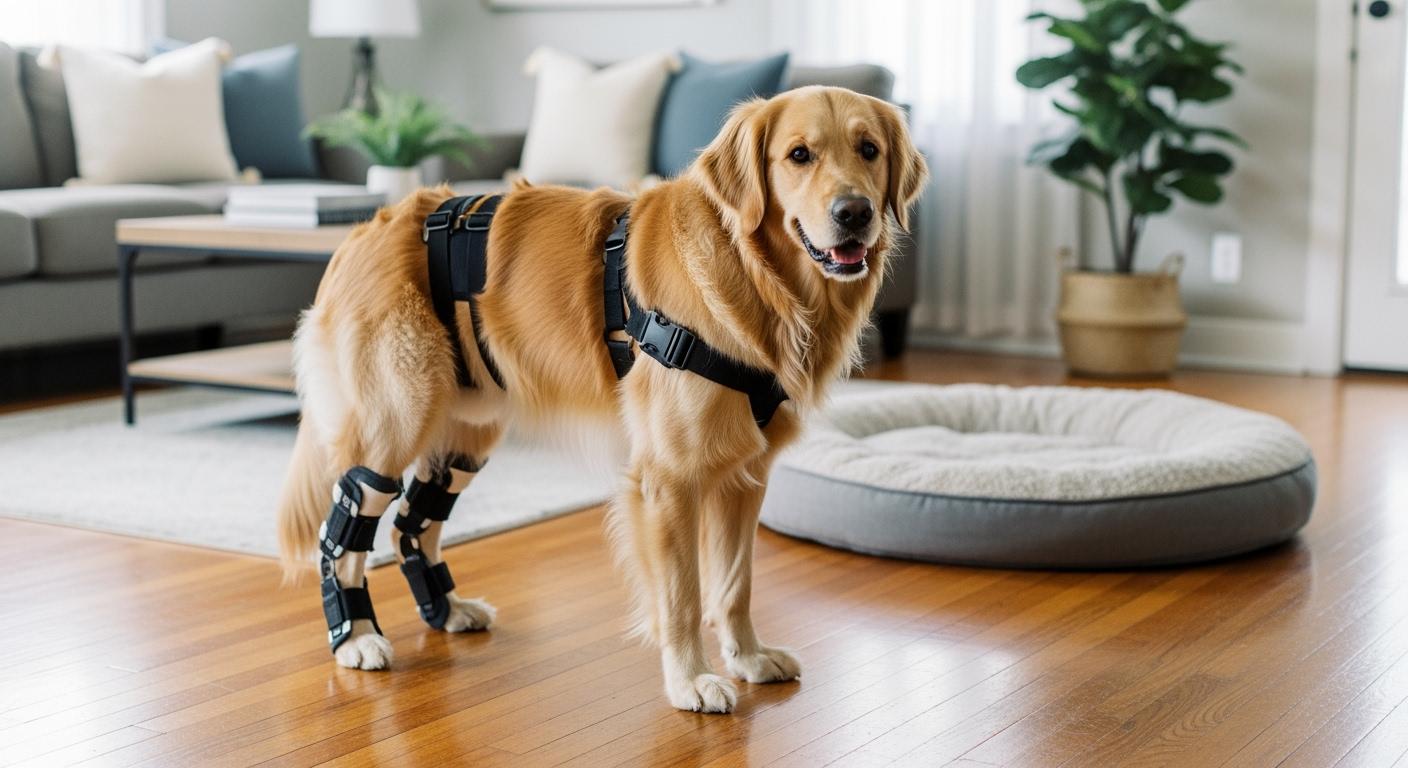
A double ACL brace for dogs faces its hardest test during the quietest moment of the day. Not running. Not jumping. Squatting.
When a dog lowers into bathroom posture, every strap and anchor point on a bilateral knee brace gets repositioned in three dimensions. The belly strap drops. The rear anchor rotates. Clearance that looked adequate while standing collapses. What happens next determines whether the brace stays clean or becomes a hygiene problem that also compromises skin and joint recovery.
This is not about whether the brace “fits” in the static sense. It is about whether the structure accounts for what the dog’s body does to the brace during the one movement no fitting session replicates.
The Failure: Strap Migration and Soiling During Bathroom Posture
A brace that sits perfectly indoors can fail within seconds outside. The mechanism is straightforward once you trace it.
During a squat, the dog’s hindquarters drop, the pelvis tilts, and the rear legs fold. On a single knee brace, only one side needs to clear the toilet zone. On a double ACL brace, both sides carry straps and anchors across the rear body, doubling the surface area that can drift into the groin or urethral path.
Belly Straps Drift Under Compression
When a dog stands, the belly strap on a bilateral brace sits against a relatively flat abdominal surface. Squatting compresses the abdomen, shortening the distance between the ribcage and pelvis. A strap tensioned for standing length now has excess material — and that slack has to go somewhere.
Without a structured anchor point that resists forward migration, the strap slides toward the path of least resistance: the groin fold. Once there, it can intercept urine flow or press against soft tissue that tolerates almost no sustained pressure. The dog feels it immediately.
Here is the causal chain: abdominal compression during squatting shortens the strap path → excess strap length pools at the lowest-tension zone → low-tension zone is the groin, where no rigid structure blocks travel → strap edge contacts urethral area → dog hesitates, shifts posture, or breaks the squat early.
That last step — the hesitation — is the observable signal. A dog that pauses mid-squat, stands, circles, and re-squats is often responding to strap pressure, not joint discomfort. The distinction matters because the fix is structural, not medical.
Rear Anchors Rotate Under Asymmetric Load
Most dogs with bilateral ACL injuries load one leg more than the other. The worse knee gets less weight; the better knee takes more. This asymmetry transmits rotational force into the brace’s rear anchor — the assembly that sits across the lower back or upper hindquarters and ties the two leg sleeves together.
When the dog squats with uneven weight distribution, the heavier-loaded side pulls the anchor downward and rearward. The lighter side lifts. The anchor rotates. As it rotates, it can slide forward over the pelvic ridge, reducing or eliminating toilet clearance. After the dog stands back up, the anchor may or may not return to its original position.
A quick post-potty check tells the story. Run a finger along the rear anchor’s bottom edge. If it has migrated more than half an inch forward from its pre-walk position, the anchor lacks the rotational stability to stay put under real-world use. A brace with independent left-right tension adjustment — where each side’s strap tension can be set separately — resists this rotation more effectively than a single symmetric tension system. The reason is mechanical: uneven knee loading requires asymmetric tension to keep the anchor plane parallel to the body.
Soiling Is Not Just a Laundry Problem
Urine on brace fabric does more than smell. The chemical composition of urine — urea, ammonia, uric acid — breaks down into irritants as it dries. Against skin that is already under light compression from brace wear, those irritants penetrate faster. Within hours of a soiled brace staying on the dog, the skin under the contaminated area can progress from mild redness to a moist dermatitis that opens the door to bacterial colonization.
Here is a check anyone can run: after the dog returns indoors, press a dry paper towel against the inner lining at the groin edge for five seconds. Remove it. If the towel shows any dampness — clear, yellow, or brown — the liner has been contaminated. A brace with a fixed, non-removable liner cannot be properly dried in the time between potty trips. A brace with a removable, washable contact layer can be swapped out in under a minute.
| Product detail | Better design | Failure design | Why it matters during potty breaks |
|---|---|---|---|
| Rear-body anchor | Adjustable, stays above toilet zone | Slides forward under squat compression | Prevents soiling and strap-to-skin contact |
| Belly strap path | High abdominal route, away from groin | Low route, drifts into urethral zone | Eliminates urine-stream interception |
| Groin-edge finish | Rounded, soft-edged, washable | Hard, raw-edge, non-washable | Prevents friction damage during repeated squat cycles |
| Left-right tension | Independent per-side adjustment | Single symmetric tension only | Resists anchor rotation under uneven weight |
| Liner system | Removable, machine-washable | Fixed, surface-wipe only | Enables full decontamination between potty trips |
| Brace profile | Slim, close-body contour | Bulky, stands off from body | Allows full squat range without binding |
| Status | What you see |
|---|---|
| Green | Brace stays centered, dog toilets normally, no dampness, no skin marks |
| Yellow | Mild strap shift, light rubbing line, hesitation during squatting, damp liner edge |
| Red | Urine or feces on brace, groin redness, swelling, heat, pain, worsening limp, repeated chewing |
Why the Structure Fails: Material and Design Gaps
Strap Width and the Anti-Rotation Surface
A narrow belly strap — under one inch wide — concentrates all retention force along a thin line. When the dog squats and the abdomen compresses, that thin strap has almost no surface area to generate friction against forward slide. It rolls. The roll turns the flat strap face into a cord, which digs into soft tissue and slides further.
A wider strap distributes retention force across a larger contact patch. More contact area means more friction per unit of tension. But width alone is not enough. The strap also needs a non-stretch core layer — typically a nylon webbing sandwiched between padding layers. Without that core, the strap stretches under dynamic load, slack appears, and the same migration cascade begins regardless of initial width.
You can check for this: after 10 minutes of walking, mark the strap edge position against the dog’s fur with a piece of tape. Walk another 10 minutes, then check whether the strap has moved relative to the tape mark. A shift of more than half an inch means the strap lacks either the width or the internal structure to hold position under sustained movement.
Fixed Liners Versus Removable Contact Layers
The inner liner of a knee brace is the surface that spends all day against the dog’s skin. After a potty trip where the liner gets damp — even slightly — the material’s drying behavior becomes a health variable.
A fixed liner sewn into the brace shell can be surface-wiped but not fully cleaned. Moisture trapped in the foam or fabric backing stays there. Over repeated damp-dry cycles, the liner’s internal layers accumulate urea residue, which becomes increasingly concentrated. Each subsequent exposure to fresh urine reactivates those residues, creating a progressively higher chemical load against the same patch of skin.
A removable contact layer — one that unzips or unclips from the shell — changes this entirely. It can be hand-washed and air-dried between uses. More importantly, it lets the owner inspect the skin surface underneath at every swap. That is the difference between catching a red mark at the irritation stage and discovering a dermatitis after it is already painful.
In production terms, the decision between fixed and removable liners is a cost and assembly choice. A fixed liner requires fewer stitching operations and fewer separate SKU components. A removable system needs a secondary attachment mechanism — zippers, snaps, or hook-and-loop — each of which adds a seam and a potential failure point. The tradeoff is between manufacturing simplicity and real-world hygiene. A liner that cannot come out cannot be properly cleaned, period.
Left-Right Tension Independence
A single tension adjustment controlling both leg sleeves assumes symmetric loading. That assumption fails for most dogs. One knee is typically more compromised than the other. During a squat, the stronger leg drives down while the weaker leg follows. This creates a torque couple across the rear anchor.
Independent left-right tension lets each side be set to a different baseline. The stronger side can be tensioned higher to counter its greater contribution to anchor rotation. The weaker side can be set looser to avoid over-compressing a joint that already has reduced muscle support. Without this independence, the owner must choose between over-tightening the weak side or under-tightening the strong side — both of which increase rotation risk.
This is not a theoretical distinction. An orthopedic knee brace with proper daily-use fit protocols accounts for the fact that the left and right legs are rarely at the same stage of recovery simultaneously. The adjustment system either accommodates that asymmetry or fights it.
When a Double ACL Brace Is the Wrong Answer
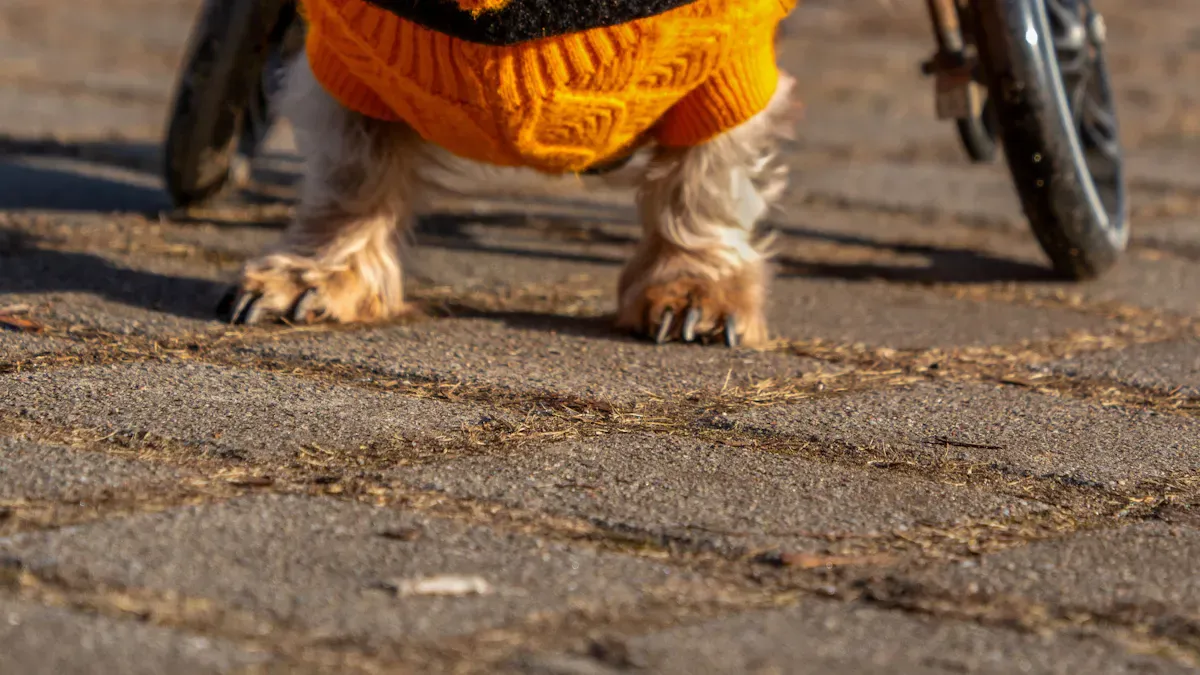
A bilateral knee brace covers more of the dog’s rear body than any other brace configuration. That coverage brings a specific set of conditions under which the brace goes from helpful to counterproductive.
Single-Knee Injuries Do Not Need Double Coverage
If only one ACL is torn or partially torn, a brace spanning both hind legs introduces unnecessary material into the toilet zone on the healthy side. The healthy leg does not need stabilization, yet it must now carry straps, anchors, and padding that complicate every bathroom trip.
A single knee brace for a torn CCL keeps the support where it is needed — on one joint — and leaves the opposite side completely clear. For a dog with one injured knee and one healthy knee, this is the cleaner, lower-risk configuration.
Dogs With Very Short Torsos
Breeds with compact body proportions — Bulldogs, French Bulldogs, some Pugs — have limited real estate between the last rib and the pelvis. On these dogs, the distance between where a rear anchor can sit and where the toilet zone begins is sometimes under two inches. A bilateral brace that requires anchor placement in that narrow band may simply not have enough clearance, regardless of how well it is adjusted.
Dogs That Cannot Tolerate Rear-Body Coverage
Some dogs, particularly those with prior groin-area skin issues or scar tissue from abdominal surgery, react to any sustained contact across the rear body. The reaction is behavioral — repeated sitting, scooting, turning to chew at the brace — and it tends to escalate over days, not hours. If the dog cannot tolerate the necessary anchor placement, no amount of adjustment will make the brace comfortable enough for consistent daily wear.
Disclaimer: The fit checks and observations described here assume a short-coated dog where strap position and skin condition are visible on inspection. Double-coated breeds — Huskies, Malamutes, German Shepherds, and similar — may conceal rub marks and dampness under dense fur. On these dogs, rely on hand-checking under the liner edges rather than visual inspection alone. Run your fingers along every strap path after each potty trip; dampness, warmth, or the dog flinching at touch are the relevant signals, not what you can see. If the dog’s leg conformation falls outside typical breed proportions — particularly dogs with angular limb deformities or very deep chests — the clearance checks described here may miss pressure points that only emerge after extended wear.
A well-structured ACL knee brace works within definable boundaries. Pushing past those boundaries — by using a bilateral design on a single-side injury, on a body shape that leaves no room for anchor placement, or on a dog whose skin cannot tolerate the coverage — does not get more support. It gets more problems.
FAQ
How is a double ACL brace different from wearing two single knee braces?
A purpose-built double ACL brace connects the two leg sleeves through a shared rear anchor assembly. That connection is structural — it distributes rotational forces across both sides. Strapping two independent single braces onto the hind legs does not create this load-sharing path. Each single brace rotates independently, and their separate rear straps can cross or overlap, doubling the material in the toilet zone. A true double brace channels forces into one anchor plane; two singles create two independent — and often conflicting — anchor planes.
What is the first sign that strap migration is starting?
The earliest signal is not visible. It is behavioral: the dog takes one or two steps, stops, looks back toward the hindquarters, and repositions. This “check pause” typically happens before any strap has visibly moved. What the dog feels is the beginning of pressure redistribution — the strap is not yet in the groin, but the tension pattern has changed enough that the dog notices.
Can a brace with fixed padding work if it is wiped clean after every trip?
Surface wiping removes what is on top of the fabric. It does not remove what has already wicked into the foam or backing layers underneath. Over multiple damp-clean cycles, residue accumulates below the surface. A fixed liner that gets contaminated once may look clean on the outside while holding irritants against the skin from the inside.
Does a bilateral brace restrict the dog’s ability to lift a leg to urinate?
It can, depending on the rear anchor position. Male dogs that lift a leg need the brace’s anchor to sit high enough on the back that it does not restrict hip abduction on the lifting side. A brace with an anchor placed too low — close to the tail base — can mechanically block the leg from reaching the lifted position. The dog compensates by leaning forward or attempting a squat instead, which may cause incomplete voiding.
