
A hip dysplasia dog support brace can look fine on a dog standing still on flat ground. The wrap sits flat. The straps are snug. Then the dog rises from rest, turns, or climbs a single stair — and the brace shifts backward.
That shift is not a sizing error. It is a structural problem. Most hip wraps fail during the sit-to-stand transition because the angle of force changes abruptly. When a dog rises, the femoral head presses forward and outward against a shallow acetabulum. That off-axis load transfers a rotational force into the brace. A narrow hip wrap has no leverage arm to resist it. The edge rolls. The brace slides backward. The dog loses support at the exact moment it needs it most.
This is about whether the brace was built to handle the forces hip dysplasia creates in real movement — not about picking the wrong size. The rest of this article breaks down where these braces fail, why, and which structural details determine whether one stays on and works, or ends up in a drawer.
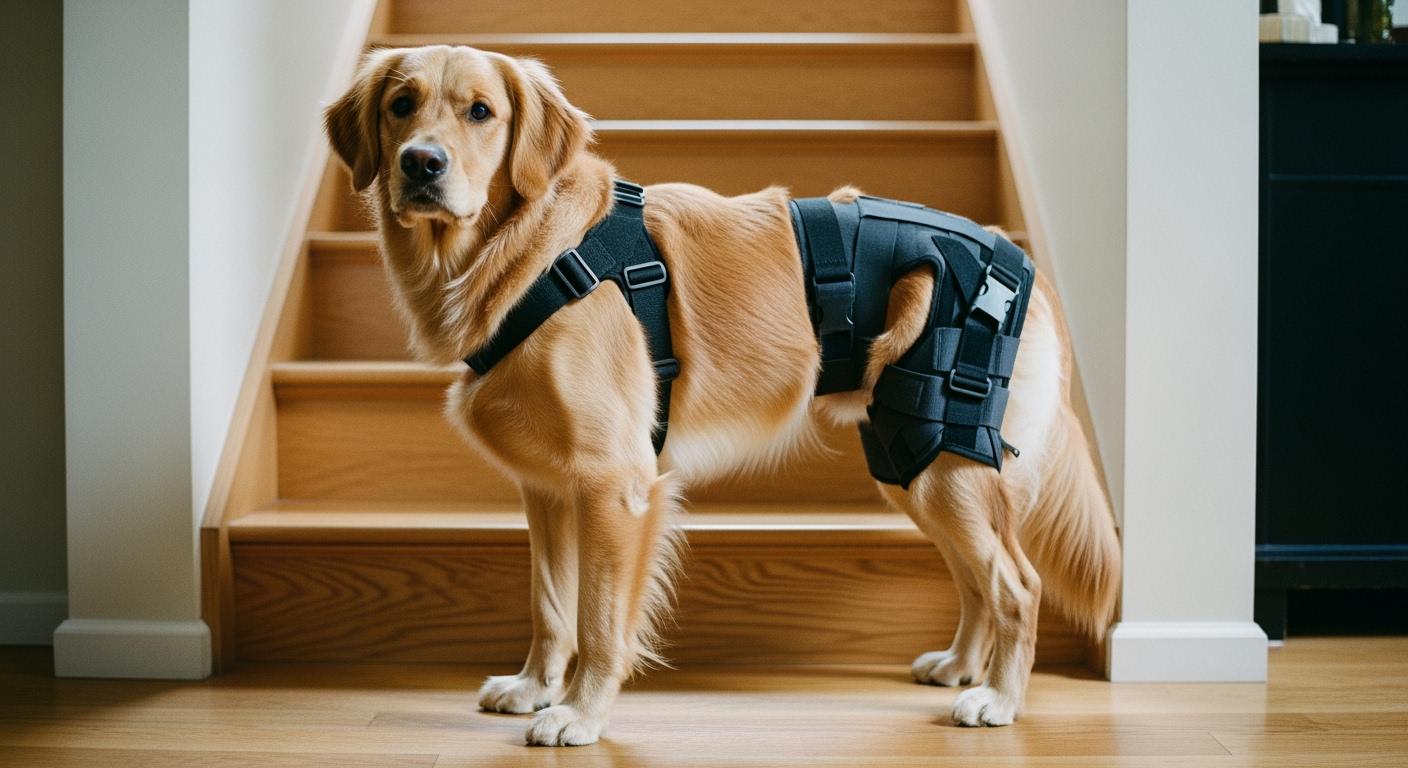
Why Most Hip Support Braces Shift During Standing and Stairs
The single biggest failure point is the hip wrap pulling backward when the dog transitions from rest to motion. A brace that cannot hold position during this transition provides zero stabilization.
The Rotational Force Most Wraps Cannot Resist
Hip dysplasia alters how load travels through the joint. Instead of a congruent ball-and-socket distributing force evenly, a dysplastic hip has a shallow acetabulum. The femoral head rides the rim during weight-bearing. When the dog pushes up from a sit, the force vector angles forward and outward — and that off-axis load hits the brace at an angle the wrap was never contoured to resist.
A narrow hip wrap — a three-inch band sitting across the widest point of the pelvis — catches that rotational force on a thin contact line. With no surface area forward of the hip to create a counter-moment, the wrap edge rolls. Once rolling starts, static friction between the lining and the coat is broken. The entire brace migrates backward within a few steps. The dog compensates by stiffening the hind end or shifting weight to the front legs.
A wider wrap — one that extends forward toward the flank and anchors around the lower torso — distributes that same rotational force across more surface area. The forward section acts as a resisting lever. The wrap edge has farther to travel before it rolls. That difference — a few inches of coverage forward of the hip axis — is often what separates a brace that holds position through a full sit-stand cycle from one that slides within the first minute. The relationship between wrap geometry and positional stability is walked through in the hip dysplasia brace fit and daily use guide.
Stairs Magnify Every Anchoring Weakness
Stairs do not create new brace failures. They expose failures already present on flat ground but too subtle to notice.
On stairs, each step requires the dog to shift weight fully onto one hind leg while the other lifts. That unilateral load rotates the pelvis. If the brace lacks a front anchor — a chest or torso connection that resists pelvic rotation — the wrap twists. The anti-slip lining, if it exists, breaks contact on one side. Within two or three steps, the rear handle is sitting off-center and any support the brace was providing is redirected into soft tissue rather than skeletal structure.
A chest anchor changes this. By connecting the hip wrap to a vest or torso band forward of the ribcage, the brace gains a second anchor point. Pelvic rotation during stair climbing meets resistance from both the hip wrap and the chest connection. The brace stays centered. The rear handle remains positioned over the support zone rather than drifting. This is the structural difference between a brace that works on stairs and one that does not — and it has nothing to do with how tight the straps are pulled.
In practice: After a stair trial, check whether the rear handle sits at spine midline or has drifted to one side. A shift of more than half an inch means the anchor system is not resisting pelvic rotation. Tightening the straps will not fix this — the brace needs a forward anchor point.
Catching Migration Before the Dog Refuses the Brace
Dogs do not fill out complaint forms. They compensate, stiffen, slow down, or stop. By the time a dog refuses to wear the brace, the failure has been happening for days.
Three checks, performed after ten minutes of normal indoor movement, catch migration early:
- Edge-position check: Note where the front edge of the hip wrap sits against the fur at the start of wear. After ten minutes of walking and sit-stand cycles, check whether that edge has moved backward by more than half an inch. Any visible shift means the wrap is migrating under load.
- Handle-center check: The rear support handle should sit at the spine midline. After movement, if the handle has drifted left or right, the brace is rotating around the torso.
- Strap-tension drift: Straps that were snug at the start should not need re-tightening after ten minutes. If they do, the brace fabric is stretching under load or the anchor system is allowing creep. A closer evaluation of how different strap configurations perform across coat types is covered in the hip support brace fit and slipping evaluation.
| Real-use problem | Why the brace fails | Better design direction |
|---|---|---|
| Brace slides backward | Hip wrap moves before stability | Wide hip wrap, front anchor |
| Brace rotates on stairs | Weak anchoring, poor fit | Chest anchor, anti-slip lining |
| Strap digs near groin | Narrow straps, pressure points | Soft edge binding, wider coverage |
| Handle pulls from one narrow point | Incorrect handle placement | Rear handle over support zone |
| Fabric traps heat | Low-breathability, bulky material | Breathable, low-bulk fabric |
| Dog moves worse after wearing it | Poor fit, wrong brace for anatomy | Adjustable straps, correct joint match |
When Strap and Fabric Design Work Against the Dog
Migration is the most visible failure. But a brace that stays in position can still fail — at the skin, in the heat, at pressure points that develop silently under straps that are too narrow or fabric that does not breathe.
Narrow Straps Concentrate Force Where Tissue Moves Most
The groin and inner thigh are high-motion zones. Every sit-stand cycle flexes and extends the tissue. A strap passing through this zone needs to spread its holding force across enough surface area that no single point exceeds what the skin can tolerate during repeated movement.
A half-inch strap concentrates the entire holding tension into a thin line. When the dog sits, the strap edge digs into flexed tissue. When the dog stands, the strap shifts against extended tissue. Over dozens of daily cycles, that concentrated pressure breaks down the skin’s outer layer. Redness first. Then swelling. Then the dog flinches when the brace comes out.
Straps of at least an inch to an inch and a half, with soft edge binding that rounds the transition between strap and skin, spread the same holding force across two to three times the contact area. The edge binding matters specifically because strap edges are where pressure peaks. A raw-cut neoprene edge has a sharp transition. A rolled or bound edge distributes that peak across a radius rather than a corner.
This is not a comfort feature. It is a wear-time limiter. A strap that irritates skin limits how long the brace can be worn. A strap that distributes pressure extends wear time. The structural logic behind matching the right support type to the right joint is explored further in the comparison of hip versus knee support designs for dogs with hip dysplasia.
Fabric That Traps Heat Shortens Every Wear Session
A hip brace wraps around the lower torso — a high-heat zone with limited airflow. If the fabric traps heat, the skin underneath becomes damp within fifteen to twenty minutes. Damp skin softens. Softened skin is more vulnerable to friction damage from strap pressure that was tolerable when the skin was dry.
Breathability is not about the fabric feeling cool to the touch. It is about whether moisture vapor from the dog’s skin can pass through the brace layers. A dense neoprene outer layer with a non-wicking inner liner traps moisture at the skin surface. After twenty minutes, the microclimate inside the brace is warm and wet. Friction coefficients change. The skin begins to chafe at contact points that were fine at the start.
You can verify this directly: after a twenty-minute wear session, flip back the inner lining and feel the skin underneath. If the skin feels damp or looks pink at the strap edges, the fabric combination is not moving moisture adequately for this dog’s coat and activity level. A dog with dense undercoat hits this failure point faster than a short-coated breed under identical conditions.
Edge Binding Performs a Mechanical Function
Edge binding is easy to dismiss as trim. In a hip brace, it rounds the pressure profile at every strap and panel edge. Without it, each edge is a potential cut line into the skin. With it, the edge becomes a transition zone rather than a boundary.
The binding material matters. Cotton binding absorbs moisture and stays wet — creating a damp abrasive line around every panel edge. Synthetic binding with low water absorption stays drier and maintains consistent friction against the coat. At the production level, folded-and-stitched binding distributes tension along the stitch line; a heat-welded edge creates a stiff ridge that can dig in when the brace flexes during movement.
When a Hip Dysplasia Support Brace Is Not the Right Tool
A hip support brace provides external stabilization — compression, alignment assistance, and proprioceptive feedback. It does not rebuild joint integrity. It does not restore acetabular depth. It does not replace weight-bearing capacity already lost.
Hip braces work within a specific window: early to moderate hip dysplasia where the dog still bears weight on both hind legs, still rises independently, and still navigates flat ground and low stairs with difficulty but without collapse. Outside that window, the brace is the wrong tool.
Signs a hip support brace is no longer sufficient:
- The dog cannot rise from a sit without assistance, even with the brace on and properly adjusted.
- The dog bunny-hops consistently — both hind legs moving together — rather than alternating gait, indicating the hips cannot manage unilateral loading.
- Weight-bearing has shifted predominantly to the front legs, with the hind end carried low.
- The dog knuckles or drags rear paws, suggesting neurological involvement beyond what external stabilization can address.
In these cases, a rear lift harness or full-support mobility aid may be warranted — not as a brace upgrade, but as a different category of support. A brace stabilizes a joint that still functions. A lift harness transfers load off a joint that no longer can.
Distinguishing a hip problem from a stifle problem also matters. A dog with hip dysplasia may develop compensatory gait patterns that overload the knee. If the primary pain source has shifted to the stifle, a hip brace will not resolve it — and may worsen the gait by stabilizing the wrong joint. The joint-specific design differences are detailed in the hind-leg hip brace specifications.
Disclaimer: These fit and function checks assume a short-coated dog where brace edges are visible against the skin and rub marks can be spotted visually. Double-coated breeds — Huskies, Malamutes, German Shepherds, and similar — may hide developing pressure marks under dense undercoat. For these breeds, hand-check the skin at each strap edge after every wear session rather than relying on visual inspection alone. What looks fine from the outside may already be irritated beneath the coat.
What Keeps a Hip Brace in Position Through Real Movement
Everything above describes failure. This section describes the opposite — the structural and material choices that determine whether a hip dysplasia dog support brace stays in position through real daily movement.
Wide Hip Wrap with Forward Extension
A wrap covering only the widest point of the pelvis provides compression but not positional stability. A wrap extending forward — from the hip axis to the flank — adds a lever arm that resists rotational forces during sit-stand transitions. Wider coverage also changes how pressure distributes: the same compression force spreads across a larger area. The dog feels support rather than constriction. That is the difference between a brace accepted for hours and one tolerated for minutes.
Front Anchor That Resists Rotation
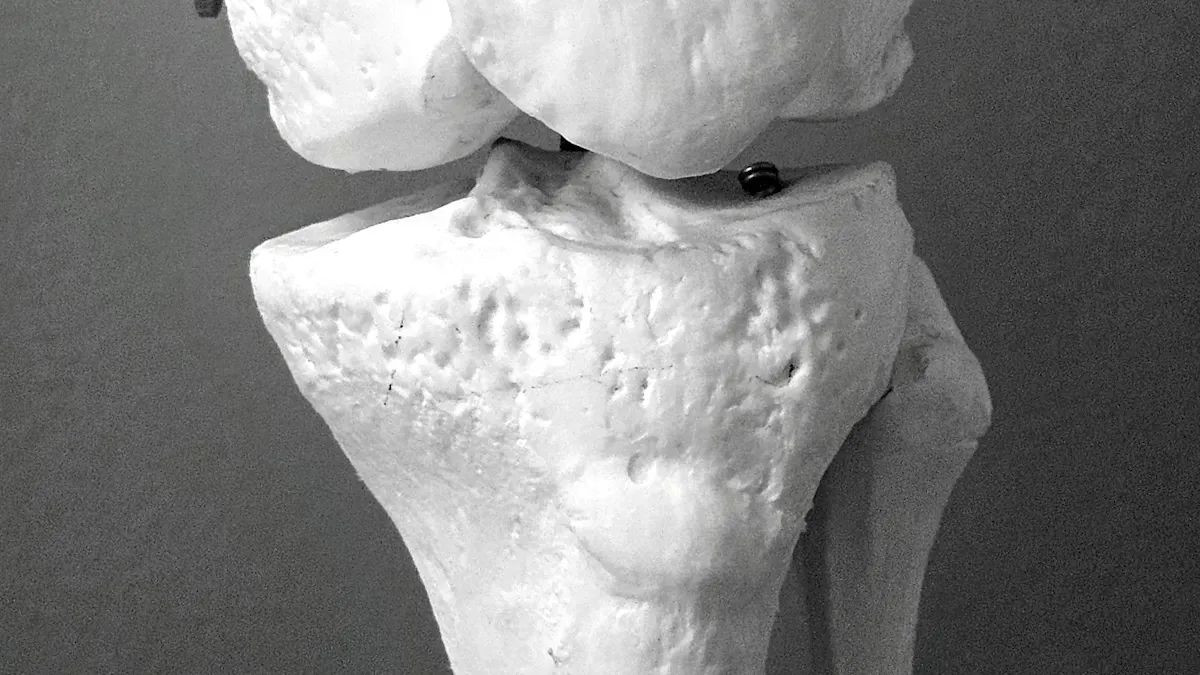
A hip wrap alone cannot prevent rotation. The pelvis rotates during gait. Without a second anchor point forward of the hips, the brace rotates with it — and drifts. A chest or torso anchor connected to the hip wrap via adjustable side straps creates a two-point stabilization system. The hip wrap controls compression. The chest anchor controls position. Together they keep the brace centered through movement that would shift a single-point wrap. This is why a structured first-week wear plan often identifies chest-anchor tension as the variable that matters more than hip-wrap tightness for positional stability.
Breathable, Low-Water-Retention Materials
Fabric choice determines wear duration. A non-breathable brace is a twenty-minute brace regardless of fit. A three-layer construction — breathable outer shell, structural middle layer for compression, wicking inner liner — keeps the skin dry and extends wear time into hours. If any layer fails at its function, the whole brace underperforms.
Handle Centered Over the Support Zone
A rear handle is a guidance and short-assist tool, not a lift strap. Its value depends entirely on placement. Centered directly above the hip axis — not forward over the lumbar spine, not rearward over the tail base — it transfers assist force straight through the brace structure into the hips. An off-center handle pulls the brace to one side during use, creating uneven compression and triggering the rotation failure described earlier. Before relying on the handle, confirm it sits at centerline and stays centered after a short assisted walk.
A hip dysplasia dog support brace either holds position through real movement or it does not. The checks are simple: mark the edge, walk the dog, check for shift. Feel the skin under the lining after twenty minutes. Watch whether the handle stays centered on stairs. A brace that passes those checks provides support. One that does not — regardless of price, brand, or specification sheet — is not doing its job.
